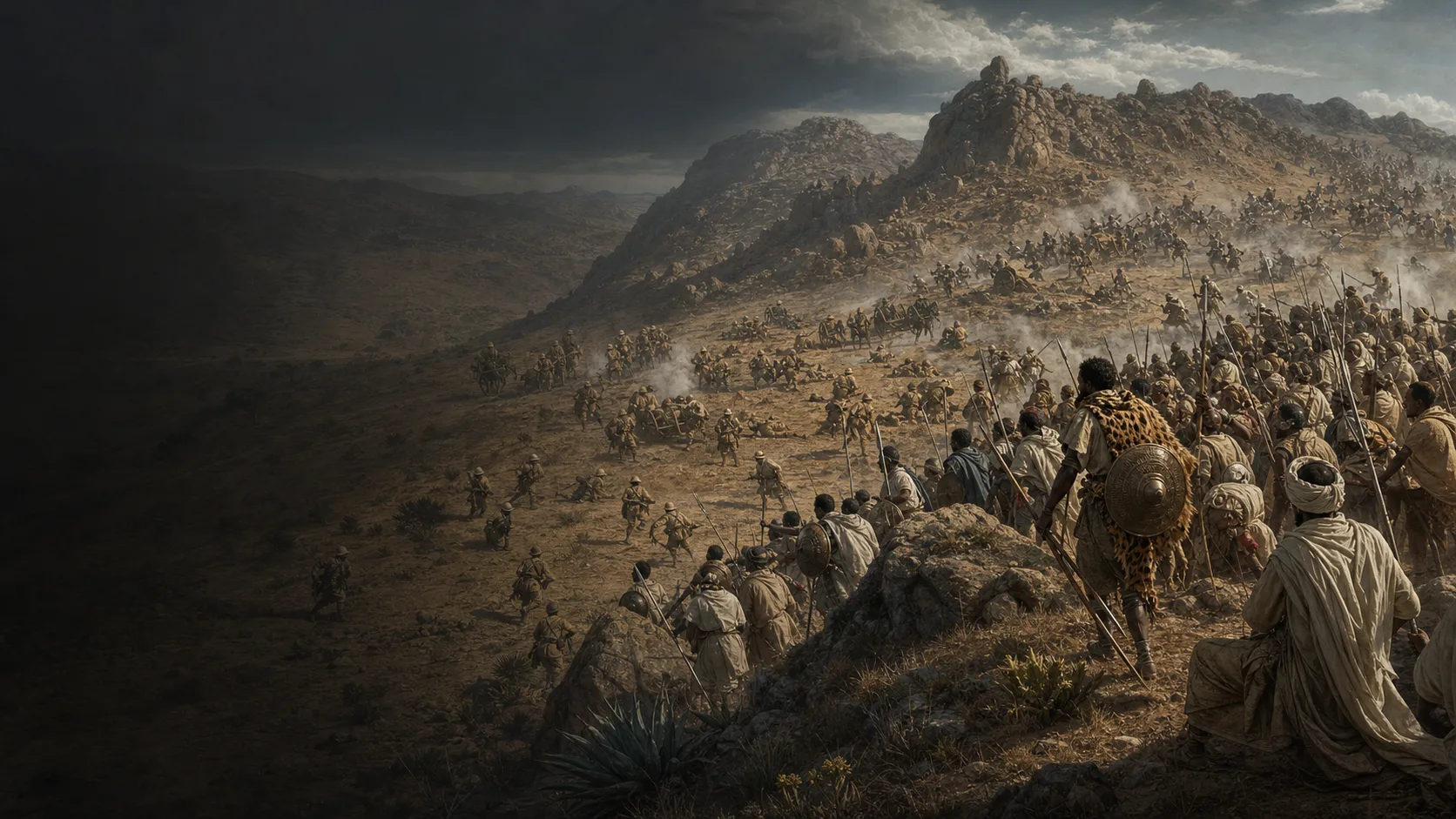
A night march separates the Italian brigades before a large, well-armed Ethiopian army.
Military history
How does the separation of the Italian brigades allow Ethiopian contingents to win several linked engagements at Adwa?
On 1 March 1896, Baratieri’s brigades emerge separately in the mountains east of Adwa. Albertone has advanced too far; Dabormida moves into another valley. Menelik’s contingents, armed with many rifles and supported by artillery, concentrate their attacks on these separated positions. Albertone is defeated, then the Italian centre gives way; Dabormida holds out longer before a costly retreat. The Ethiopian victory opens negotiations that abolish the protectorate claimed by Italy.
Wuchale and sovereignty
Differences between the Italian and Amharic versions of the Treaty of Wuchale fuel the conflict. Italy claims the right to control Ethiopia’s foreign relations; Menelik rejects this protectorate. The fighting at Amba Alagi and Mekele precedes the concentration around Adwa.
Two armies under supply pressure
By late February, both armies are short of food. The Ethiopian army brings together provincial contingents with their own leaders and services. Baratieri hesitates between retreat and advance; the brigade commanders he consults favour an offensive.
A planned line, several actual positions
The 29 February order calls for three columns and a reserve, with communications maintained. The night march and confusion over the name Kidane Meret disrupt the arrival. Albertone reaches a position much farther away than Baratieri expected; Dabormida then separates from the centre.
Firearms on both sides
Ethiopians use many purchased or captured rifles, including Gras, Remington and Vetterli models. Italian infantry and askari also carry a variety of weapons. Fire causes heavy losses; concentration of forces and access to positions matter as much as the presence of a modern weapon.
Military history
Sources
Contemporary synthesis and reproduced documentsBeniamino Melli, La Colonia Eritrea (1899), II, XVIII
Effectifs et ravitaillement ; déposition d’Ellena ; ordre du jour n°87 du 29 février 1896.
Decision to advance and prescribed deployment; distinguishes cited records from Melli’s nationalist interpretation.