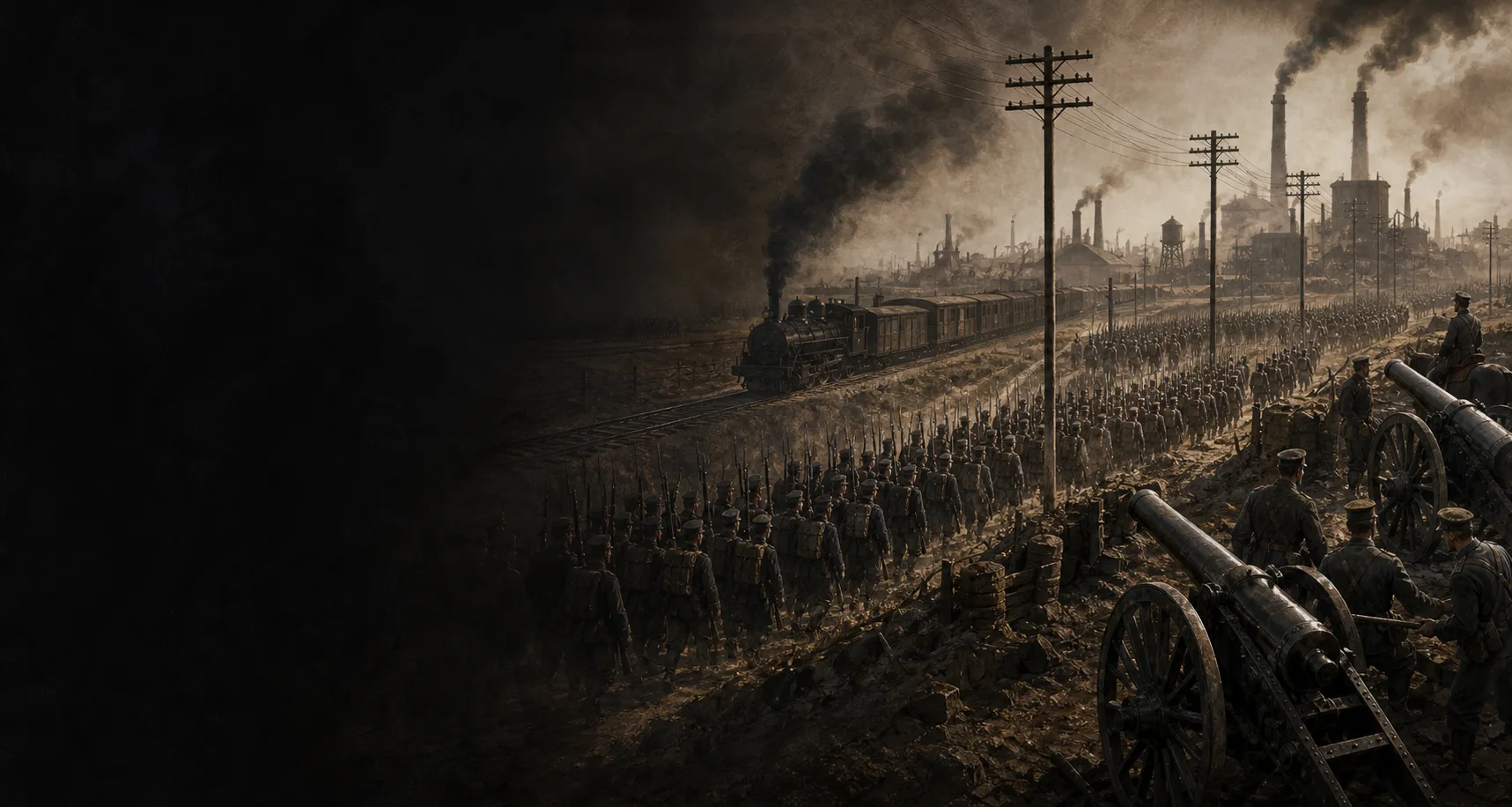
The Napoleonic legacy becomes standard
Corps, general staffs, conscription and mobile artillery become permanent instruments rather than the sole products of exceptional genius.
Military history
Between 1815 and 1914, industry reshapes war in successive layers. Railways concentrate men, the telegraph shortens delays, rifled weapons and quick-firing artillery widen the lethal zone, while conscription gives states unprecedented reserves. Modernity does not make operations transparent: it makes mistakes faster and more costly.
Corps, general staffs, conscription and mobile artillery become permanent instruments rather than the sole products of exceptional genius.
Rifles, explosive shells and telegraphy make compact formations more vulnerable and give new weight to entrenchments.
Rail concentration rewards timetables, planning and the ability to bring several armies together.
Navies, railways, finance and industrial weapons allow empires to project force, but also create rivalries and distant fronts.
Explore
Military history
Railways, mobilization, general staffs and the transformation of operations in the nineteenth century.
Clarendon Press, 1996 ; ISBN 9780198202080
Industrialization of armaments, imperial rivalries and production constraints.
View ↗The evolution of military institutions, mobilization and the relationship between war and society.