The war shifts to the Danube
Bavaria’s alliance with Louis XIV exposes the Habsburgs to an offensive in the heart of the Empire. Marlborough leaves the Netherlands theatre to address this threat.
Battle
Cross the Nebel, hold in front of the villages, then break Tallard’s army.
Military history
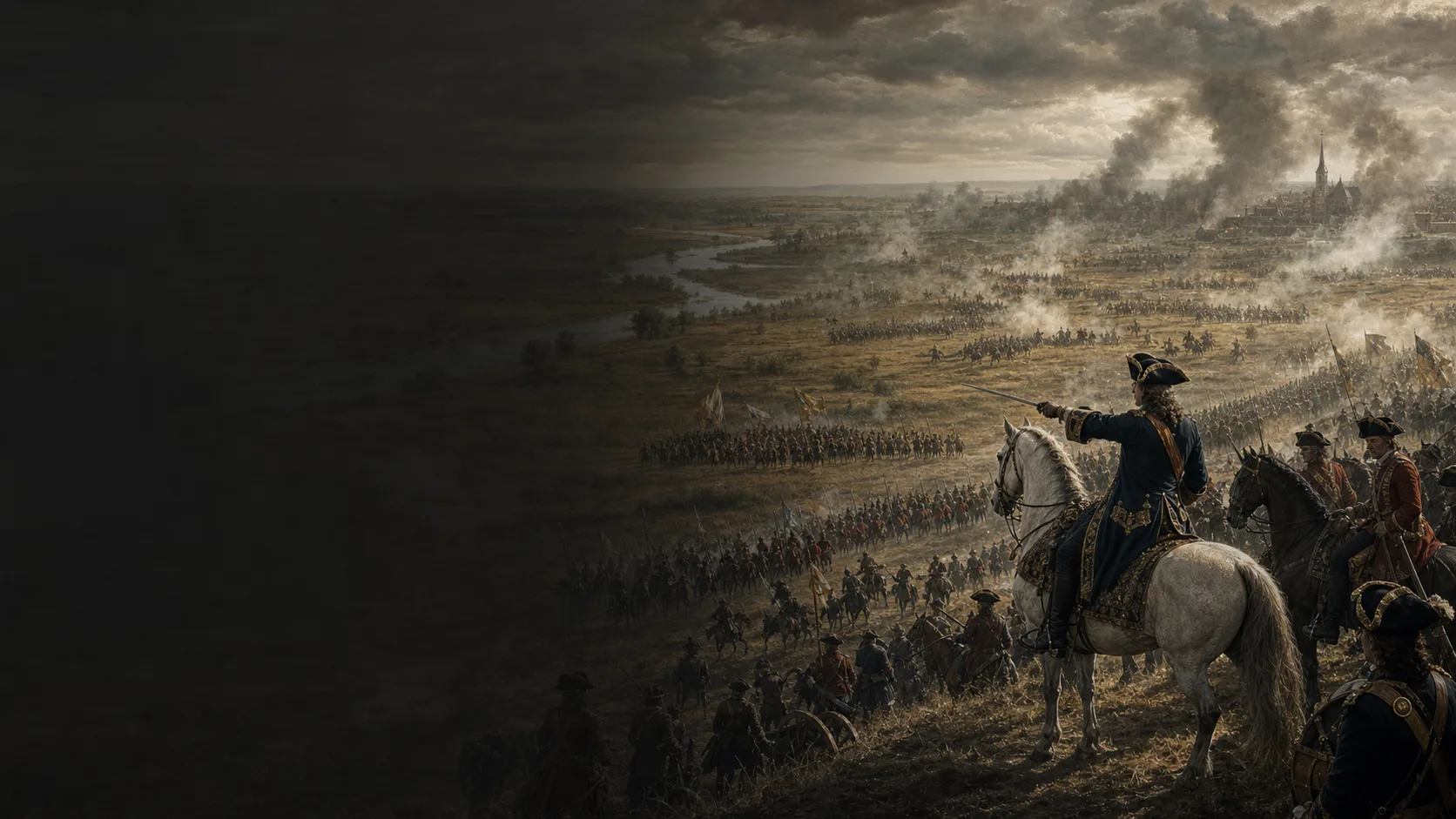
On 13 August 1704, Marlborough and Prince Eugene of Savoy attack a Franco-Bavarian position between woods and the Danube. The first assaults fail in front of the villages. While Eugene remains engaged against Marsin and the Elector, Marlborough takes his centre across the Nebel and reforms it under counterattack. The break in Tallard’s army eventually isolates the defenders of Blenheim; the other wing can still withdraw.
Bavaria’s alliance with Louis XIV exposes the Habsburgs to an offensive in the heart of the Empire. Marlborough leaves the Netherlands theatre to address this threat.
Credit, suppliers, and transport allow the army to change theatres. The campaign nevertheless faces shortages and lacks heavy guns: the successful march does not mean the logistics are flawless.
After joining forces, Marlborough and Eugene decide to attack. Opposite them, Tallard holds the Blenheim sector; Marsin and the Elector occupy the sectors around Oberglau and Lutzingen. The movement of reinforcements between these commands becomes decisive.
Military history
Lettre entière ; transcription avec renvoi à Coxe, 1818, p. 305
Victory announcement and Tallard’s capture; does not document detailed movements.
View ↗Partie V, p. 109–144 ; concentration préalable p. 99–108
Terrain and tactical sequence; older interpretations compared against the museum synthesis.
View ↗University of Victoria, mémoire de master, conclusion p. 91–94 et notes p. 95–96
Credit, supplies, adaptation and logistical limits of the march.
View ↗Rubriques « The battle » à « The consequences » ; effectifs dans « The armies »
Deployment of the wings, fixation at the villages, breakthrough in the center, and surrender.
View ↗RCIN 725037, Frederick Thomas Ivoy, 1704 ou après ; notice, orientation sud-ouest en haut
Contemporary map record identification and the orientation of the catalogue entry; the image is not used as a survey of the terrain.
View ↗Dyrham Park, objet 452105.4
Weapon type of the period; silhouettes are depictions, not copies of a specific regiment.
View ↗