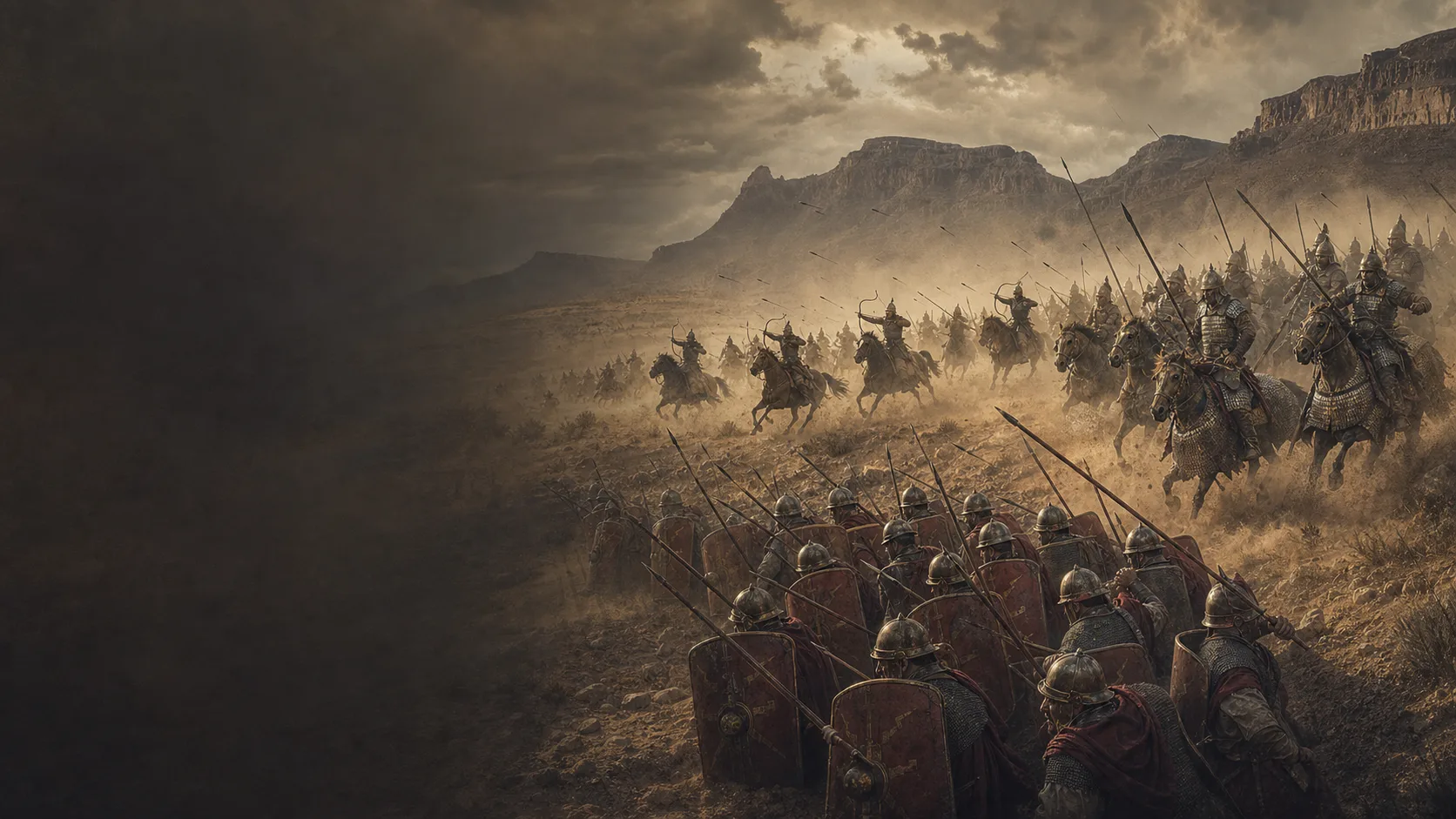
Crassus’s campaign
As governor of Syria, Crassus crosses the Euphrates to attack Parthia. Orodes II leads another army against Armenia, preventing the hoped-for Armenian reinforcement.
Battle
A heavy army becomes a target when faced with a mobile, well-supplied force.
Military history
In 53 BCE, Crassus invades Mesopotamia. Opposing him, Surena combines horse archers, armoured cavalry and an arrow supply train. The Romans struggle to impose close combat on a force that controls the distance. Publius Crassus’s detachment is cut off, while the main army resists until night and withdraws in fragments.
As governor of Syria, Crassus crosses the Euphrates to attack Parthia. Orodes II leads another army against Armenia, preventing the hoped-for Armenian reinforcement.
The plain gives the cavalry room to manoeuvre. The challenge is to reach an opponent that can shoot and withdraw; the exact site and local conditions remain disputed.
The Parthians do not seek to hold a fixed line. They use distance, mobility, and a shock reserve.
Military history
Crassus 19–22 : campagne et effectifs ; 23–24 : carré et archers ; 25 : sortie et mort de Publius ; 26–31 : résistance, retraite et mort de Crassus ; 33 : bilan.
Course of events, Crassus’s decisions, and traditional loss figures.
View ↗Chapitre « Orodes », consacré à Rome et à la Parthie
Combat systems, terrain setting, map reconstruction, and the limitations of Roman accounts.
View ↗Passage sur Crassus et la campagne de Mésopotamie
Command, Roman formation, and political consequences.
View ↗Vol. V, fasc. 1, pp. 9–13 ; sections « The invasion », « The engagement », « The retreat » et « Results ».
Checks troop strengths, Armenia’s role, combined-arms tactics and the retreat. Some reconstructions in this synthesis differ from Plutarch’s account.
View ↗