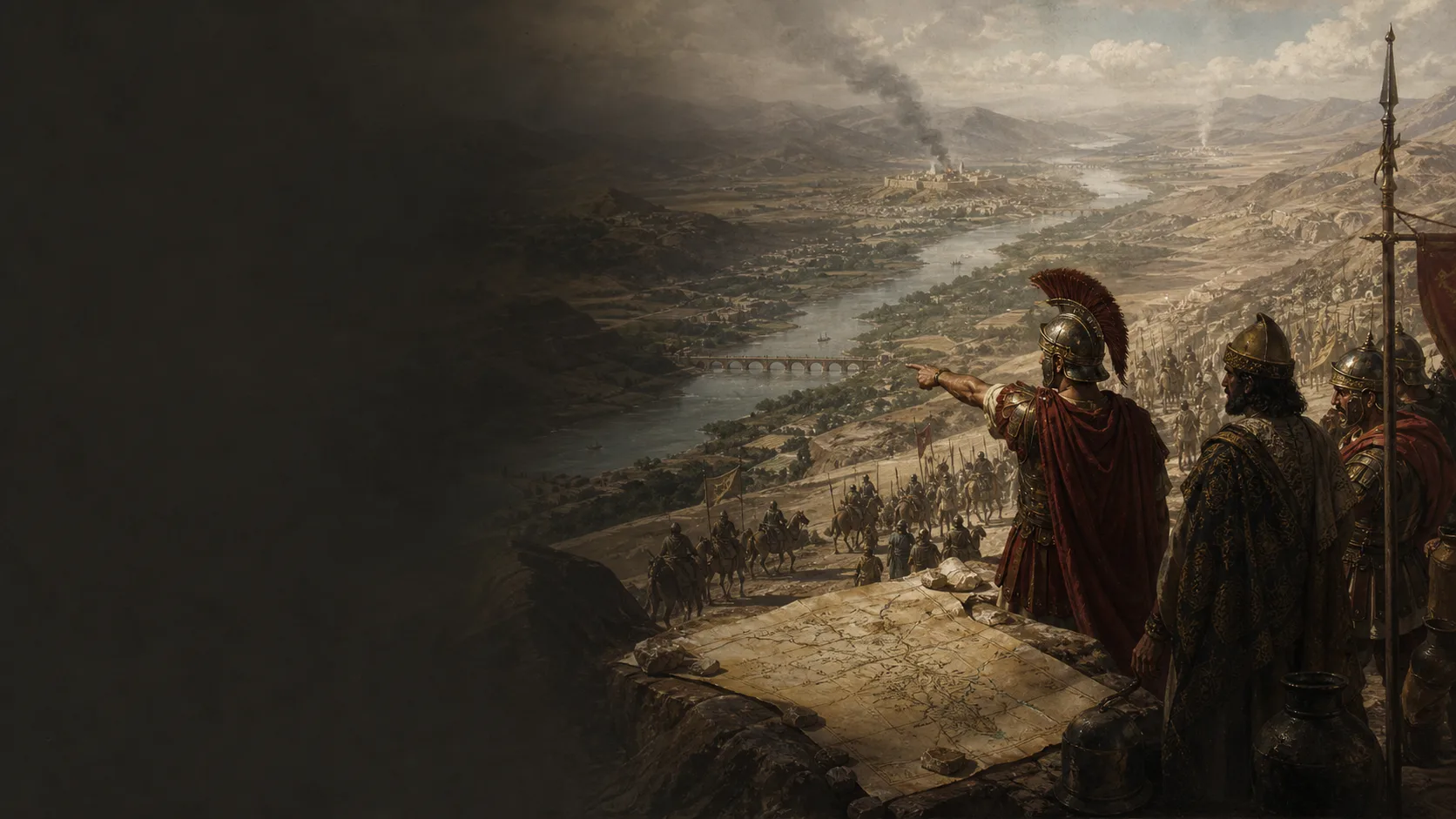
Crassus’s expedition
Rome launches an offensive campaign in Mesopotamia without adequate intelligence or local support. Carrhae turns the legion’s superiority at close quarters into vulnerability against mobile missile fire.
Military history
The Roman–Parthian Wars do not form a continuous campaign. They pit two powers seeking to control Armenia, Upper Mesopotamia and client kingdoms without easily maintaining deep occupation. Parthian mobility and Roman legions yield different advantages; the outcome often depends on season, allies and supply routes.
Rome launches an offensive campaign in Mesopotamia without adequate intelligence or local support. Carrhae turns the legion’s superiority at close quarters into vulnerability against mobile missile fire.
Antony and then Augustus seek to restore Roman prestige, regain the initiative in Armenia, and recover the lost standards. Diplomacy sometimes obtains what conquest cannot hold.
Trajan pushes farther east, captures capitals and reaches the Persian Gulf, but revolts and the difficulty of securing communications make the conquest reversible.
Explore
Military history
Account of Carrhae, Crassus’s decisions, and the Roman tradition concerning the defeat.
II, 1–4 et 56–58 ; VI, 31–37 et 41–44 : Arménie, successions et diplomatie sous Tibère.
Indirect ancient account of Armenian succession and Roman-Parthian diplomacy under Tiberius. The return of the standards under Augustus is documented separately in the Res Gestae, § 29.
View ↗Journal of Roman Archaeology, Supplementary Series 18, 1996 ; ISBN 1887829180
The eastern frontier, mobility, armies, and the constraints on Roman campaigns.
View ↗§ 27 : intervention en Arménie ; § 29 : restitution des enseignes romaines par les Parthes. Texte latin, grec et traduction de Frederick W. Shipley, édition Loeb de 1924.
Intervention in Armenia and return of standards captured from Roman armies. This official record expresses Augustus’ political viewpoint; its language of victory is not a neutral account of the negotiations.
View ↗