1. Home
  2. World Wars
  3. Soviet–Japanese Conflict at Nomonhan
  4. Khalkhin Gol

Battle

Khalkhin Gol

11 May–16 September 1939

A mechanized encirclement that foreshadows combined-arms warfare.

Military history

How did a Japanese line pinned in the center become enveloped by the Soviet-Mongolian wings?

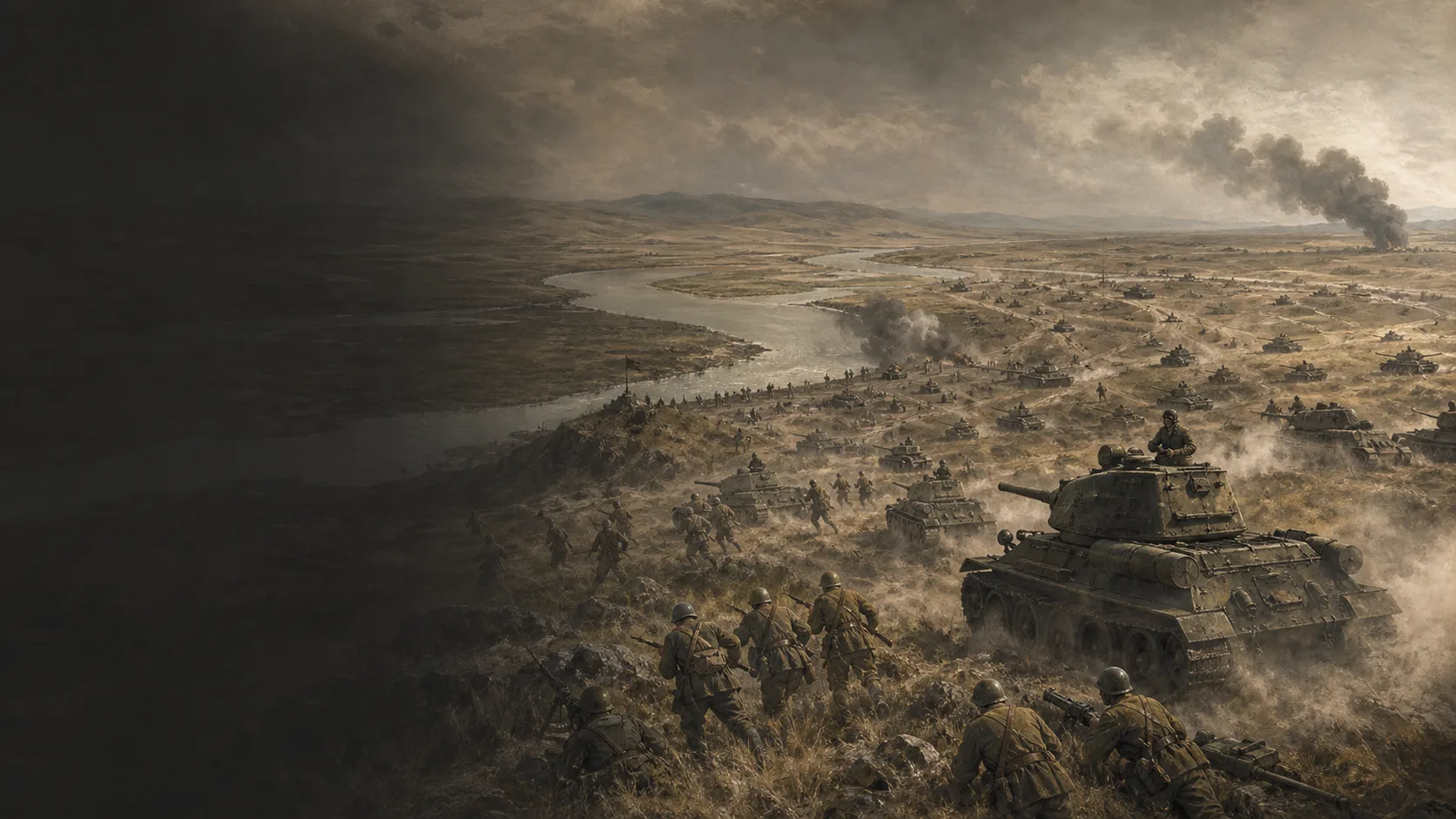
At Khalkhin Gol, the border incidents of May became an operational battle in August. The Japanese bridgehead at Bain-Tsagan, established on the west bank on 2 July and abandoned on 5 July, was not the August pocket: Zhukov pinned the Japanese line on the east bank on 20 August, sent both wings across, and converged on the rear of the 23rd Division.

A disputed border

The border between Soviet-backed Mongolia and Japanese-controlled Manchukuo remains disputed. The raid by Mongolian horsemen on 11 May triggers a series of engagements that grow to involve divisions and armor.

The Japanese choice

The Japanese 23rd Division holds the main line on the east bank. The 2 July offensive creates a bridgehead at Bain-Tsagan in the west, but the Soviet-Mongolian counterattack forces its abandonment on 5 July; this action is not the August encirclement of the eastern line.

Soviet depth

Zhukov prepares the 20 August offensive with a concealed concentration, artillery support, and prepared crossings. The central fixing action and north-south pincer target the depth of the Japanese east-bank line, its roads, and its reserves.

Military history

Sources

Digitized contemporary archiveJACAR, documents de l’incident de Nomonhan

Timeline du 12 mai 1939 : C01003453200 (télégramme du 12 mai), C01003463200 (rapport/censure du 5 juin) et A06031030100 (Weekly Report no. 139, 14 juin, carte contemporaine).

Beginning of the incident, Japanese chronology, and situation documents.

View ↗
Modern monographEdward J. Drea, Nomonhan: Japanese-Soviet Tactical Combat, 1939

Maps 4, 6, 7, 17–19 ; pp. 1–10 et 32–85 ; tableau p. 9 pour 57 000 Soviétiques/Mongols et 30 000 Japonais ; annexe des pertes

Orders of magnitude for the decisive offensive, operational decisions, chronology of crossings, and losses.

View ↗
Modern academic overviewDavid M. Glantz, The Battle of Khalkhin Gol

Notice de l’Encyclopedia of War : sections sur le conflit frontalier et la défaite japonaise de 1939

Operational scale, coordinated use of armor, aviation, and artillery, and the strategic consequence.

View ↗
Specialist cartographyAMS, Topographic Map of the Khalkhin Gol battle area, sheet NL50-3

Feuille NL50-3 ; Khalkhin Gol nord-sud, Bain-Tsagan à l’ouest, Nomonhan et les arrières japonais à l’est ; topologie schématique. Une mesure exacte dépasse l’usage documentaire retenu ici

Topological verification of the river, Bain-Tsagan, Fui, Nomonhan, and approach roads.

View ↗
Specialist pressConflits, La bataille de Khalkhin-Gol / Nomonhan. Un affrontement nippo-soviétique structurant de la Seconde Guerre mondiale

Sections « Un affrontement massif aux confins de l’Union soviétique » et « Le respect des principes stratégiques comme clef de la victoire » : séquences du 11 mai, du 2 juillet et du 20 août ; interarmes, logistique et manœuvre soviétique. Ne porte pas les coordonnées fines.

Specialist overview of the combined-arms and logistical sequence. Using it alone for precise positions would exceed the documentary use adopted here.

View ↗

Edited by BattlesInMotion.com