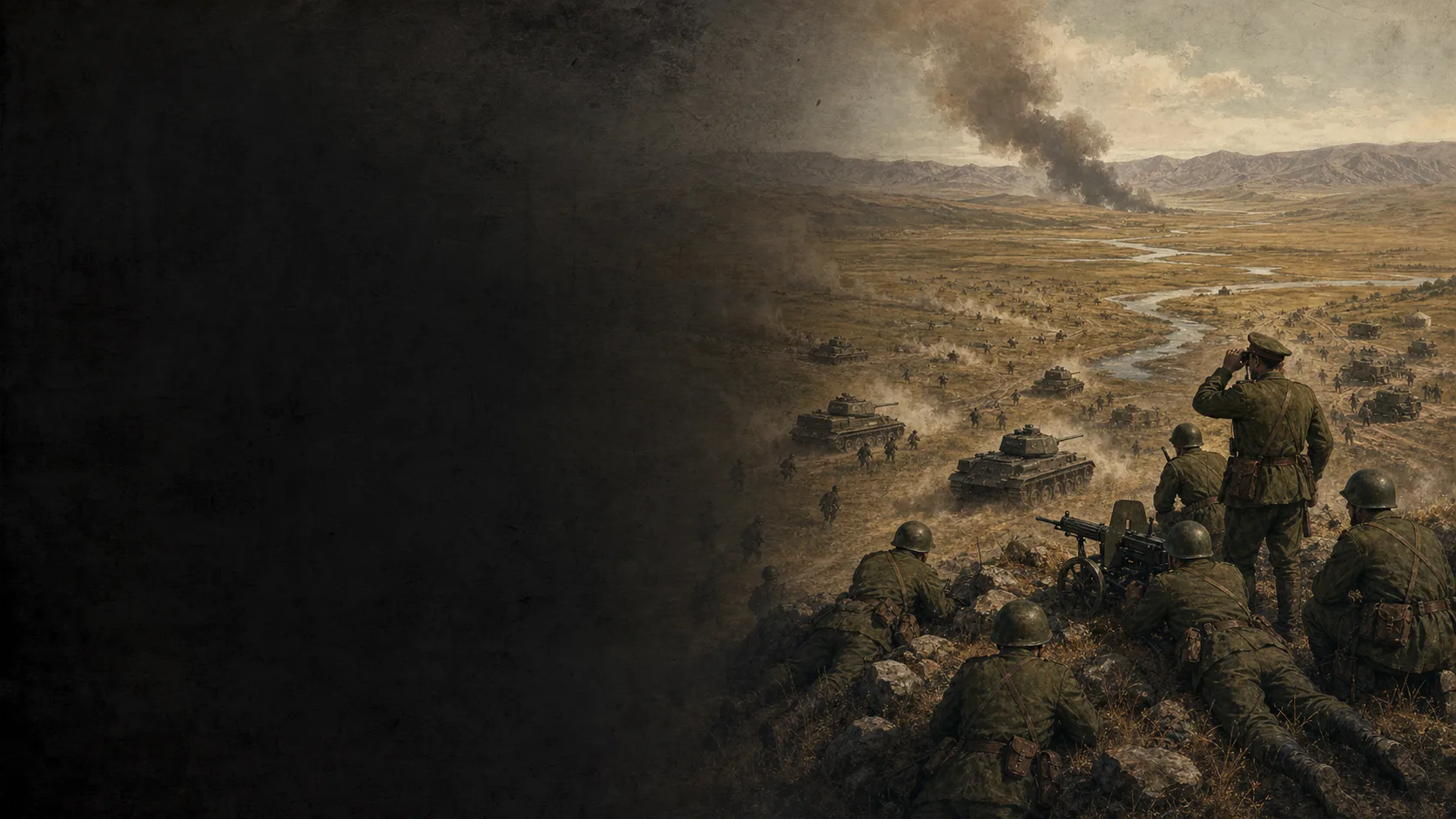
Incidents become battle
Border clashes widen. Both sides seek to reinforce their positions, but the Japanese underestimate the Soviet ability to bring in heavy forces.
War
A border war reveals the cost of confronting the USSR
Military history
The Nomonhan conflict pits Japanese expansion from Manchuria against the Soviet determination to secure the Mongolian border. Khalkhin Gol begins as a local crisis, then becomes an operation combining armour, artillery, aviation and supply to trap the opposing bridgehead. Its outcome weighs on Japan’s choice to favour the south rather than attack the USSR immediately.
Border clashes widen. Both sides seek to reinforce their positions, but the Japanese underestimate the Soviet ability to bring in heavy forces.
Zhukov pins Japanese forces in the centre and concentrates tanks, artillery and aviation on the flanks. Surprise comes from combination and depth more than from any single weapon type.
Japanese exit routes are cut and the bridgehead is destroyed. Japan reassesses the risk of a land war against the USSR and turns more towards southern objectives.
Explore
Military history
The 20 August offensive, attack sectors, encirclement and outcome.
Chronology, forces and operational decisions on both sides.
Japanese perspective, testimony, limits of the figures and strategic significance.
NIDS, septembre 2017, pp. 1–5 lues ; p. 2 bilans attribués à Krivosheev/Hata ; pp. 3–4 rôle de Shtern et soutien logistique.
Disputed border, theater logistics, Shtern’s role and the limits of portraying victory as cost-free. Limited to the case of Khalkhin Gol; this reference does not cover the whole conflict.
View ↗