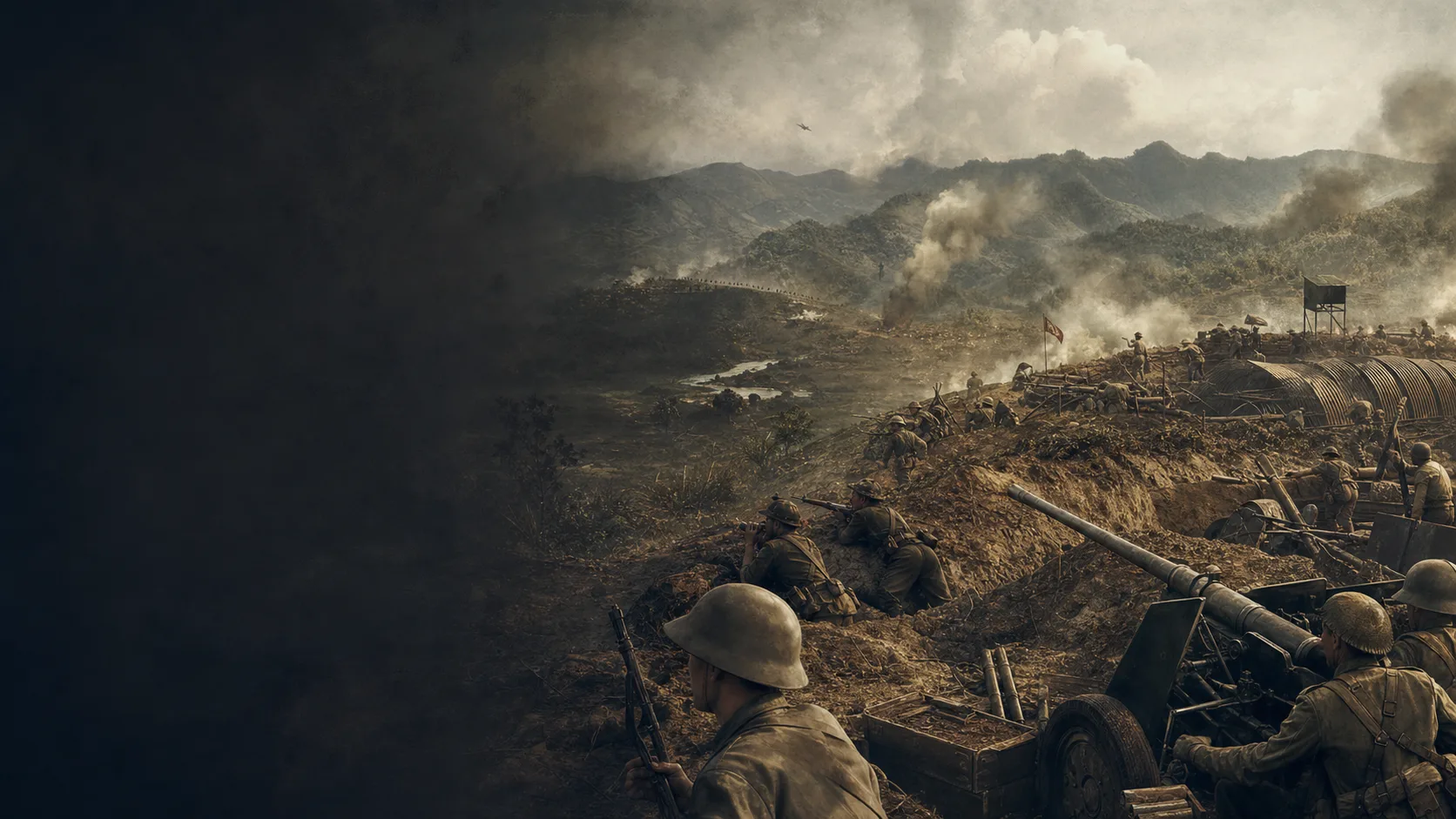
The wager on a base
French command installs a garrison in the basin to control communications and provoke a battle. The calculation assumes that aircraft can supply the base and strike enemy concentrations.
Battle
An isolated air-land base becomes a basin besieged by an underestimated logistical system.
Military history
France establishes a base in the Dien Bien Phu basin to control the routes to Laos and draw Viet Minh forces into a battle that French aircraft and artillery are expected to dominate. The Viet Minh nevertheless move guns, ammunition and men across mountainous terrain, then dig trenches up to the camp. After the outer positions fall and airborne supply is strangled, the garrison surrenders on 7 May 1954.
French command installs a garrison in the basin to control communications and provoke a battle. The calculation assumes that aircraft can supply the base and strike enemy concentrations.
The Viet Minh concentrate several divisions and move artillery into the hills. A US telegram dated 14 March already reports 105 mm and 75 mm guns and attacks on the outer strongpoints.
The outposts provide observation and depth. Béatrice and Gabrielle cover the north; Isabelle is detached to the south. The layout protects the runway but spreads the defenders across positions that can be attacked separately.
The base depends on air transport from the start. Enemy fire degrades ground movements and then recovery operations. When regular takeoffs and landings stop, airdrops continue, but they cannot evacuate wounded men.
Explore
Military history
Document 609, rapport contemporain sur le début de l'attaque
Beginning of the offensive, attacks on the strongpoints, Viet Minh artillery and the garrison’s condition on 14 March.
View ↗P. W. Shull, étude DTIC, 1999
Reference carried over from the previous dossier, not fully reread in this revision; the updated phases and positions rely on the DMPA.
View ↗Volume publié en 2024, chapitre 11, pp. 238–258 ; notice en ligne du 2 janvier 2025.
Bibliographic reference retained; full text not consulted in this revision, and no new geometry is drawn from the entry.
View ↗Étude historique sur les décisions et les perspectives du siège
Reference carried over from the previous dossier, not fully reread in this revision; updated phases and positions rely on the DMPA.
View ↗PDF lu, pp. 2–8 et 10–11 ; plan des pp. 6–7 et photo ECPAD p. 5 examinés entièrement.
Strongpoint layout, siege stages, the 30 March offensive and Isabelle on the night of 7–8 May; theatre dress of the paratroopers. Casualty totals are not adopted as certain.
View ↗Texte consulté pp. 119–121, 133–136, 146–147, 151–156, 203–207, 218–219 ; figure 9.1 p. 135 examinée.
Siege preparation, final flights, hill fighting, fall of the centre and Geneva timetable. Specific date differences are checked against the DMPA; the scale of figure 9.1 is not used.
View ↗Notice lue et photographie du véhicule entier examinée ; image Salle-france-contemporaine-m24-chaffee-scaled.jpg.
Ten tanks disassembled, transported and reassembled; silhouette, tracks and 75 mm gun shown in the illustration. Restoration markings are not reproduced.
View ↗Article de 2013 lu ; photographie anh-2N.jpg du vélo de Bùi Tín examinée entière.
Wooden extensions and handlebar extensions fitted to a pushed bicycle; record loads differ from ordinary loads. Bags in the illustration are reconstructed.
View ↗1er BEP au défilé de juillet 1950 ; réguliers Việt Minh, collection Dang Van Viet ; photographies examinées entières.
Theatre clothing and silhouettes; this does not establish a particular unit or uniform equipment at Na San.
View ↗