1. Home
  2. Contemporary World
  3. First Indochina War
  4. Hòa Bình

Battle

Hòa Bình

10 November 1951 — 25 February 1952

Seize · fix · interdict · evacuate

Military history

How did a French seizure intended to regain the initiative become a salient whose lines of communication were progressively severed?

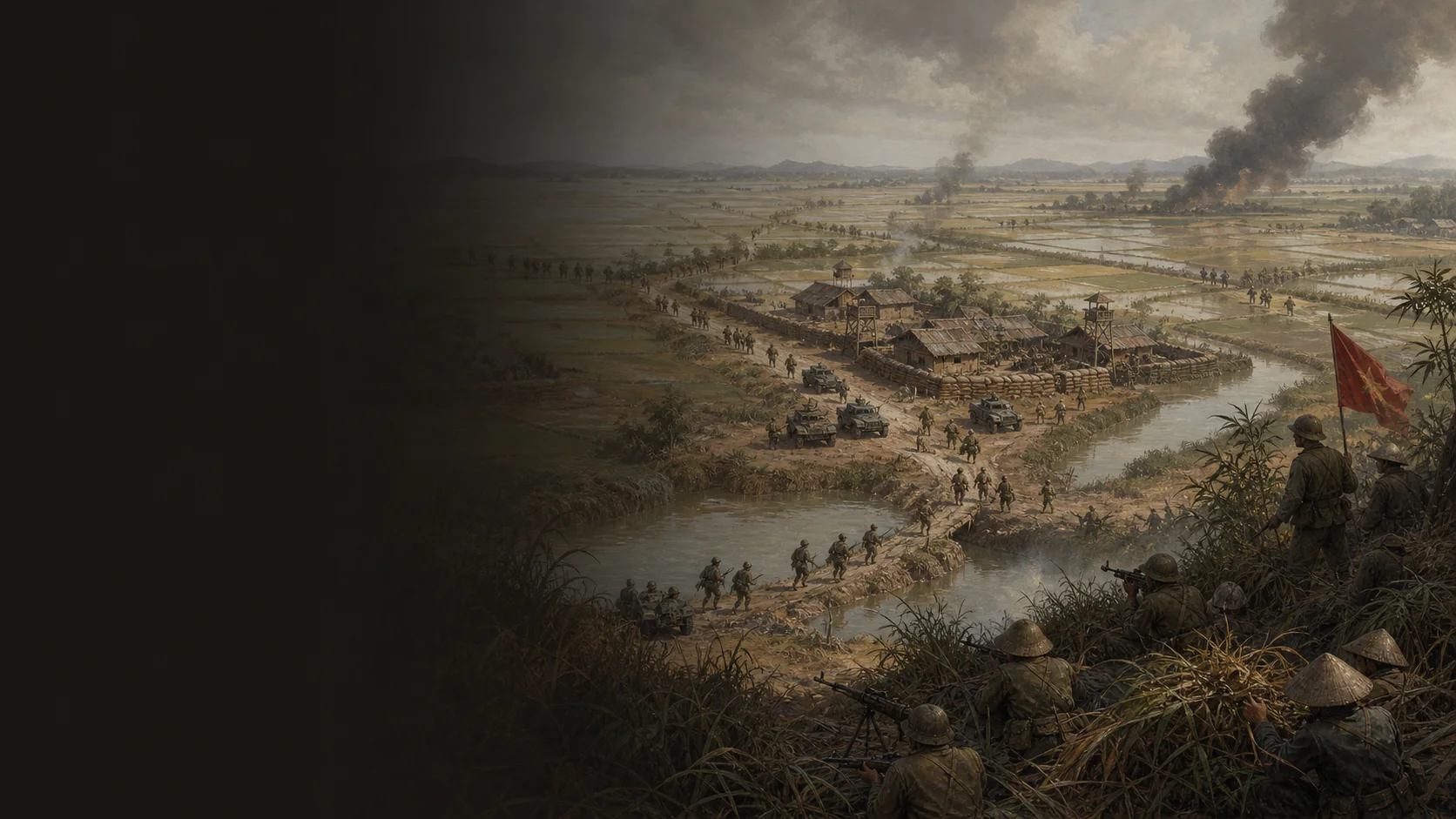
The Hòa Bình campaign begins with a swift French seizure, but the position has value only while the Black River and Route 6 remain usable. French task forces occupy the town and establish three sectors linked by outposts and convoys. Giáp then commits his regular divisions around the perimeter, first severing the river route and then the overland route, while the Việt Minh sustains a threat to the delta. France retains fortified positions and succeeds in extracting its main force, but abandons the salient because holding it absorbs too many troops without producing the sought-after decision.

The French gamble

After the Việt Minh setbacks in the delta in 1951, the French command seeks to regain the initiative. Hòa Bình is meant to threaten enemy communications, disrupt rice collection, and provide a fortified position that forces Giáp to choose between the salient and the delta. Sources differ on the precise statement of French intentions; this account treats these aims as a cluster rather than as the wording of a single order.

A junction

Hòa Bình lies west of the delta, on a bend of the Black River and at the western end of RC6. The garrison, river posts, and road strongpoints form a network separated by woods, high ground, marshes, and river crossings. The spatial problem is therefore one of maintaining links between isolated positions, not holding a continuous front.

Giáp’s response

The Việt Minh does not immediately try to crush the central garrison. The 304th and 312th Divisions move toward the sector, after which attacks and ambushes target Ap Da Chong, Tu Vũ, the river posts, and RC6 convoys. The intended effect is cumulative: make every reinforcement costlier, cut the river, cut the road, and keep up pressure elsewhere.

What the evidence supports

The sources agree on the French seizure, the commitment of Việt Minh divisions, the progressive closure of the supply routes, and the evacuation. They differ over the exact operational date of the withdrawal, casualty figures, and how French success should be interpreted. The account separates contemporary observations, later syntheses, and cartographic reconstruction.

Military history

Sources

Contemporary primary and diplomatic sourceFRUS 1952–1954, vol. XIII, part 1, document 21: The Minister at Saigon to the Department of State, 26 February 1952

Document 751G.00/2–2652, briefing de Salan du 22 février et commentaires de la dépêche; paragraphes sur les forces Việt Minh, les pertes annoncées et l'évacuation commencée le 22 puis annoncée le 24; note 3 sur la conférence de presse du 24 février.

Contemporary evidence for French perceptions of the campaign, the withdrawal timetable, claimed casualties, and the gap between Salan’s optimism and U.S. reservations.

View ↗
Retrospective participant primary sourceVõ Nguyên Giáp, People’s War, People’s Army (1961)

PDF p. 102, passage sur la campagne de Hòa Bình hiver 1951–printemps 1952; paragraphes sur la pénétration de l'arrière des deux côtés du fleuve Rouge, l'élargissement des bases et la défaite de l'attaque de de Lattre.

The Việt Minh perspective on initiative, rear areas, and the political significance of the French abandonment, with the retrospective bias noted among the limitations.

View ↗
Official U.S. Army synthesisRonald H. Spector, Advice and Support: The Early Years, 1941–1960

PDF p. 150, section Hoa Binh; passage sur les trois divisions sous Giáp, la coupure successive de la voie d'eau puis de la voie terrestre, l'évacuation du 24 février et la destruction de plus de 150 tonnes; note 3 citant le rapport Salan et les rapports USARMA de février et mai 1952.

The official operational framework for isolation, logistical cost, division-level forces committed, and the consequences of evacuation.

View ↗
Official institutional history of the Joint Chiefs of StaffHistory of the Joint Chiefs of Staff and the First Indochina War, chapitre The De Lattre Episode, 1951

PDF, chapitre “The De Lattre Episode, 1951”, passage commençant par “With the return of good weather in the autumn” et décrivant le mouvement Cho Ben–Hoa Binh, les communications, la collecte du riz et la pression croissante sur le périmètre de Hanoi.

French strategic objectives and the cost of the extension toward Hòa Bình within the wider 1951 campaign.

View ↗
Specialist academic articleAlexander Zervoudakis, “L’armée de l’Air et Hoa Binh”, Revue historique des Armées, 1995, no 198, p. 89–97

Article Persée, pp. 89–97; ouverture et paragraphes sur la prise de Hòa Bình en novembre 1951, le ravitaillement aérien de janvier 1952 et l'évacuation de février; conclusion et bibliographie, p. 97, qui discutent les lectures de “pourrissement”, d'erreur coûteuse et de victoire Việt Minh.

The role of air power, reasons for the occupation, and boundaries among competing historiographical interpretations.

View ↗
Specialist historical-press articleThe Hoa Binh Campaign, HistoryNet

Article HTML, paragraphes situant Hòa Bình sur la rive ouest de la rivière Noire et décrivant les accès fluvial et routier par la RC6 via Xuan Mai ; passages commençant par “Operational Group South”, “On November 14” et “Giap chose to first challenge” sur les sept bases de la rivière Noire ; sections sur la RC6, le retrait et le bilan du 10 novembre au 25 février.

Support for the operational map reconstruction: Hòa Bình, the Black River, RC6 through Xuan Mai, river outposts, and task-force axes; the chronology of attacks, the cutting and reopening of RC6, Operation Violette, the threat to the delta, and a specialist casualty estimate.

View ↗
Vietnamese institutional source / official synthesisVietnam News Agency, « Chiến dịch Hòa Bình (10/12/1951-25/2/1952) »

Article institutionnel citant Bách Khoa toàn thư Quân sự Việt Nam, Quyển 1 (2015), sections sur les trois phases : 10–26 décembre, 27–31 décembre, 7–25 janvier ; coupure de la rivière Noire et de la route 6 ; retrait à partir du 23 février et fin le 25 février.

Cross-checking the chronology and the two-front logic from the Vietnamese perspective; casualty totals and the designation of victory remain attributed to this official tradition.

View ↗
French institutional archiveService historique de la Défense, dossier sur la situation militaire en Indochine et les télégrammes de de Lattre à Salan

Notice SHD, description du dossier: d.1 situation militaire fin 1950–1951; d.2 télégrammes de de Lattre à Salan, juillet–décembre 1951; d.7 bilan des forces amies et ennemies au 25 décembre 1951; pièces couvrant fin 1950–décembre 1951.

Institutional confirmation of the telegrams, force reports, and contemporary files that bound the French reconstruction of the seizure and initial deployment.

View ↗

Edited by BattlesInMotion.com