1. Home
  2. Contemporary World
  3. First Indochina War
  4. Nà Sản

Battle

Nà Sản

23 November — 2 December 1952

Hold an air–land hedgehog; the victory remains tactical

Military history

How did the air–land camp at Nà Sản stop the night assaults while retaining only local significance?

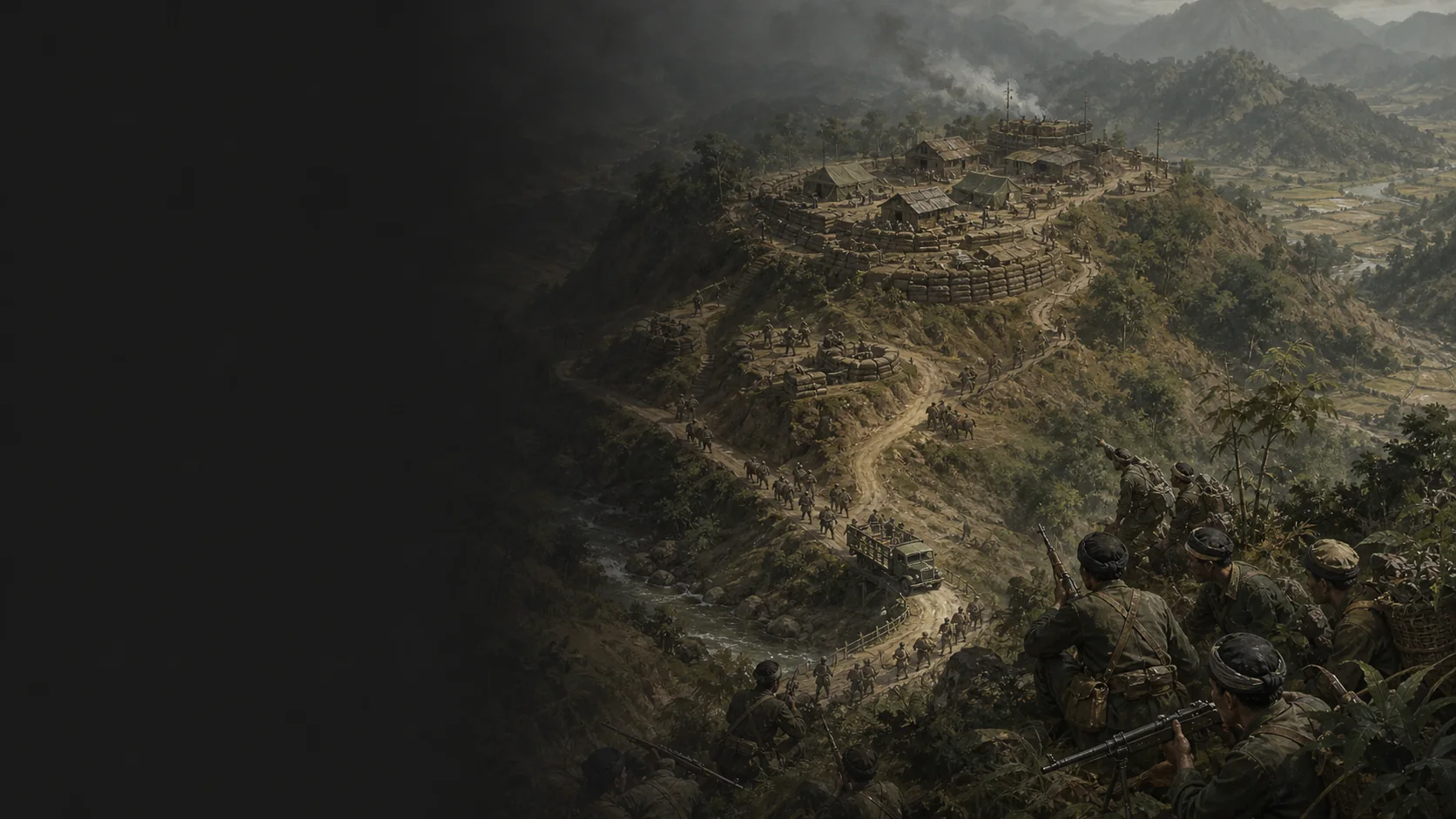
Nà Sản is a defensive gamble born of the French retreat in the Tai country. After several posts fall or are abandoned and Sơn La is evacuated, French command concentrates a camp of strongpoints, fire support, and paratroop reserves around an all-weather airstrip. Võ Nguyên Giáp surrounds the position with several divisions and first tries to take advanced works, then to break the defenses during the nights of 30 November–2 December. The attacks achieve local penetrations, but firepower, aircraft, and counterattacks prevent consolidation. The Việt Minh abandons the attempt to force the camp; this tactical success nevertheless does not restore French control of the Northwest, and Nà Sản is evacuated by French decision in August 1953. Strengths, casualties, and the precise attribution of some assaults remain bounded by the sources rather than merged into a single figure.

The retreat makes the position necessary

The Northwest campaign and French withdrawal from Sơn La open a direction toward the Tai country and Laos for Giáp. Salan chooses Nà Sản because its airstrip and terrain allow a concentrated position to be sustained even though the ground around the camp is difficult to hold overland.

The hedgehog depends on the airstrip

Gilles organizes a network of strongpoints linked by wire, mines, and interlocking fire. An outer belt protects the heights, while an inner belt covers the airstrip, command post, artillery, reserves, and medical facilities. The exact number of positions and men present varies by source; the principle of air–land concentration is common to all.

The first attacks test the system

The assault on PA8 during the night of 22–23 November shows what the Việt Minh must solve: overrun an advanced position, then withstand mortar fire and the paratroop reserve. Fighting over the following nights around PA22bis, PA24, PA21bis, and PA26 shifts the question from taking a point to consolidating a breach.

A tactical victory dependent on logistics

The French camp remains supplied by air and can concentrate fire on threatened positions; the Việt Minh has divisions, mortars, and porters but cannot durably neutralize the airstrip or French firepower. When Giáp abandons the attempt to force Nà Sản, he retains freedom of action in the Northwest. The evacuation ordered by Navarre in 1953 shows that holding the camp was not the same as solving the strategic problem.

Military history

Sources

Edited primary source, retrospective memoirsRaoul Salan, Mémoires, Fin d'un Empire, extraits sur Nà Sản

Copie archivée de la page « Nà Sản », section reproduisant Raoul Salan, Mémoires, pp. 348–352 : constitution du groupement et batteries ; pont aérien du 16 octobre au 30 novembre ; nuits du 30 novembre au 2 décembre ; bilan rétrospectif et évacuation de 1953.

Selection of Nà Sản, the airstrip’s role, strongpoint organization, reserve units, attack sequence, retrospective estimates of sorties and casualties, and evacuation. A participant and partisan source checked against archives and syntheses.

View ↗
Contemporary primary source, U.S. diplomatic memorandumJohn M. Allison, memorandum on the Tonkin situation and Nà Sản

Foreign Relations of the United States, 1952–1954, vol. XIII, part 1, document 141, note 3, 751G.00/11–2452, Washington, 24 novembre 1952, paragraphes sur Sơn La, Nà Sản et les « 6,000 odd Franco-Viet forces ».

Contemporary state of the Sơn La withdrawal, concentration of about nine battalions around Nà Sản, encirclement of the airstrip, and uncertainty over strength actually available at the observed moment.

View ↗
Specialist institutional work, Army University PressThomas S. Helling, The Final Days of Empire: France's Bloodied Exit from Indochina

Combat Studies Institute Press, chapitre 6 « Nà Sản Base Aéroterrestre » : commandement, terrain et dispositif pp. 88–90 ; carte fig. 6.1 p. 89 ; PA8 p. 92 ; PA22bis/PA24 pp. 93–94 ; PA21bis/PA26 pp. 94–95 ; logistique médicale pp. 95–96 ; renoncement et évacuation pp. 97–98.

Detailed institutional synthesis of positions, airstrip, units, and assault nights; control map; medical data and 1953 abandonment decision. Narrative judgments are cross-checked and figures retained with their scopes.

View ↗
Specialist article, Revue historique des ArméesBernard Féral, « De Na San à Diên Biên Phu »

Revue historique des Armées, no 194 (1994), p. 66 pour le rôle de chef d'état-major du camp, les assauts nocturnes et le coût des contre-attaques parachutistes ; p. 67 pour l'exposition de l'artillerie, la vulnérabilité diurne de la piste et les limites de l'appui aérien ; DOI 10.3406/rharm.1994.4326.

Participant testimony on how the strongpoints worked and the expenditure of paratroop reserves; used as a retrospective specialist source, not sole arbiter of figures.

View ↗
Specialist university synthesis, Université du Québec à MontréalNà Sản, Battle of

Notice Indochine de l'UQAM, paragraphes commençant par « In late 1952 » sur la transformation du site et par « On 30 November » sur les assauts, l'artillerie, le ravitaillement et la décision du 2 décembre ; section sur l'évacuation ultérieure.

Strategic framework, description of the air-supplied base, Vietnamese insufficiency in artillery and logistics, immediate result, and bounds of French success.

View ↗
Official institutional history, U.S. Army Center of Military HistoryRonald H. Spector, Advice and Support: The Early Years, 1941–1960

CMH Pub 91-1, PDF p. 180 / imprimé p. 159 pour les neuf bataillons français, cinq batteries de 105 mm, la piste, le ravitaillement aérien et le coût du succès ; PDF p. 182 / imprimé p. 161 pour l'évaluation CINCPAC et l'initiative conservée par le Việt Minh.

Independent institutional check on the system, its dependence on air supply, and the limited reach of the French victory without repeating an unsupported global estimate of Vietnamese losses.

View ↗

Edited by BattlesInMotion.com