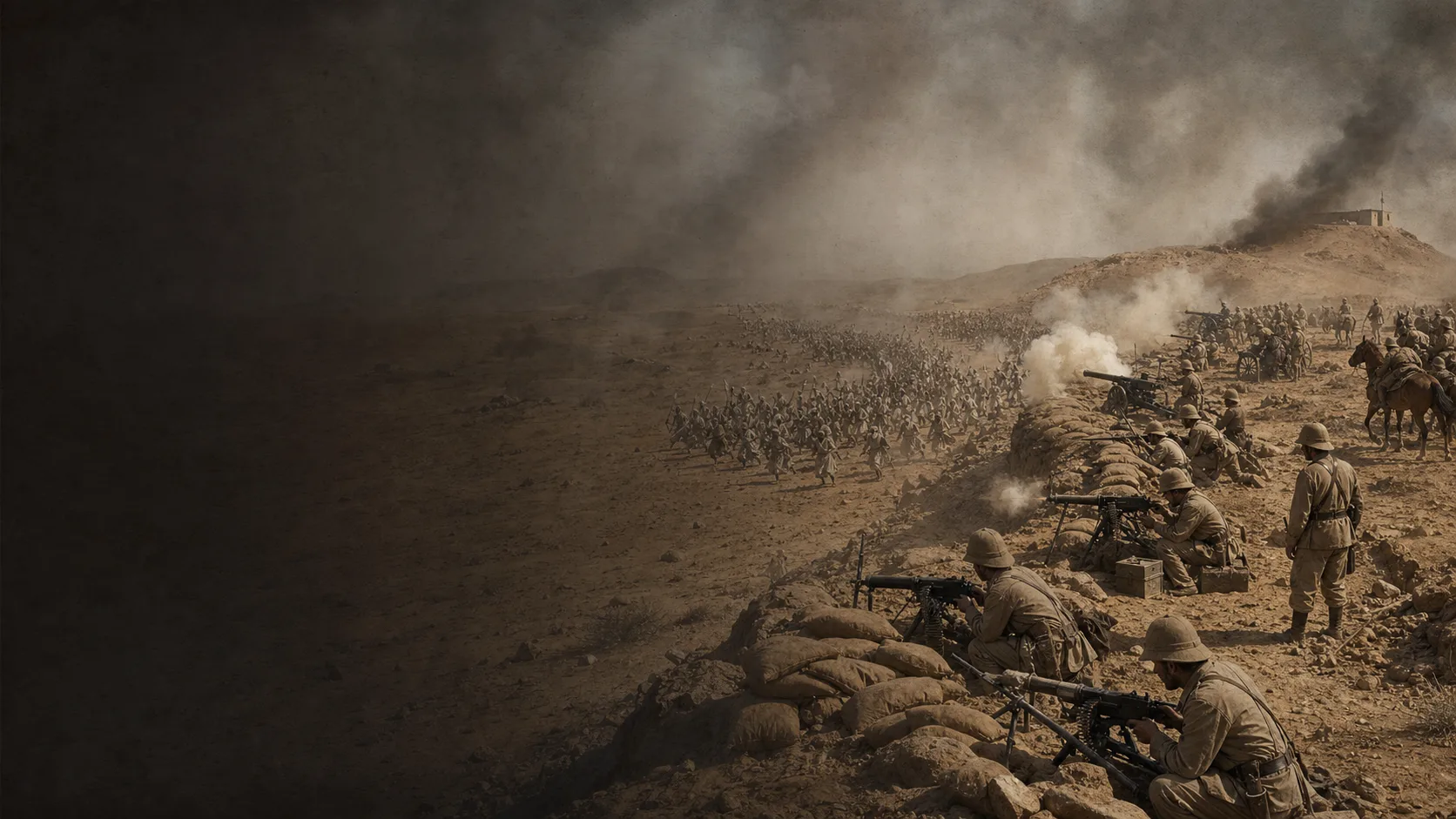
After the assaults on the camp, MacDonald’s changes of front stop a renewed attack.
Military history
How does Anglo-Egyptian firepower remain effective when leaving camp exposes MacDonald’s brigade to attacks from several directions?
On 2 September 1898, Kitchener’s army repels Mahdist assaults from a camp backed by the Nile. But the battle does not end at this firing line. In the north, mounted units are pressed towards the river; in the south, the 21st Lancers charge into a ravine whose defenders they have underestimated. As the brigades march towards Omdurman, MacDonald’s remains behind and faces two successive attacks. His changes of front, batteries and arriving reinforcements restore the situation. The capital falls; the Khalifa escapes.
An offensive supported by the Nile
Railways, depots and river transport allow Kitchener to concentrate troops, ammunition and food towards Omdurman. Gunboats also provide covering fire along the banks. Capturing the capital is intended to consolidate Britain’s and Egypt’s reconquest of Sudan under British influence.
A camp open to the river
On 1 September the army camps near Egeiga. The line forms a curve whose two ends approach the Nile: a thorn hedge to the south and shallow trenches on the other faces. The British occupy the south; brigades of the Egyptian army extend the front northward.
Assaults and reserves
Abdallahi has many infantry, including riflemen, and fewer cavalry. The different bodies do not all engage at the same place or time. After the assault on the camp fails, forces that remain organized can attack the brigades on the march.
An Egyptian army that is also Sudanese
Hunter’s brigades include Egyptian and Sudanese battalions led by British officers. MacDonald commands the 2nd Egyptian and the 9th, 10th and 11th Sudanese. Their manoeuvre under fire becomes essential in the second part of the battle.
Military history
Sources
Participant accountWinston Churchill, The River War
Fin XIII ; XIV–XV, camp, Kerreri, sortie et MacDonald ; fin XVI, poursuite et pertes.
Tactical sequence and limits of the pursuit; a partisan British account with indirect views of the opposing side.