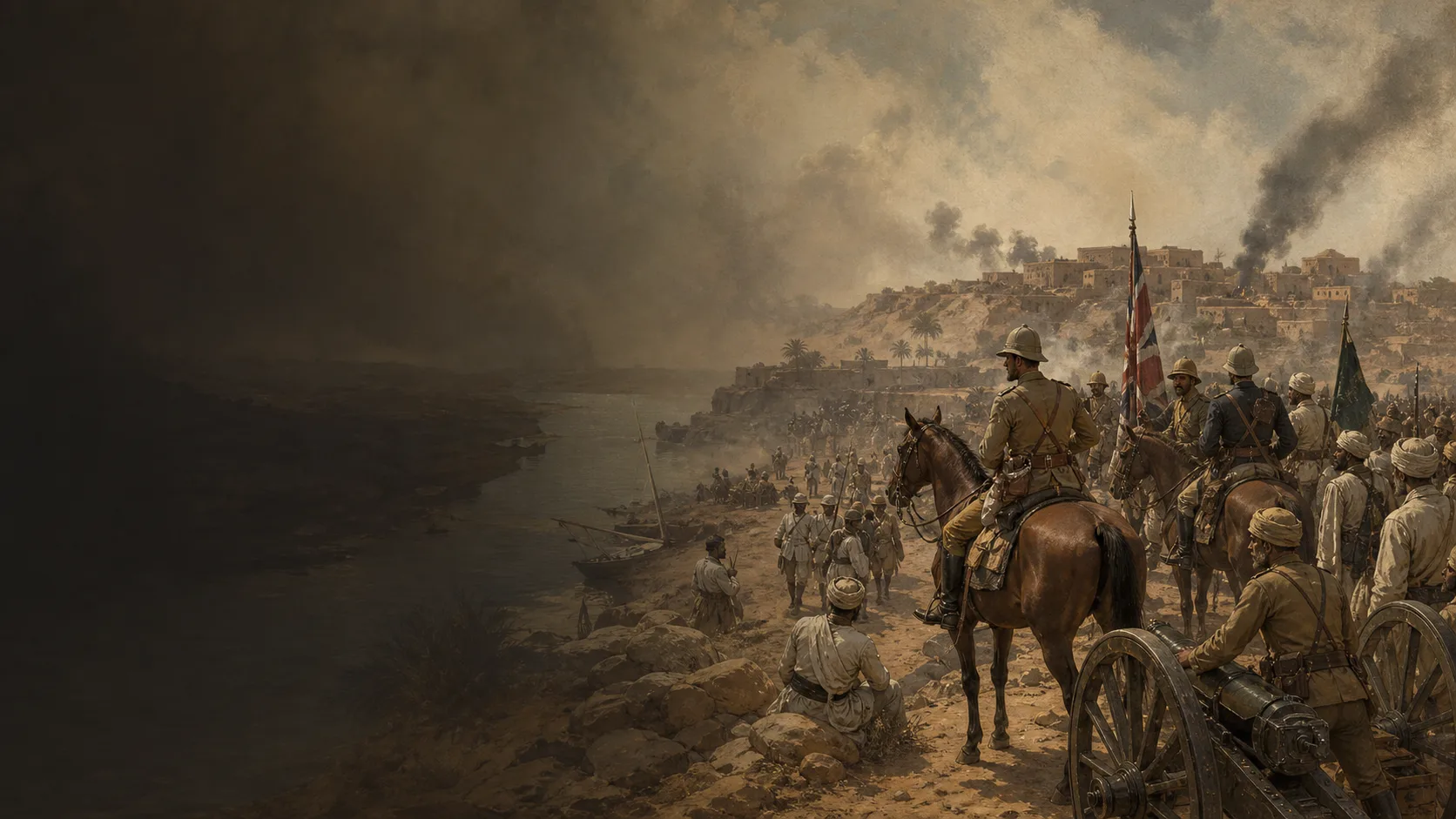
Up the Nile
Kitchener advances slowly, protecting his depots and extending the railway. Logistics become the prerequisite for any decisive battle.
War
Railways and machine guns make imperial reconquest possible
Military history
The British reconquest of Sudan relies on infrastructure that compresses distance: railways, depots, gunboats and communications along the Nile. The Mahdist army retains an impressive capacity for mobilisation, but it cannot match the same level of firepower or prevent a modern force from choosing a prepared defensive position.
Kitchener advances slowly, protecting his depots and extending the railway. Logistics become the prerequisite for any decisive battle.
The Anglo-Egyptian army reaches the Nile with a prepared position, artillery and machine guns. The Mahdists must attack across an open plain.
The assaults on the camp are repelled, then the battle continues around the mounted units and brigades on the march. MacDonald changes front and receives reinforcements. Omdurman is occupied, but the Khalifa escapes; fatigue and supply limit the pursuit.
Explore
Military history
Fin XIII ; XIV–XV, camp, Kerreri, sortie et MacDonald ; fin XVI, poursuite et pertes.
Tactical sequence and limits of the pursuit; a partisan British account with indirect views of the opposing side. Limited to the case of Omdurman; this reference does not cover the whole conflict. Case reference for Omdurman: the course and constraints of this battle. Its scope alone does not cover the entire conflict.
View ↗Mahdist organisation, campaigns, and political consequences.
Technological asymmetry, logistics, and the battle’s place in colonial expansion.