1. Home
  2. Gunpowder & Empires
  3. Great Northern War
  4. Poltava

Battle

Poltava

8 July 1709

The siege pins down the Swedish army; the redoubts pull it apart before the Russian line counterattacks.

Military history

How did a limited siege, an incomplete defensive system, and a loss of cohesion bring about the Swedish army's defeat at Poltava?

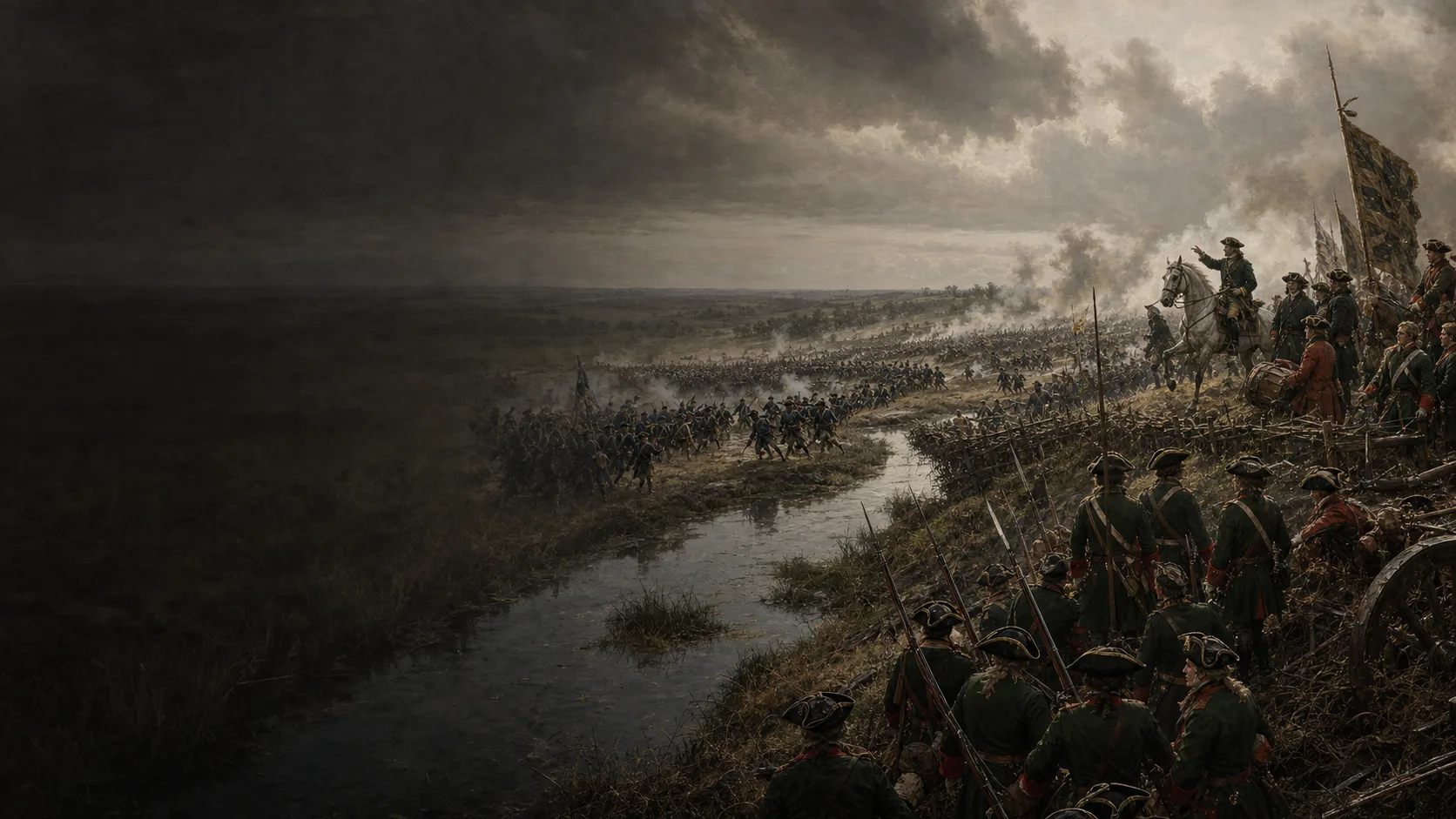
Poltava was neither simply the capture of a town nor the instant annihilation of the entire Swedish army. The siege of the fortress, held by Kelin's garrison, pinned down Charles XII's army long enough for Peter I to cross the Vorskla and prepare a camp, redoubts, and a battle line. On the morning of June 27 in the Julian calendar, the Swedish attack reached the works but lost cohesion; the line battle decided the encounter, after which the river and the failed crossing at Perevolochna turned a tactical defeat into the loss of the field army.

The siege fixes the stakes

The fortress of Poltava controlled a route towards the Vorskla and Perevolochna. Swedish and Cossack forces blockaded it from May 1, but the museum dossier does not support a series of massive assaults: Kelin's garrison and the siege works primarily pinned the armies around the town.

Two positions around Poltava

On the eve of battle, the Swedish and Ukrainian camp lay south of Yakivchanskyi Forest, in the trenches below the fortress and around Pushkarivka. The Russian army held a camp near Yakivtsi, between the woods and behind the Takhtaulivska ravine; the Vorskla bounded its rear, and the approaches did not form a continuous enclosure.

Time becomes a defensive work

After the Russians crossed the Vorskla, the redoubts covered the ground between the woods and the camp. Their purpose was to restrict routes, delay the infantry, and protect the cavalry. A continuous wall lies beyond what the dossier establishes. Archaeological research confirms the effect of some positions while leaving their exact geometry unresolved.

Military history

Sources

Primary source — official archival registerPierre Ier, lettre à S. A. Kolychev sur Poltava et Perevolochna

Registre fédéral des documents uniques, notice 473 : lettre datée du 27 juin 1709 ; notice et relation jointe sur la bataille de Poltava et la capitulation de Perevolochna du 30 juin.

Chronology of the Russian account, proclaimed outcome, and surrender; an official source to be compared with opposing testimony and specialist studies.

View ↗
Printed primary source — National Library of RussiaКнига Марсова, или воинских дел от войск царского величества российских

Notice RUSNEB, édition commencée en 1713, cote P-67 : 105 feuillets de relations et plans ; la notice précise que les textes et les images ont été complétés et remaniés progressivement.

Russian printed tradition and provenance of the plans; used as a contemporary source, never as the sole arbiter of propaganda, losses, or redoubt geometry.

View ↗
Institutional source — National Historical and Cultural Reserve Poltava BattlefieldMuseum exhibition — The True History of the Battle of Poltava

Halls 5–8 : blocus de Poltava, déploiement au 26 juin, franchissement de la Vorskla, camp et redoutes, deux temps de la bataille, pertes estimées et capitulation à Perevolochna ; Hall 9 : construction de la mémoire et de la version officielle.

Campaign chronology, relative positions, orders of magnitude, function of the redoubts, two-stage course of the battle, outcome, and critique of imperial memory.

View ↗
Institutional source — battlefield museum dossierОблога Полтави в 1709 році: міфи і факти

PDF, pp. 1–2 : garnison de Kelin, distinction entre habitants et soldats, critique du récit des 2 600 citadins et des 87 jours d'assauts, début de la blockade et fonction stratégique du siège.

Sensitive wording concerning the garrison and siege; distinction between a fixing siege and an assault on the town.

View ↗
Transcribed contemporary account — Russian perspectiveRussian Account of Poltava, relation reçue à Mons le 13/24 juillet 1709

Paragraphes sur le franchissement de la Vorskla le 20 juin, l'approche du 24, l'attaque du 27, la colonne de Roos, le déploiement à 9 heures et la poursuite ; transcription moderne signalée comme une relation reçue de témoins russes.

Operational sequence and detachment names in the Russian tradition; each detail is corroborated or qualified because of the perspective and transmission.

View ↗
Contemporary Swedish testimony — Project Runeberg editionRobert Petrés dagbok under kriget, 1709

Karolinska krigares dagböcker, vol. I, édition 1901, pp. 279–284 du scan numérique : entrées des 17–22 juin sur les ouvrages, la blessure de Charles XII et des régiments décrits comme affaiblis par marches, faim, froid et combats ; OCR à contrôler, à distinguer d’un ordre de bataille complet.

Swedish viewpoint, condition of the troops, and the king's wound before the battle; it explicitly limits the scope of tactical details drawn from this journal.

View ↗
Academic paper — Institute of History of UkraineBo Knarrström, Archaeology in Poltava. Results from the 2007/2008 field seasons

Dans les actes de la conférence Poltava 1709, PDF, pp. 44–45 : questions sur la fiabilité des cartes et des récits, redoutes dont la position exacte reste non établie, et effet important attribué à la redoute n° 3.

Archaeological and cartographic limits on the number, shape, and location of the redoubts; justification for an educational, non-metric map.

View ↗
Specialist military-history journalGunnar Åselius et Fredrik Eriksson, Tenacious retreat of Sweden as a great power

Baltic Worlds, vol. IV:3, 2011, pp. 28–31 : redoutes et géométrie toujours discutées, six bataillons de Roos isolés, attente du corps principal, artillerie russe et divergences sur les pertes et l'interprétation de la blessure de Charles XII.

Specialist corroboration of the redoubts–Roos–line sequence and framing of historiographical divergences.

View ↗
Specialist academic articleSergey Ivanyuk, The Forgotten 5th Battalion: To the Question of Garrison of the Poltava Fortress in 1709

Vestnik Volgogradskogo gosudarstvennogo universiteta, série 4, 2014, résumé et conclusion : les effectifs de la garnison restent discutés ; l'auteur reconstitue un cinquième bataillon à partir de lettres et documents.

Constraint on the size of the garrison and rejection of a figure for Kelin's force presented as perfectly settled.

View ↗
Academic article — Harvard Ukrainian StudiesAlexander Kamenskii, The Battle of Poltava in Russian Historical Memory

Harvard Ukrainian Studies, vol. 31, 2009–2010, pp. 195–204, notamment PDF pp. 2 et 5 : lettres de Pierre après la bataille, contrôle de l'information, version officielle construite et absence de mémoires russes de vétérans.

Critique of official Russian narratives and heroic anecdotes; not used alone to establish tactical movements.

View ↗
Academic article — Harvard Ukrainian StudiesKristian Gerner, The Battle of Poltava as a Realm of Memory and a Bone of Contention

Harvard Ukrainian Studies, vol. 31, 2009–2010, pp. 679–693, notamment PDF pp. 1, 3 et 10–13 : significations divergentes de Poltava dans les mémoires russe, suédoise et ukrainienne.

Strategic and political significance, without turning a national memory into evidence of an intention or tactical result.

View ↗
Institutional historical map — Russian State LibraryPlan du combat près de Poltava

Notice RUSNEB : carte manuscrite, une feuille, échelle 1:33 600, cote Кo 3/VI-18, environs de Poltava ; la carte est une source de comparaison, à distinguer d’un relevé moderne.

Cartographic framework and place names; the final geometry is deliberately simplified and its uncertainties are explicit.

View ↗

Edited by BattlesInMotion.com