Two rival powers
Prussia and Austria fight for predominance in Germany. Prussian successes in June bring the armies towards Benedek’s position near Königgrätz.
Battle
The capture of Chlum turns a battle still stalled before the heights.
Military history
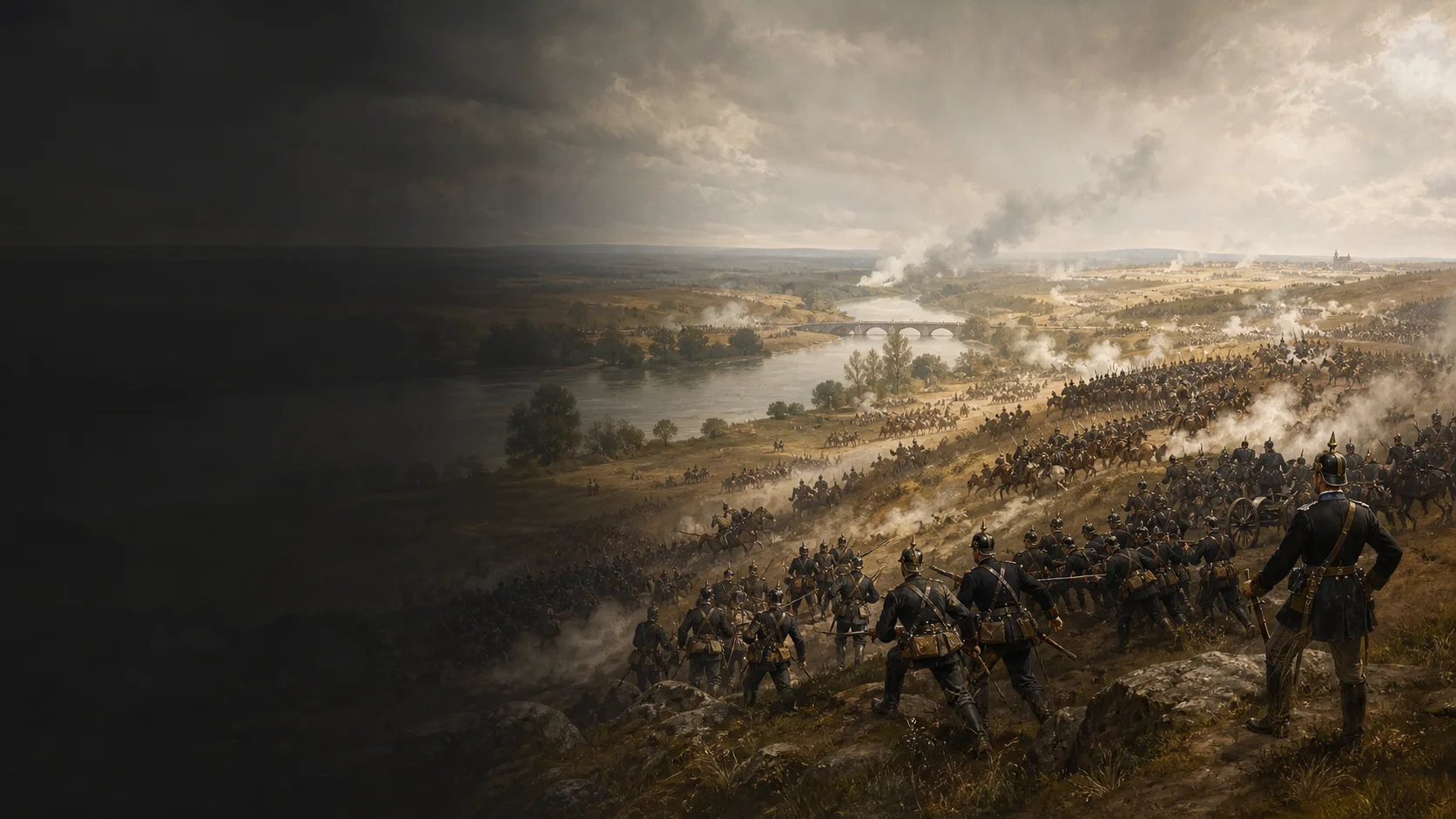
On 3 July 1866, the Prussians attack an Austrian position protected by the Bistritz, woods and powerful artillery. Their First Army remains stalled before the heights for a long time. To the north, the Crown Prince’s Second Army approaches in the rain. Its Guard reaches Chlum behind part of the defenders: Benedek must retake the village or abandon his position. Resistance by the reserves, cavalry and batteries allows a substantial part of his army to withdraw.
Prussia and Austria fight for predominance in Germany. Prussian successes in June bring the armies towards Benedek’s position near Königgrätz.
The Crown Prince receives orders to support the First Army. On 3 July his columns must still march over sodden roads; their arrival on the battlefield is not assured.
Austrian batteries dominate the western approaches. But the Army of the Elbe advances from the southwest, while the Prussian arrival from the north threatens the rear of defenders engaged in the woods.
Military history
Entrées des 2–3 juillet 1866, pp. 33–52 : ordre nocturne, marche, Horenowes, Chlum et renforts.
Arrival of the Second Army, incomplete information and resistance at Chlum; rumours and immediate figures are not adopted.
View ↗Livre VII, ch. II, pp. 235–253 : positions, Bistritz, bois, armée de l’Elbe, Chlum et couverture du repli.
Tactical sequence; timings compared and national judgments not reused.
View ↗ULB Darmstadt, K5453_1, plan au 1:50 000, image complète examinée ; positions de midi et directions de marche.
Relationships among the Bistritz, Swiep, Horenowes, Chlum, Problus and the Elbe; not a metric reconstruction of routes.
View ↗Document 46, Holitz, 3 juillet 1866 ; AT-OeStA/KA AhOB MKSM HR Akten 343, transcription « Die Niederlage von Königgrätz ».
Chlum occupied, flank and rear threatened, retreat disorganized and regrouping attempted.
View ↗Pages imprimées 38–39 : bataille du 3 juillet, engagement des IIe/IVe corps, réserves et retraite.
Modern check on the Imperial right’s commitment and the phase distinctions; timings are not fixed.
View ↗Paragraphes de la bataille, des pertes, de la poursuite en Moravie et de la conclusion de la guerre.
Orders of magnitude and consequences, without confusing total casualties with deaths.
View ↗Paragraphes sur la culasse, les variantes et la comparaison balistique avec le Lorenz.
Rear-loading, firing rate and technical limitations; the silhouette remains illustrative.
View ↗Paragraphes sur le chargement par la bouche et la construction du Lorenz.
Distinguishes Austrian equipment from the Dreyse without identifying the exact model used by each regiment.
View ↗