Mobilization
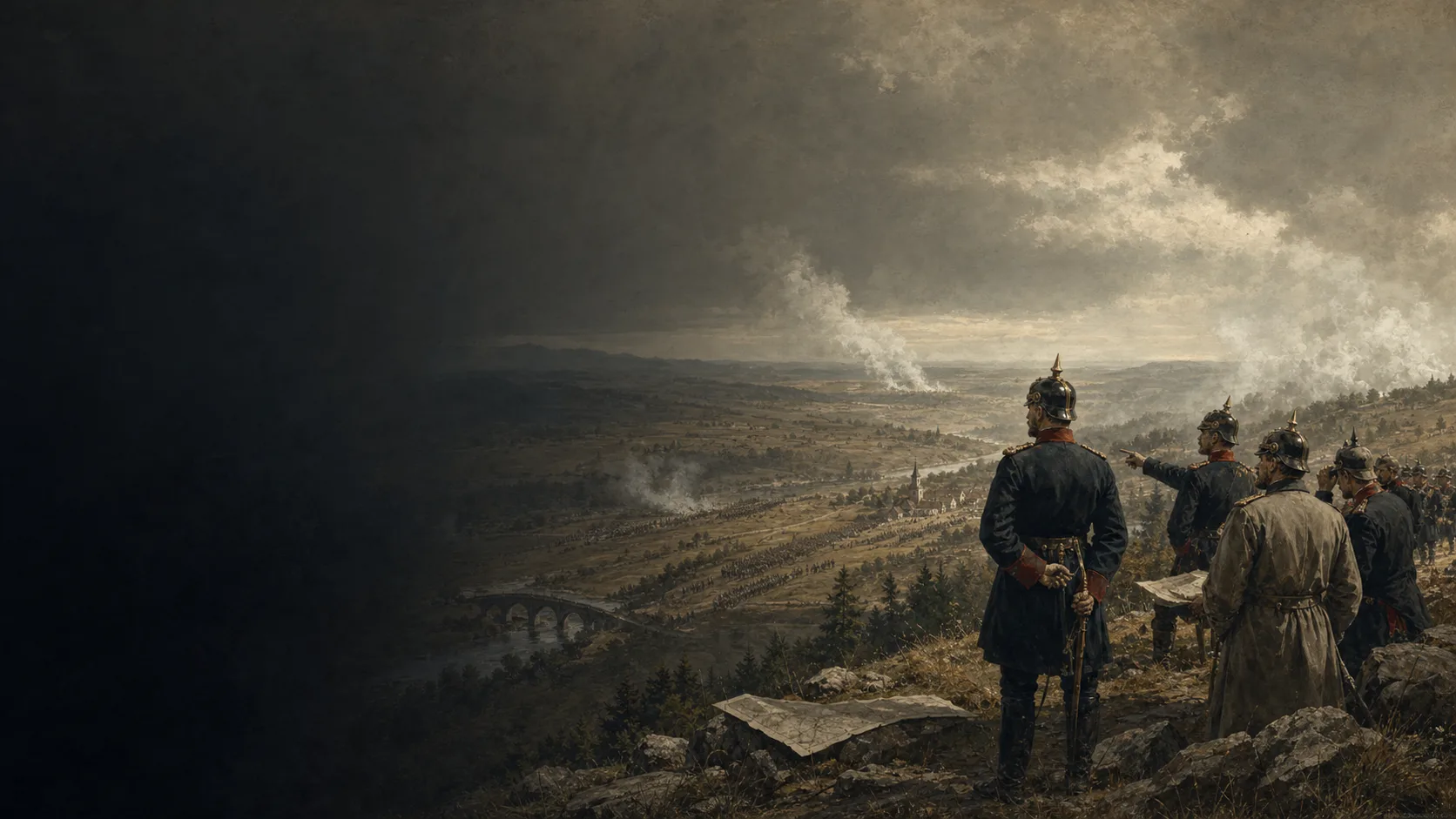
Railways allow Prussia to move its armies into Bohemia. The plan assumes the corps will join before Austria can exploit their dispersion.
War
Railway timetables and the needle gun give Prussia a decision in Germany
Military history
The Austro-Prussian War is short because Prussia combines military reform, a railway network and a command system able to concentrate several armies. Austria has a substantial army and dangerous artillery, but its decisions are slower and its army must deploy against several threat axes.
Railways allow Prussia to move its armies into Bohemia. The plan assumes the corps will join before Austria can exploit their dispersion.
Initial fighting pins the Austrian forces and gives the Prussian Second Army time to approach despite command and terrain friction.
Frederick Charles’s First Army attacks alongside the Army of the Elbe. The arrival of the Second Army under Crown Prince Frederick William breaks the Austrian deployment.
Explore
Military history
Orders, concentration of armies and the Prussian justification of operations.
Forces, technology, command and the course of Königgrätz.
Convergence, political decisions and the significance of the Prussian victory.
Entrées des 2–3 juillet 1866, pp. 33–52 : ordre nocturne, marche, Horenowes, Chlum et renforts.
Arrival of the Second Army, incomplete information and resistance at Chlum; rumours and immediate figures are not adopted. Limited to the case of Sadowa; this reference does not cover the whole conflict.
View ↗Notice d’Arnulf Scriba, version du 6 septembre 2014 ; paragraphe sur les trois armées prussiennes et leurs commandants.
Identifies the commanders of the three Prussian armies and distinguishes Frederick Charles’s First Army from Crown Prince Frederick William’s Second Army.
View ↗