1. Home
  2. Middle Ages
  3. Arab Conquest of Syria
  4. Yarmouk

Battle

Yarmouk

August 636

An imperial counteroffensive becomes a trap of terrain and retreat.

Military history

How does a retreating Arab army turn its assembly position into victory over the imperial army?

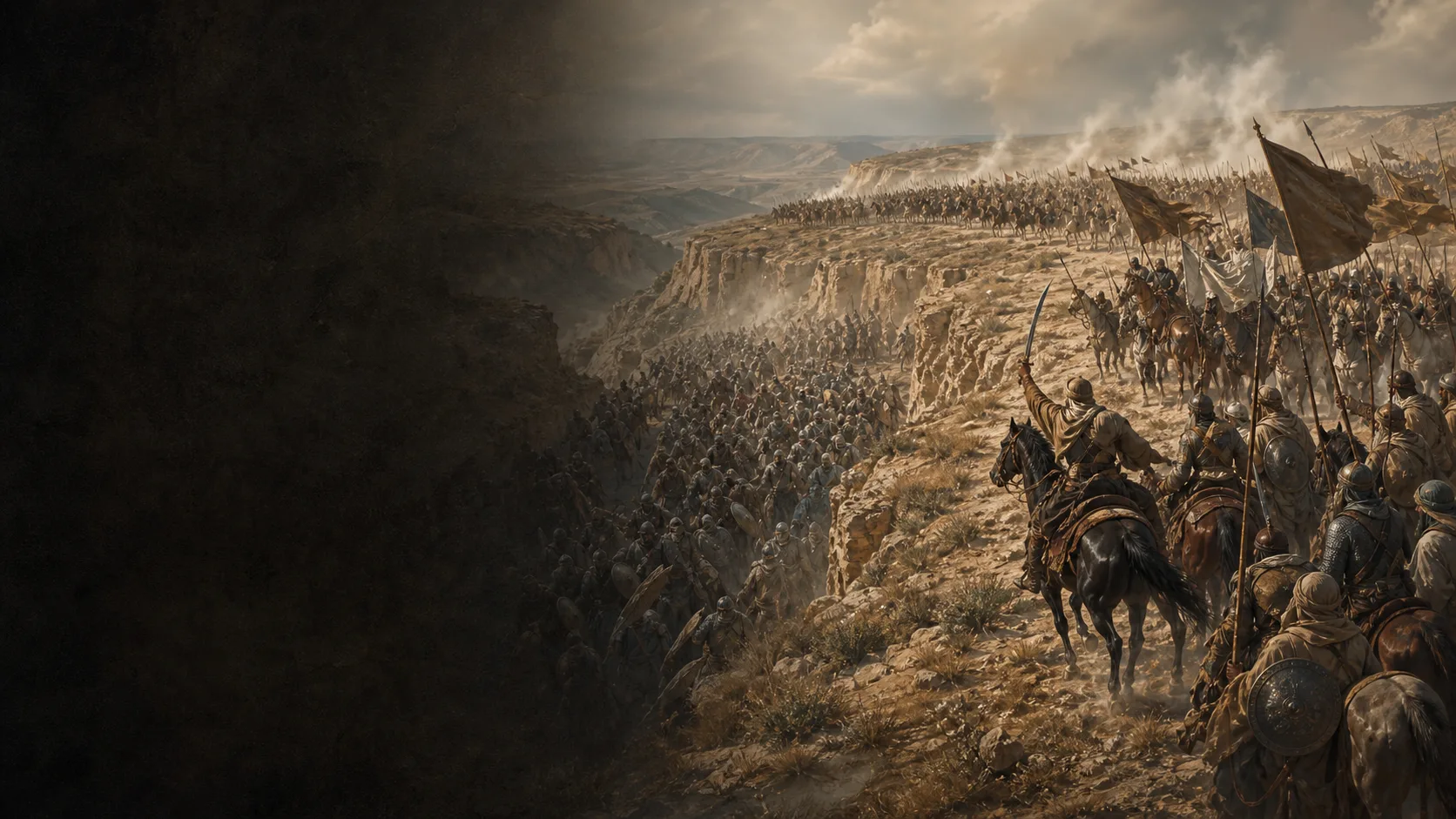
Yarmouk is the culmination of a campaign, not an isolated clash between two armies of known strength. A major Byzantine counteroffensive forces the caliphate's forces to evacuate positions in Syria and assemble near the Yarmouk. Prolonged fighting at times pushes the Arab wings back towards their camps; Khalid's cavalry reserve then intervenes in threatened sectors. In the final phase, capture of a crossing over the Ruqqad and attack on the camp make Byzantine withdrawal extremely dangerous in the ravines. Late Arabic sources provide figures and detailed episodes, but no complete reconstruction of the manoeuvres is secure.

A counteroffensive after the Persian war

After the Arab conquests of 634–635, Heraclius advances a composite imperial army towards Syria. Kaegi describes a Byzantine aim of pursuing and driving the Arab forces out of Syria, but the sources do not permit a detailed tactical plan to be assigned to every commander.

Retreat to choose a position

Arab forces evacuate Hims and Damascus, then withdraw from the Jabiya region towards a line near Adhri'at. This retreat is not yet final defeat: it assembles the contingents and places them in a zone whose ravines can constrain attack and, above all, exit.

A battle difficult to date and describe

The translation of al-Baladhuri dates the battle to 20 August 636; the six-day sequence comes from a modern reconstruction. Kaegi notes that the sources also speak of Jabiya-Yarmouk, that some intermediate dates are disputed, and that no contemporary Greek account describes the battle. The entry retains the month attested by the catalogue and qualifies the daily sequence.

Figures that imperfectly describe an army

Ancient accounts sometimes announce 24,000 Arab fighters, 200,000 Byzantines, or 70,000 dead; these numbers belong to narrative traditions and are not combined. Modern estimates remain disputed, to the point that Kaegi retains only a cautious order of magnitude for the imperial forces.

Military history

Sources

Specialist academic monographWalter E. Kaegi, Byzantium and the Early Islamic Conquests

Cambridge University Press, 1992, chapitre « Problems of cohesion » : pp. 120–123, « The principal events of the battle » ; pp. 134–136, « Byzantine objectives » et doctrine des camps ; pp. 138–141, manœuvres, réserve et piège ; pp. 143–145, forces, frictions et commandements ; pp. 149–150, sable et sources anciennes ; p. 155, portée stratégique et absence de récit détaillé. Le PDF consulté conserve la pagination imprimée.

Principal modern source for the campaign–concentration–attacks–bridge–pursuit chain, schematic topography, cohesion frictions, and limits of reconstruction.

View ↗
Academic encyclopaedia articleMichael J. Decker, « Yarmuk, battle of »

The Encyclopedia of Ancient History, article en ligne, résumé et bibliographie : absence de récit grec contemporain détaillé, absence de récit musulman contemporain conservé, traditions tardives imbriquées et impossibilité d'une reconstruction complète ; références à Donner, Howard-Johnston et Kaegi.

Historiographical framework, formulation of source uncertainties, decisive significance, and limits of strength figures.

View ↗
Late Arabic primary source, institutional translationAl-Baladhuri, The Battle of the Yarmuk and After

Internet Medieval Sourcebook, traduction de P. K. Hitti et F. C. Murgotten de Kitab Futuh al-Buldan, vol. I, pp. 207–211 : paragraphe « A description of the battle » pour le 20 août, les forces annoncées, les 24 000 combattants arabes et le chiffre traditionnel de 70 000 morts ; paragraphes finaux pour la date en Rajab 15 et les conséquences narratives.

Testimony of the Arabic tradition on date, narrative composition, and result; figures shown as disputed traditions, never as a count.

View ↗
Early Armenian primary source, critical translationSebeos, History, chapter 30, translation by Robert Bedrosian

Chapitre 30, PDF, pp. 123–126 : mobilisation d'Héraclius et force de 70 000, traversée du Jourdain, attaque d'un camp arabe, embuscades, retraite et ravins ; pp. 124–125 pour le rôle du camp et les pertes. Le passage est utilisé comme perspective chrétienne ancienne et contrôle de motifs, sans l'identifier mécaniquement à chaque épisode de Yarmouk.

Early non-Muslim source on mobilisation, camp, and collapse; useful testimony whose identification and details require caution.

View ↗
Institutional academic noticeEncyclopaedia Iranica, « Sebeos »

Sections sur la tradition manuscrite et la troisième partie de l'histoire : manuscrit tardif et attribution discutée ; pp. 135–137 de l'ouvrage pour les opérations de 636–640 ; remarques sur la fiabilité testable et les désordres chronologiques.

Provenance and status check of the Armenian testimony: attribution to Sebeos and each chronological order remain debated.

View ↗
Specialist military history, publisherDavid Nicolle, Yarmuk AD 636: The Muslim Conquest of Syria

Osprey Campaign 31, notice éditeur : description de la campagne de 633/634 à la chute de la Syrie byzantine ; table des matières « Origins of the Campaign », « Opposing Plans », « Campaign », « Aftermath and Reckoning » et « Battlefields Today », 96 pages, édition 1994.

Specialist bibliographic reference for the campaign, opposing plans, and topography; no numerical detail from the publisher's notice is extrapolated.

View ↗
Specialist article on Syriac sourcesUmut Can, « Battle of Yarmouk (636) in the Chronicle of 1234 »

The Journal of Mesopotamian Studies, vol. 3/1, 2018, PDF, pp. 1–3 : résumé et méthode ; pp. 5–8 : transmission, manuscrits, sources utilisées et comparaison annoncée des traditions. La chronique du XIIIe siècle est retenue pour l'histoire de la transmission, avec une fonction distincte de celle d’un témoignage contemporain.

Check of the plurality and chronological distance of Syriac traditions; caution against assuming the independence of detailed narratives.

View ↗

Edited by BattlesInMotion.com