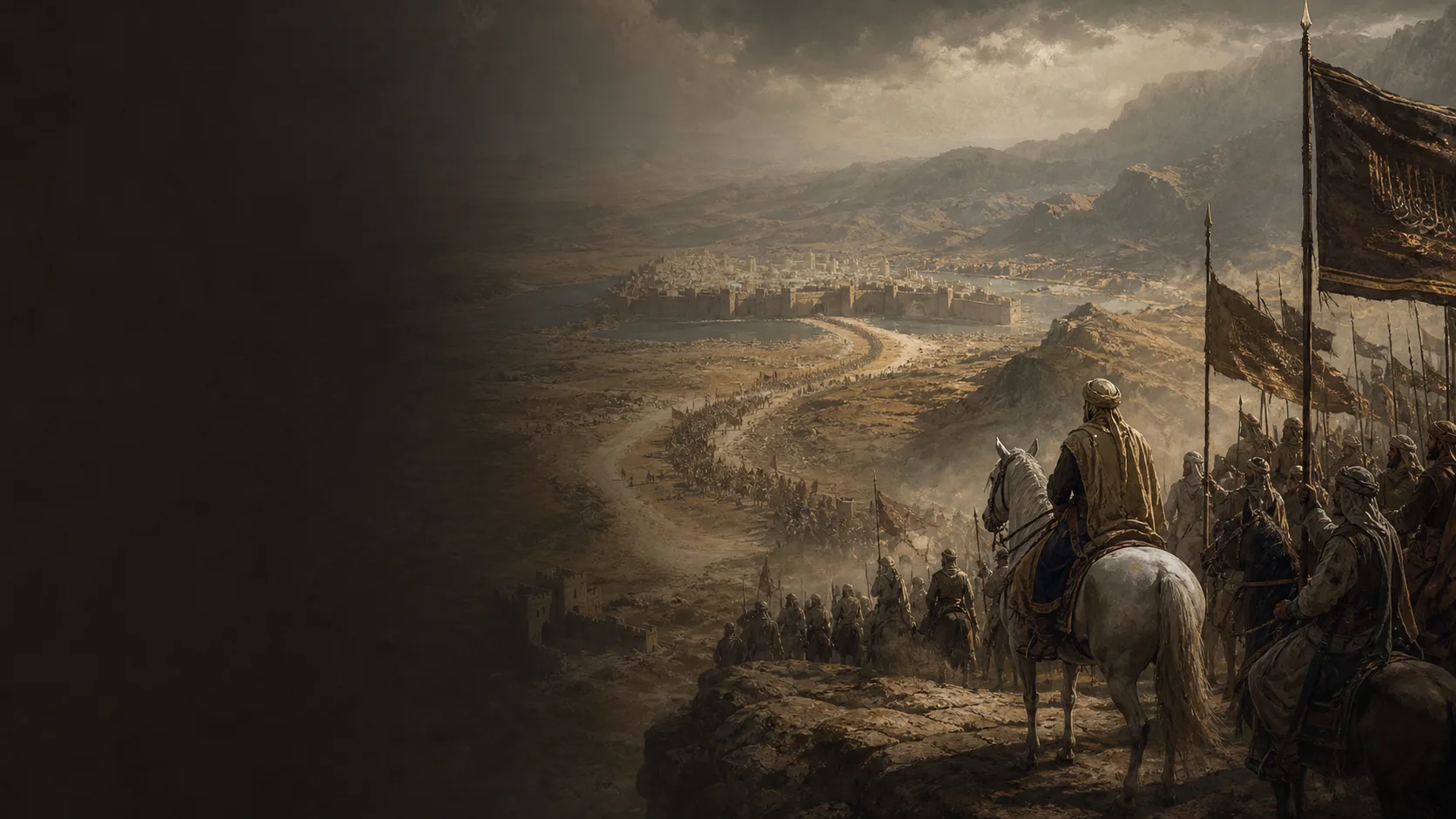
The first advances
Arab armies enter Syria along several axes, take strongholds and compel Byzantium to move one army after another into a theatre difficult to supply.
War
The conquest of Syria turns an imperial frontier into a new centre of power
Military history
The Arab conquest of Syria pits mobile armies against a Byzantine Empire emerging from long wars with Persia. Arab contingents do not win through speed alone: they exploit divisions in command, knowledge of roads and the ability to concentrate reserves in a theatre where the imperial army must protect several cities.
Arab armies enter Syria along several axes, take strongholds and compel Byzantium to move one army after another into a theatre difficult to supply.
Arab forces regroup their reserves and refuse to be destroyed separately. The battle drives the Byzantine army towards ravines and destroys its capacity for immediate reconquest.
Jerusalem and several Syrian centres negotiate or capitulate according to their circumstances. Control of roads and garrisons turns victory into a change of power.
Explore
Military history
Arab traditions on the campaigns, commanders and consequences of the conquest.
Critique of figures, Byzantine institutions and operational dynamics in Syria.
Chronology, armies, cities and political integration of conquered territories.
Internet Medieval Sourcebook, traduction de P. K. Hitti et F. C. Murgotten de Kitab Futuh al-Buldan, vol. I, pp. 207–211 : paragraphe « A description of the battle » pour le 20 août, les forces annoncées, les 24 000 combattants arabes et le chiffre traditionnel de 70 000 morts ; paragraphes finaux pour la date en Rajab 15 et les conséquences narratives.
Testimony of the Arabic tradition on date, narrative composition, and result; figures shown as disputed traditions, never as a count. Limited to the case of Yarmouk; this reference does not cover the whole conflict.
View ↗