Pressure and fragmentation
Saladin multiplies raids and limited sieges while the Crusaders must choose between defending towns, negotiating and gathering a relief army.
War
Hattin destroys the field army and opens the way to the strongholds
Military history
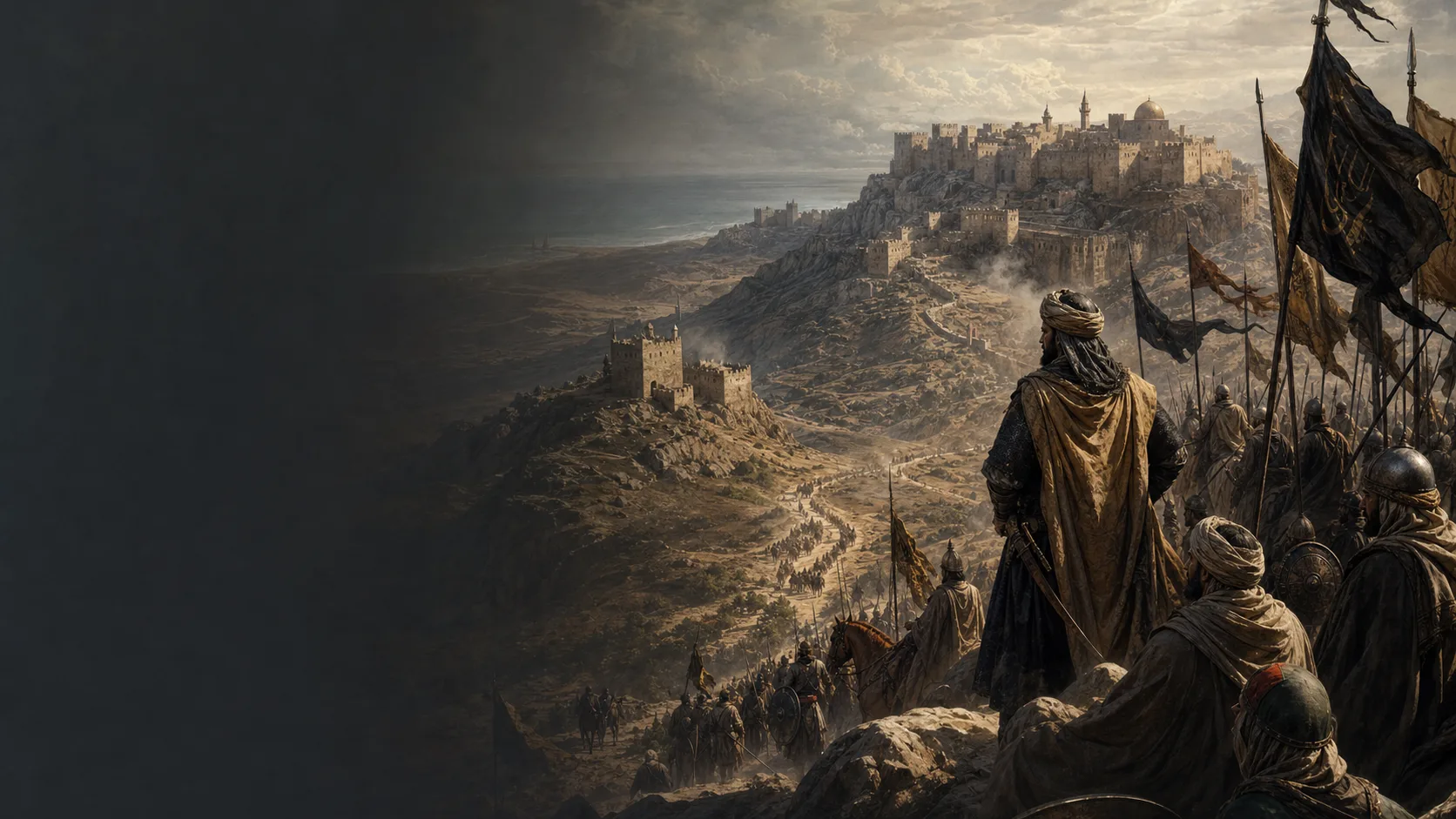
The 1187 dossier cannot be reduced to an abstract religious opposition. Saladin seeks to concentrate Ayyubid forces, control water and roads, then force the Kingdom of Jerusalem to commit its field army far from its bases. Hattin is the operational decision that leaves the strongholds vulnerable in the following months.
Saladin multiplies raids and limited sieges while the Crusaders must choose between defending towns, negotiating and gathering a relief army.
The Crusader army leaves a better-supplied position to reach Tiberias. Harassment, heat, smoke and lack of water gradually erode its cohesion.
After Hattin, Saladin captures or secures the surrender of several strongholds, then enters Jerusalem. The surviving Crusaders no longer have enough mobile force to reverse the campaign quickly.
Explore
Military history
Ayyubid chronology, the 1187 campaign, captives and consequences.
Armies, terrain, supply and the organization of Crusader campaigns.
Muslim perspectives, Saladin’s politics and the limits of heroic narratives.
§16–18 pour le départ du 3 juillet, le Wâdî Rûmâna, Maskana, les deux routes, la perte de l’eau, la déviation vers Kafr-Hattîn et le camp entre Lûbiyâ et Kafr Maskana ; §19 pour le camp ayyoubide de Lûbiyâ et son ravitaillement ; §20 pour le plateau basaltique au pied du Nimrîn, l’attaque concentrée sur l’arrière-garde, l’arrêt, la chaleur, le vent, les incendies et la fumée ; §21 pour l’attaque de Raymond, Taqi al-Din, la fermeture du couloir, le groupe de Balian et le repli de l’infanterie.
Chronology and causal reconstruction of July 3–4, place names, water and terrain constraints, fire and smoke, and the mechanism of Raymond's breakthrough. Limited to the case of Hattin; this reference does not cover the whole conflict.
View ↗