A protected but imperfect camp
Shuja’s camp lies south of the Ganges. A long earth wall protects its east-facing front; according to Srivastava, it ends before reaching the Thora. The southern gap and the wet ground shape the cavalry approach.
Battle
Two lines resist the outflanking move; capturing the strongpoints opens the centre and drives the defeated coalition towards the Thora.
Military history
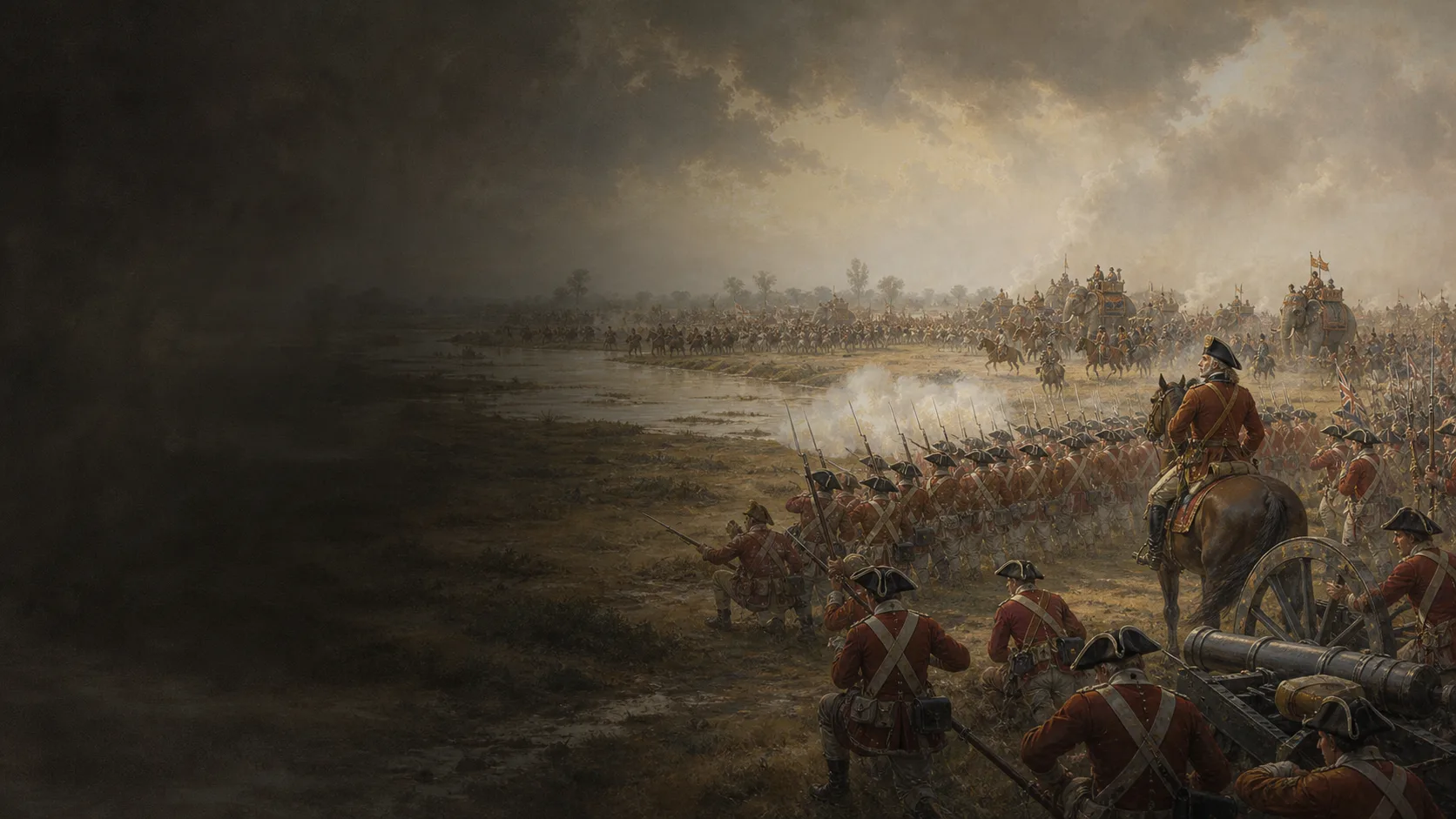
On 23 October 1764, Shuja-ud-Daula leaves his entrenchments in front of Buxar and surprises Munro, who had planned to let his army rest. The British form facing west, but a marsh hinders their advance and the opposing cavalry reaches their rear. Their two lines hold; sepoys take Ahiarauli, then Champion clears the grove. The allied centre falls into disorder, and the retreat converges on the Thora, where the loss of the bridge worsens the defeat. The political and fiscal settlement follows in 1765.
Shuja’s camp lies south of the Ganges. A long earth wall protects its east-facing front; according to Srivastava, it ends before reaching the Thora. The southern gap and the wet ground shape the cavalry approach.
During the night of 22–23 October, Munro plans a surprise attack through the gap between the wall and the Thora. The scouts sent to reconnoitre the route do not return in time. A council therefore decides to let the army rest on the 23rd and fight on the 24th; Shuja’s sortie on the morning of the 23rd imposes a different timetable.
The Company deploys two lines and reserves, with its baggage to the northeast. Awadh cavalry attacks the southern flank and rear, then turns to loot the stores. Later, the regular battalions and sepoys contest Ahiarauli and the grove.
Military history
Chap. VIII, ‘The battle of Baksar, 23rd October, 1764’, pp. imprimées 199–204 (PDF 212–217) : arrivée et camp, plan nocturne, espions, sortie et ordre britannique ; pp. imprimées 205–212 (PDF 218–225) : charges, grenadiers, bagages, Ahiarauli, batteries, bosquet/Najibs et centre. Chap. IX, pp. imprimées 218–219 (PDF 231–232) : fuite vers la Thora, petit reste passé avec Shuja et pont probablement effondré sous l’encombrement ; la note de p. 218 juge la version d’une rupture volontaire non soutenue par les autorités contemporaines. Srivastava cite aussi la lettre de Munro au Bengal Board du 25 octobre 1764 aux pp. 201–204.
Secondary synthesis and relay of contemporary accounts for the camp's geometry, the plan, the sortie on the 23rd, named actions, and retreat sequence; it is not treated as a primary source.
View ↗British Library, India Office Records and Private Papers, Mss Eur F218/3 : notice de catalogue pour les papiers 1763–1765, dont ‘an account of the battle of Buxar by Maj Hector Munro (1764)’. Le dossier n’est pas numérisé ; aucun détail du manuscrit lui-même n’est revendiqué ici.
Establishes only the existence, author, date, and archival scope of the contemporary account identified by the catalogue; the manuscript was not consulted.
View ↗Pages imprimées 129–132 (PDF164–165,168–169) ; plan PDF163. p.129 : origine du plan et absence de Mir Qasim ; p.130 : deux lignes ; p.131 : charges, bagages, repli et version d’une destruction volontaire du pont.
Control source for the two echelons, charges, baggage, grove fighting, and logistical retreat.
View ↗Plan non paginé, PDF163 de l’article, avant p.129 : Gange, Buxar, Thora et deux lignes approximatives. La notice p.129 précise un croquis fondé sur Malleson et les cartes du temps de Cosson ; les voies ferrées et le canal modernes ne sont pas reproduits dans la carte de 1764.
Regional orientation and the relationship between the two fronts. The incomplete wall and bridge are established by accounts, not by a detailed survey on this plan.
View ↗p. 26, section ‘Engagement at Buxar’ : arrivée le 22 octobre, combat le lendemain, vingt pièces de campagne et parc capturé ; édition numérisée de 1852.
Order of magnitude for the Company, artillery, disagreement over the date, and loss of the park; the link points directly to the actual PDF.
View ↗pp. 304–306, sections ‘The first sepoy mutiny, 1764’, ‘Battle of Buxar, October 23, 1764’ et ‘Arrangement with the emperor’.
Context for the mutiny, Munro's march, defeat, loss of the park, and progression toward the 1765 settlement, with caution over its imperial vocabulary.
View ↗Cambridge University Press, chap. 1, pp. 1–47, et chap. 4, pp. 93–136 : domination militaire, arrangements politiques et règlement de 1765.
Separation among victory at Buxar, political negotiation, and the gradual construction of Company fiscal authority.
View ↗Sections ‘Dominance’ et ‘Armies’ : Buxar en 1764, ordre de grandeur des forces de la Compagnie et droit de lever les taxes en 1765.
Institutional check on orders of magnitude and the fiscal scope of the settlement.
View ↗Entrée ‘Battle of Buxar (1764)’ : ordres de grandeur de la force de la Compagnie, fourchette des forces adverses et variation des bilans.
Independent check on estimates. Using it to impose a precise human total would exceed the documentary role retained here.
View ↗Inde, XVIIIe siècle ; 32.75.298a,b ; acier, argent, cuir.
Equipment type shown in the illustration; it does not prove an Awadh uniform in 1764 or the use of this specific object at Buxar.
View ↗Kutch, XVIIIe–XIXe siècles ; 36.25.647 ; peau de buffle, alliage cuivreux, polychromie.
Equipment type shown in the illustration; it does not prove an Awadh uniform in 1764 or the use of this specific object at Buxar.
View ↗