1. Home
  2. Gunpowder & Empires
  3. British Conquest of Bengal
  4. Plassey

Battle

Plassey

23 June 1757

A brief fight, a court coalition already fractured

Military history

How did a small Company force exploit a fractured court coalition to overturn power in Bengal?

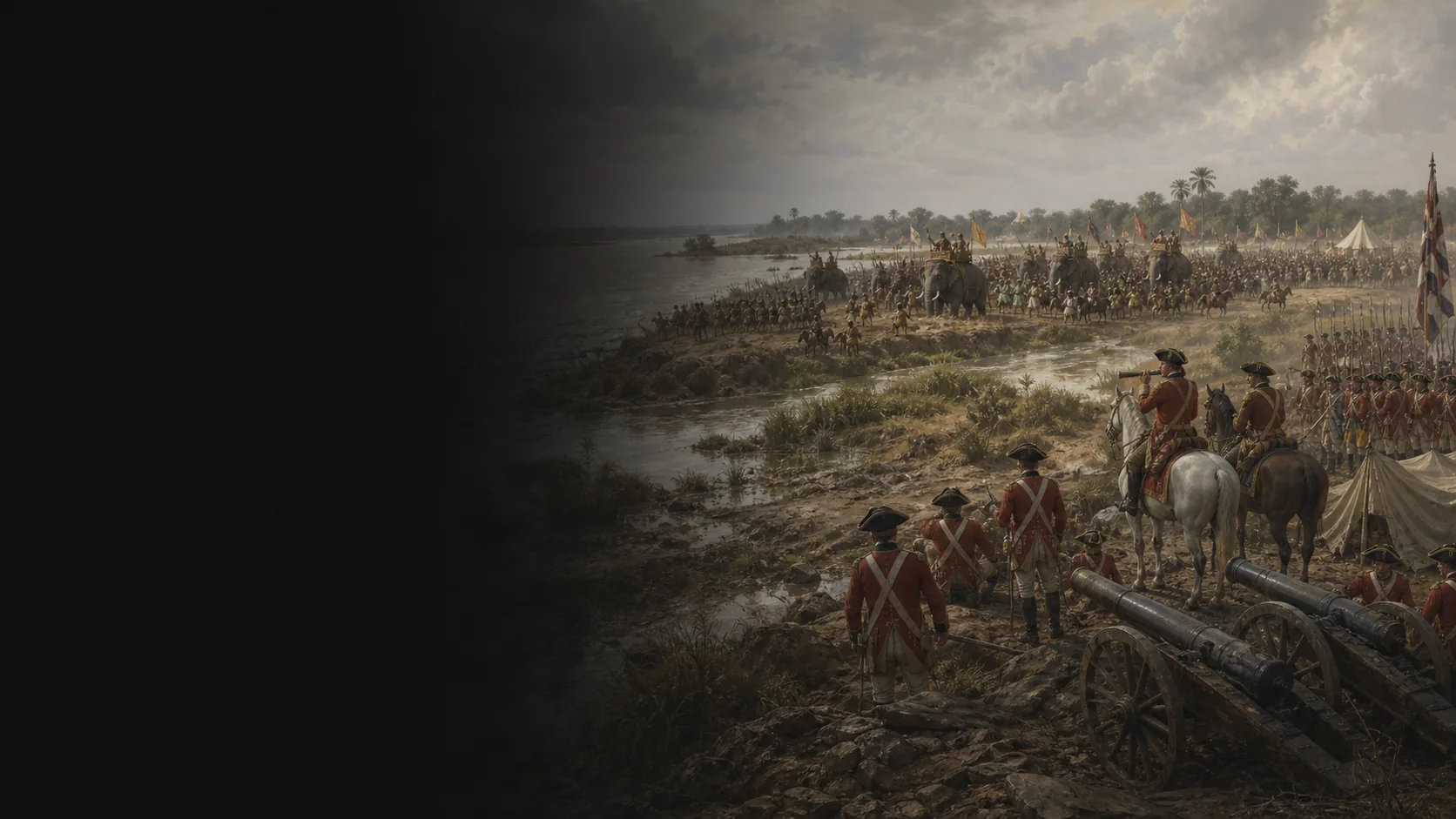
On 23 June 1757, the East India Company confronts at Plassey a much larger army of the nawab, already riven by a succession crisis. Robert Clive holds the mango grove through a prolonged cannonade. After the downpour and the enemy artillery’s withdrawal toward its camp, a British detachment with two guns occupies the embankments of a reservoir; the Company then exploits the disintegration of a coalition in which contingents linked to Mir Jafar do not engage. The battle thus becomes a court revolution. Military losses are limited, while fiscal control is constructed later, notably with the grant of the diwani in 1765.

The battle emerges from a court crisis

After the recapture of Calcutta and seizure of Chandernagore, Clive and financial actors at court seek an arrangement against Siraj ud-Daulah. Secret commitments in favor of Mir Jafar precede 23 June: they do not prove that every contingent received the same orders, but they reduce the political risk of a Company defeat.

A small army facing an uncertain mass

Clive’s report gives about 1,000 Europeans, 2,000 sepoys, and eight guns; the National Army Museum uses about 800 Europeans, 2,100 sepoys, ten guns, and two howitzers. For the nawab, Clive claims 15,000 cavalry, 35,000 infantry, and more than forty guns, while the museum gives roughly 50,000 men and fifty pieces. These figures do not measure exactly the same scope.

The terrain gives fire time

The Bhagirathi, mango grove, and embankments around a reservoir structure the scene. The grove and its banks provide relative shelter for the Company force during the artillery duel; a British detachment can then occupy an advanced position. The map retains this relationship without claiming a modern survey of the site.

A military victory insufficient by itself

The break on 23 June is brief, and British losses remain low in Clive’s account; the decisive effect lies more in the nawab’s retreat, abandoned guns, and change of power than in annihilating his army. Revenue rights granted to the Company in 1765 show the interval between the court revolution and fiscal consolidation.

Military history

Sources

Contemporary primary source, Robert Clive’s reportSir Robert Clive: The Battle of Plassey, 1757

Oliver J. Thatcher (éd.), The Library of Original Sources, vol. VII (1907), p. 59–64 ; premiers mots des paragraphes : « About this time some of his principal officers », « The 22nd, in the evening », « At daybreak », « About noon the enemy drew off », « We immediately sent a detachment » et « On this a general rout ensued ».

Operational chronology, stated composition of the Company force, estimate of the nawab’s army, explicit sequence of artillery withdrawal followed by the detachment to the reservoir, capture of the camp, and Clive’s casualty account; identified as a partisan source.

View ↗
Institutional source, military museumThe Battle of Plassey

National Army Museum, rubriques « Regime change », « The armies », « The battle », « Storm of fire » et « Imperial power » ; passages sur les effectifs, l'averse et les bâches, le refus de Mir Jafar, les pertes et le diwani de 1765.

Institutional cross-checking of the sequence and political significance; formulations concerning the downpour, Mir Madan’s death, and losses are retained with their appropriate caution.

View ↗
Specialist study and edited contemporary sourcePlassey: A New Account from the Danish Archives

The Journal of Asian Studies, vol. 19, no 2 (1960), p. 177–187 ; « Extract » et notes 5, 6, 8, 9, 11 et 13–18, notamment la note 6 sur l'épisode Kilpatrick absent de Wood et la note 11 sur l'averse de quinze minutes.

Contemporary testimony independent of Clive’s letter, nuances on the downpour and figures, and distinction between Wood’s account and the Kilpatrick/Clive tradition.

View ↗
Specialist academic synthesisBattle of Plassey, 1757

Oxford Bibliographies, « Introduction », premiers mots des paragraphes : « The battle of Plassey was fought » et « Despite the volume of ink » ; notice mise en ligne le 23 mars 2023.

Historiographical framing, caution about inevitability and responsibility, and comparison of casualty orders of magnitude.

View ↗
Specialist academic monographBengal, 1757–67: Crossing the Threshold and Becoming a ‘Country’ Power

Chapitre 5, p. 153–185, « Summary », premiers mots du paragraphe : « On handing Mir Jafar to the musnud on 1 July 1757 » ; utilisé comme borne stratégique, avec une fonction distincte de celle d’une preuve de détail tactique.

Strategic boundary between Mir Jafar’s installation, the rhetoric of returning to trade, and later construction of territorial and fiscal power.

View ↗
Specialist historiographical studyWie oft wird Plassey noch geschlagen? 250 Jahre Schlacht von Plassey

Südasien, vol. 27, no 3 (2007), p. 97–99, section « Plassey und Baksar » et conclusion de l'article ; effectifs, inaction de Mir Jafar, changement de nawab et séquence Buxar-diwani.

Historiographical disputes and a guard against a teleological account of British conquest.

View ↗
Institutional archive, Robert Clive PapersRegisters of ‘Country Correspondence Letters Received & Sent’

National Library of Wales, Robert Clive Papers, série CR8, « Registers of ‘Country Correspondence Letters Received & Sent’ », description du registre 1756–1758 et de ses 538 résumés ; mentions des traités de mai et de la bataille de juin 1757.

Archival grounding for negotiations and political chronology; the register does not replace reading every letter.

View ↗
Institutional plan and collection objectPlan of the Battle of Plassey, 1757

National Army Museum, accession NAM. 1964-11-65-1, notice « Plan of the Battle of Plassey, 1757 », description de l'objet sous le titre ; image de collection associée.

Institutional cartographic check on relative landmarks; used as a collection plan, not a georeferenced survey.

View ↗
Older military synthesis, critical traditionG. B. Malleson, The Decisive Battles of India from 1746 to 1849, Chapter III — Plassey

Chapitre III, p. 62–65 imprimées pour l'averse, Mir Madan, l'ordre de retraite, l'initiative attribuée à Kilpatrick et le soutien de Clive ; p. 65–67 pour le réservoir, la poursuite du combat et l'inaction de Mir Jafar.

Later military tradition concerning the rain–Mir Madan–withdrawal sequence and Kilpatrick/Clive initiative; compared with Clive’s report and John Wood. Treating it as eyewitness evidence would exceed its documentary use here.

View ↗

Edited by BattlesInMotion.com