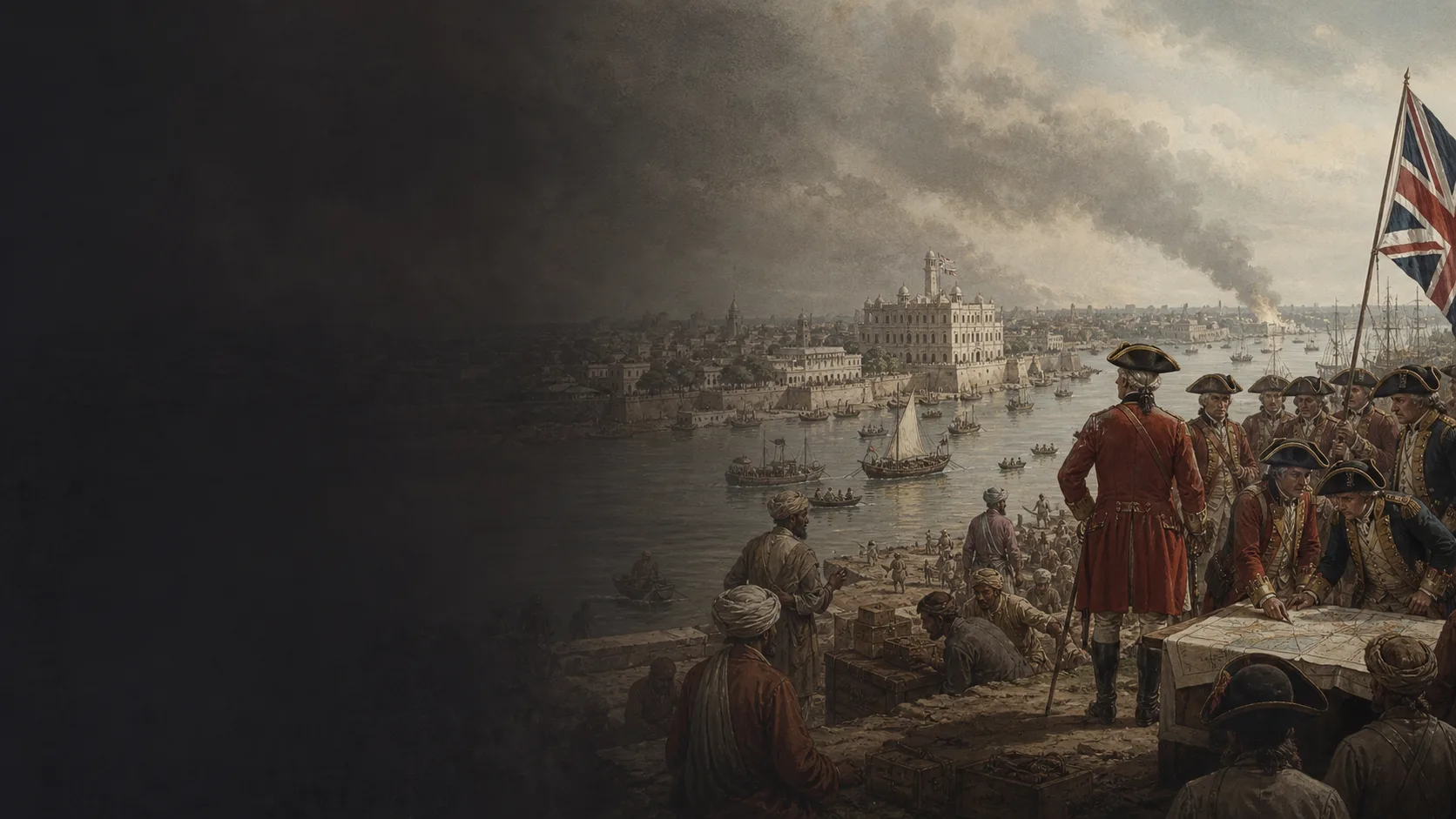
Plassey and the shift in alliances
The Company exploits divisions at the Bengal court and wins a victory whose political effect exceeds the fighting actually delivered.
War
A company victory becomes fiscal sovereignty
Military history
The British conquest of Bengal cannot be reduced to Plassey or Buxar. The East India Company turns alliances, trained troops and a commercial position into political power, then into control of revenue. Buxar matters because it confirms on the battlefield a balance of power prepared by treaties and local rivalries.
The Company exploits divisions at the Bengal court and wins a victory whose political effect exceeds the fighting actually delivered.
The nawab seeks to restore military and fiscal autonomy. The break with the Company gathers several opponents, but their objectives remain hard to coordinate.
The victory at Buxar gives the Company a superior military and diplomatic position. The ensuing treaty grants it the collection of revenue in Bengal, Bihar and Orissa.
Explore
Military history
The Company’s correspondence, dispatches and administrative decisions.
Institutions, finance, alliances and the transformation of power in Bengal.
Actors, political violence and the transition from commercial company to territorial power.
Chap. VIII, ‘The battle of Baksar, 23rd October, 1764’, pp. imprimées 199–204 (PDF 212–217) : arrivée et camp, plan nocturne, espions, sortie et ordre britannique ; pp. imprimées 205–212 (PDF 218–225) : charges, grenadiers, bagages, Ahiarauli, batteries, bosquet/Najibs et centre. Chap. IX, pp. imprimées 218–219 (PDF 231–232) : fuite vers la Thora, petit reste passé avec Shuja et pont probablement effondré sous l’encombrement ; la note de p. 218 juge la version d’une rupture volontaire non soutenue par les autorités contemporaines. Srivastava cite aussi la lettre de Munro au Bengal Board du 25 octobre 1764 aux pp. 201–204.
Secondary synthesis and relay of contemporary accounts for the camp's geometry, the plan, the sortie on the 23rd, named actions, and retreat sequence; it is not treated as a primary source. Limited to the case of Buxar; this reference does not cover the whole conflict.
View ↗