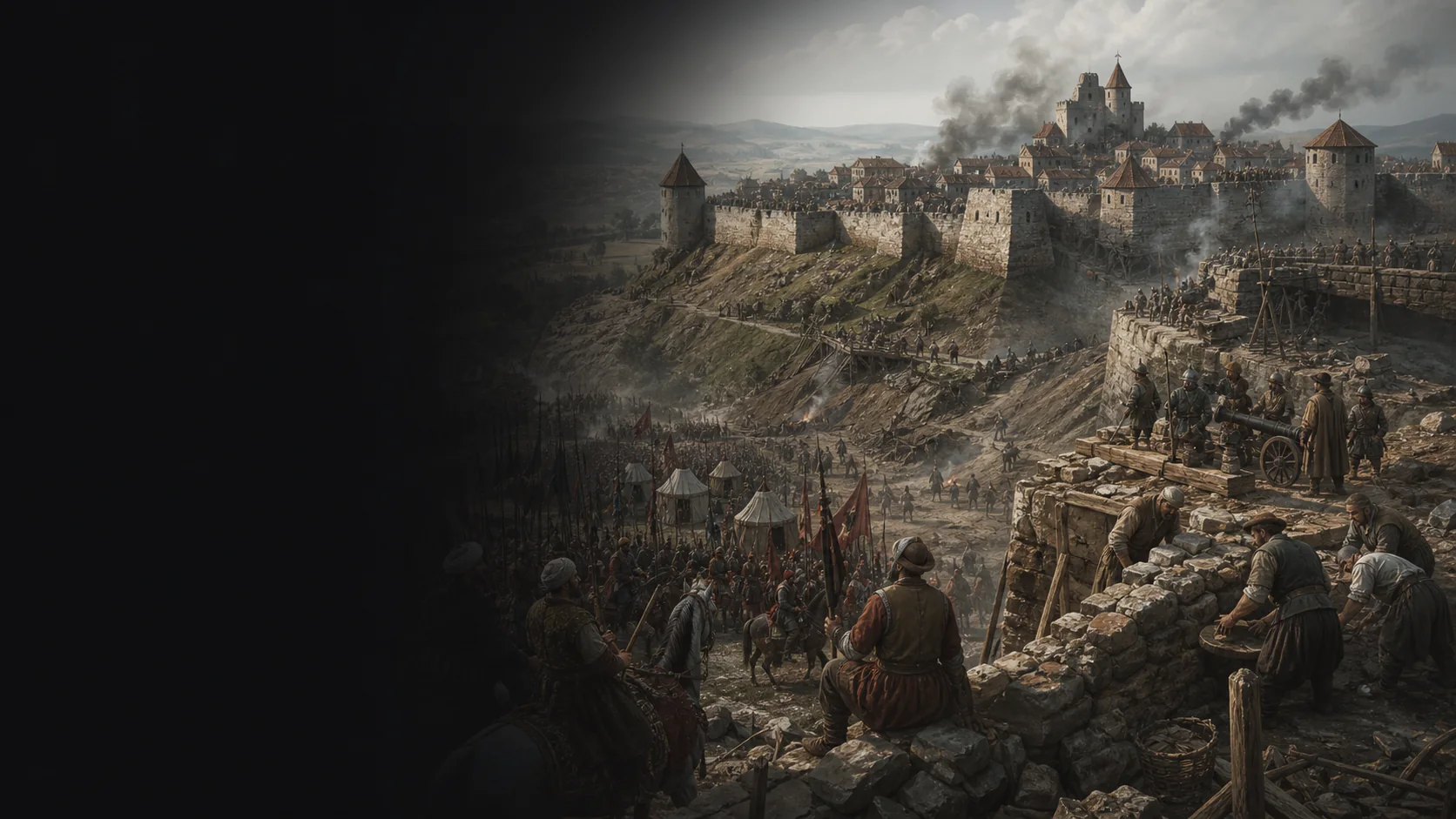
Breaches, works, and reliefs prevent an Ottoman investment from becoming a capture
Military history
How did Eger’s garrison turn Ottoman breaches, mines, and assaults into a campaign failure?
At Eger, the besiegers must capture two enclosures linked by an inner passage. Batteries damage the walls, siege works bring infantry closer, and mines threaten the gates. Under pressure, the garrison shifts men, countermines and repairs the defences. The major assaults of 29 September and 12–13 October gain no lasting entry. When the Ottomans withdraw, the fortress remains in defenders’ hands but is devastated: their letter of 19 October requests more soldiers, equipment and ammunition.
The last fortress on the northern road
After Temesvár, Lippa, and Szolnok, the Ottoman expedition targets Eger, the gateway to Upper Hungary and its mining towns. The Hungarian institutional summary describes Kara Ahmed as commander of the operation, with Sokollu Mehmed and Ali of Buda in the theater. Arrival dates for the three groups vary; the architectural study places them between 9 and 15 September.
Two enclosures, one dividing space
The fortress extends along a north–south ridge and is divided by a wall into an inner and outer castle. Sede Regia dominates the north, Almagyar lies to the east, and the town to the south; the central trench and gates prevent a breach of the outer works from becoming automatic entry into the inner core.
The siege is won through the works
The Ottoman batteries do not fire from a single front: they are distributed north, west, east, and south according to the faces targeted. Fascines, timber, sacks, and wet coverings fill the trenches; defenders monitor vibrations, dig toward the galleries, and use fire, hooks, missiles, and obstacles to interrupt the crossing.
The season bears on exploitation
Martinengo’s reports are informed but incomplete: they report repulsed assaults, a burned zone around the castle, exhaustion, and rumors of disease. Ottoman narratives stress cold, rain, provisions, and the army’s condition. These factors limit the time available for another assault; they do not replace local resistance as the explanation for the outcome.
Contemporary primary source, verse chronicleSebestyén Tinódi, Eger vár viadaljáról való ének história
Édition numérique MEK, sections Eger de l’œuvre, vers 81–196 pour relief, ville, deux châteaux et bastions; vers 594–815 pour camps, batteries et approches; vers 819–914 pour l’assaut du 29 septembre; vers 919–1275 pour l’explosion, les sorties, fascines, engins et contre-mines; vers 1392–1649 pour les assauts des 12–13 octobre et le retrait.
A firsthand narrative source or one very close to participants; its heroic composition and casualty figures remain limitations rather than a neutral register.
Contemporary primary document, military letterLettre des commandants d’Eger à Tamás Nádasdy, 19 octobre 1552
Régi magyar levelestár XVI–XVII. század, entrée 13, lettre datée d’Eger le 19 octobre 1552: fin du siège, état ravagé de la forteresse, pertes, manque de garnison, poudre, armes et munitions.
The immediate result and material needs after withdrawal; the letter is interested and does not provide a complete account of both armies.
Ottoman primary source in a scholarly editionLütfi Pacha, récit d’Eger dans Török történetírók II
Édition József Thúry (1896), PDF p. 38 imprimée: paragraphe commençant par « Azután Égre nevű várhoz mentek », siège prolongé, saison devenue impropre, effort sans résultat et départ de l’armée.
Ottoman tradition on the withdrawal and seasonal constraint; modern edition of a retrospective account. Treating it as a siege journal would exceed its documentary use here.
Ottoman primary source in a scholarly editionCelâlzâde Mustafa, récit d’Eger dans Török történetírók II
Édition József Thúry (1896), PDF pp. 271–272 imprimées, paragraphe commençant par « Mivel a szerencsétlen királynak »: canons, défenseurs, froid, pluie, neige, vivres, animaux et retrait.
Ottoman counterpoint on siege conditions; its durations and rhetorical formulations are not merged with Tinódi.
Institutional archival sourceH. Németh István, Az egri vár védői, 1552, Magyar Nemzeti Levéltár
Page officielle MNL, paragraphes 43–61: distinction entre roman et archives, cotes E 554, espions, zsoldjegyzékek, environ 1 800 soldats et 270 réfugiés; paragraphes 75–89 pour les suites documentées de Dobó, Bornemissza et Mekcsey.
Archival checks on strengths and criticism of literary memory; the institutional page also repeats high Ottoman figures that this account does not treat as secure.
Official source of historical memoryNemzeti Archívum, Eger hősei és krónikása
Page officielle, lignes 10–18: campagne de 1552, commandement ottoman, chute de Szolnok, 40–50 000 dans le résumé, environ 2 000 défenseurs, grands assauts des 29 septembre, 12 et 13 octobre, retrait du 17 octobre.
Public chronology and institutional cross-checking of the three major assaults; a heritage summary, not an independent source for every figure.
Specialist academic article, military and architectural historyGizella Nemeth et Adriano Papo, La fortezza di Eger nel XVI sec.: l’assedio del 1552
PDF QV 2021, pp. 11–13 pour crête, ville, Sede Regia, Almagyar, deux châteaux, mur médian et fossés; pp. 18–19 pour artillerie, effectifs intérieurs et chiffres ottomans; pp. 20–23 pour batteries, assauts, fascines, travaux, mines et retrait; pp. 26–27 pour l’abstract et les bornes de synthèse.
Principal specialist source for relational topography, sequence of works, and criticism of strengths; a modern reconstruction checked against older sources.
Peer-reviewed academic article, study of contemporary sourcesViktor Kanász, Nuncio Girolamo Martinengo’s reports on the military events of 1552
PDF, pp. 17–19: nouvelles des 2, 9 et 16 octobre, assauts repoussés, terre brûlée autour du château, épuisement, rumeur de maladie, murs détruits mais refus de capituler et retrait; pp. 19 et 25 pour l’examen de l’exactitude variable des rapports.
Contemporary diplomatic framing and informational limits: reports are often accurate, but some intelligence is false or delayed.
PDF pp. 2–5, pages imprimées 478–481: proximité informative et cadrage héroïque de Tinódi, rôle de Mekcsey dans la contre-mine et limites d’une lecture de la victoire par l’artillerie ou l’engin de Bornemissza seul.
A critical counterweight to the heroic narrative and a check on the division of roles among command, works, and devices.
Historical plan published in an academic cartographic synthesisOttavio Baldigara, plan des fortifications d’Eger, 31 mars 1572
The History of Cartography, vol. 3, partie 2, chapitre 61, p. 1846, fig. 61.19: plan manuscrit du Kriegsarchiv et commentaire sur l’adaptation des bastions au relief; plan postérieur de vingt ans au siège.
Checking spatial relationships and guarding against a false map; not used to locate the batteries of 1552 precisely.