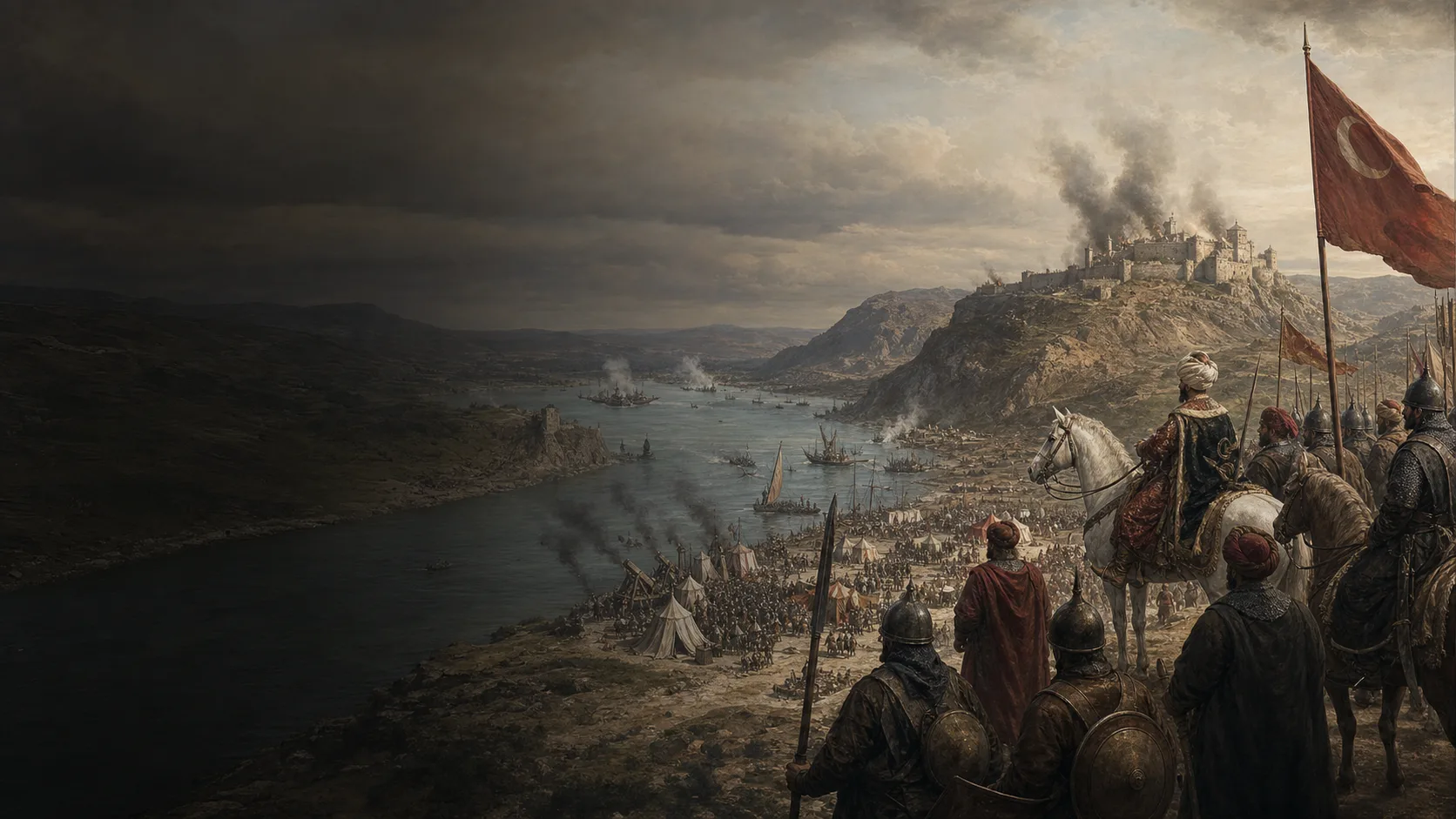
Pressure on the frontier
The fall of Belgrade and the weakness of Hungarian defences make the next great Ottoman expedition foreseeable without the kingdom being able easily to gather a coalition.
War
A Danubian frontier where Ottoman depth overwhelms Hungarian decision
Military history
The Ottoman–Hungarian Wars pit an empire able to organize large expeditions against a frontier kingdom that must defend strongholds, mobilize quickly and secure outside aid. Mohács is a brief decision because the Hungarian army commits its shock before its reserves and allies can alter the balance of forces.
The fall of Belgrade and the weakness of Hungarian defences make the next great Ottoman expedition foreseeable without the kingdom being able easily to gather a coalition.
Suleiman advances with an army in depth and substantial artillery. Louis II gathers a smaller force that must choose between waiting and letting the plain open.
After Mohács, the succession divides Hungary among the Habsburgs, Hungarian powers, and the Ottoman Empire. The struggle shifts to the fortresses: Eger resists in 1552, while Szigetvár falls in 1566. The 1568 Peace of Adrianople provisionally stabilizes this frontier.
Explore
Military history
Ottoman perspective on Suleiman’s campaign and the victory at Mohács.
Artillery, imperial organization and the context of the Hungarian campaign.
Fortifications, taxation and comparison of European and Ottoman military systems.
Document HTML, sections « A csata előkészületei » et « 1526. augusztus 29. » : deux colonnes, artillerie derrière la première ligne, relief/Földvár, première attaque, retraite dans la vallée et conclusion sur la durée d’environ une heure et demie.
Relative terrain, Hungarian order of battle, waiting, initial attack, fire, rupture, flight and death of Louis II; source read with Kasza’s critical reservations. Limited to the case of Mohacs; this reference does not cover the whole conflict.
View ↗Article du 8 septembre 2022, deux premiers paragraphes : campagne de 1552, siège d’Eger et stabilisation provisoire par la paix d’Andrinople de 1568.
Context for the fortress war, Eger’s resistance in 1552, and the provisional stabilization of the frontier in 1568. This notice alone does not document all operations from 1521 to 1568.
View ↗Article du 3 septembre 2012, mis à jour le 7 septembre 2017 ; récit de la campagne et de la prise de Szigetvár, accompagné de lettres d’archives.
The 1566 campaign, siege, and fall of Szigetvár. This reference is limited to this case and its immediate context.
View ↗