1. Home
  2. Gunpowder & Empires
  3. Ottoman–Hungarian Wars
  4. Siege of Szigetvár

Battle

Siege of Szigetvár

5 August — 8 September 1566

Four islands, a dyke, and a month of attrition before the final sortie

Military history

How did water and four enclosures prolong Szigetvár's defence until Ottoman works crossed the mud?

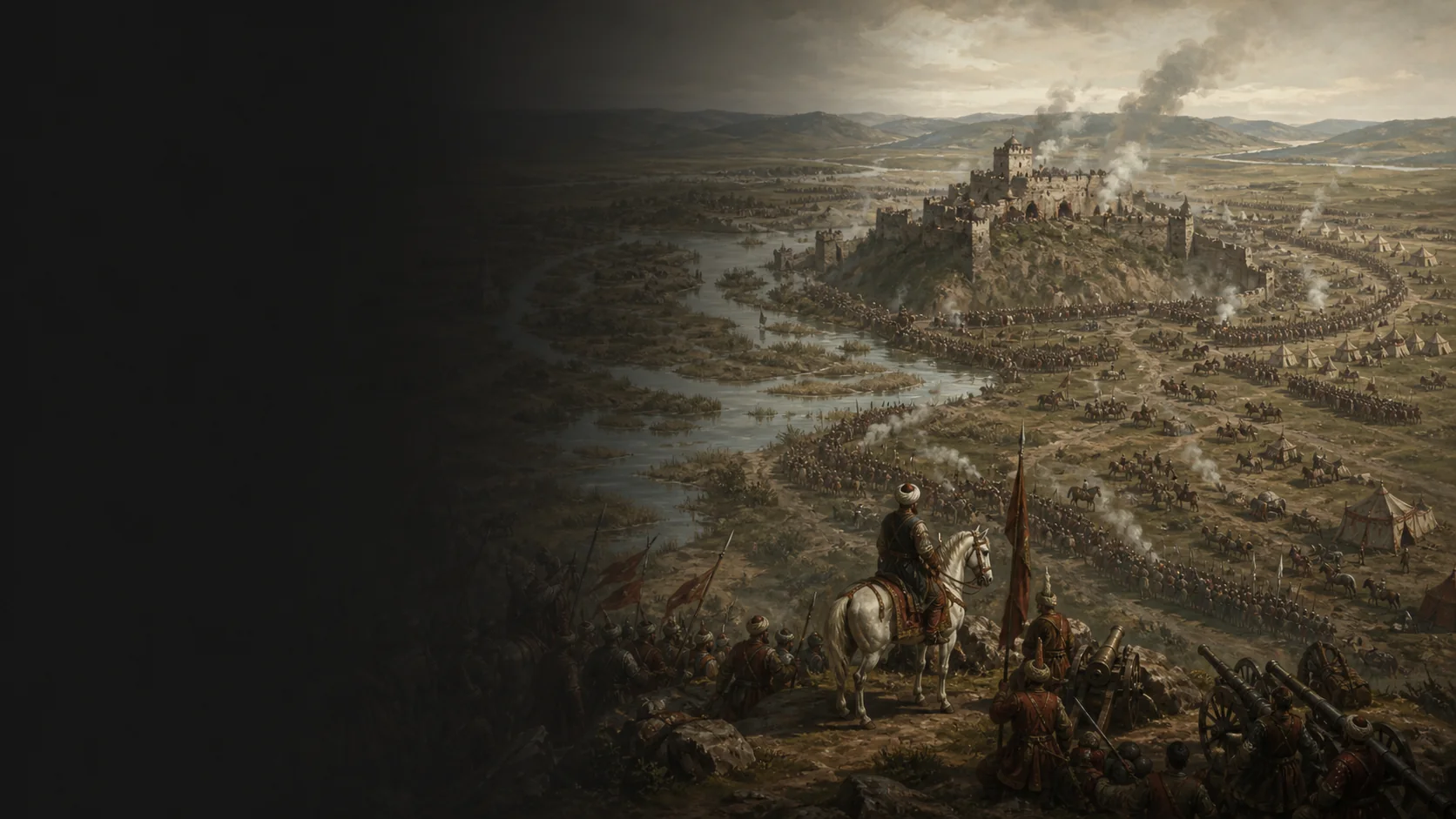
Szigetvár was not a single enclosure: the New Town, Old Town, outer castle, and inner castle formed four spaces linked by bridges and surrounded by ditches, water, and marshes fed by the Almás. In 1566, Nikola IV Zrinski held this system with about 2,300–2,500 armed men, while the Ottoman army had at least 50,000 men to close the ring, build works, move its batteries closer, and reduce the spaces one after another. The defence held because every retreat could still rest on another enclosure; it collapsed when the dyke was cut, the mud became a construction site, the outer castle burned, and the inner redoubt lost its resources. Süleyman's death, concealed by Sokollu, did not halt the assault. Zrinski's sortie ended organised defence, but the fortress remained a costly Ottoman victory.

A campaign lock

The 1566 campaign targeted at minimum Szigetvár and Gyula, which protected Ottoman communications in southern Hungary. The Habsburg army assembled near Győr did not launch a relief capable of clearing the fortress; the garrison therefore had to draw endurance from the site and its own supplies.

Water is military architecture

The sources describe four distinct sections. Ditches around the New and Old Towns received water from two branches of the Almás; a western dyke about 520 metres long retained part of it and created a lake and marshes. The system channelled approaches but depended on a work that labourers could reach and cut.

Depth buys time

The defenders could burn or abandon one space and move to the next, but each retreat left guns, food, and works to the attackers. Initial strength and the numbers surviving within each enclosure remain estimates; no relief army converted this depth into a counteroffensive.

Military history

Sources

Academic synthesis articlePál Fodor, « Szigetvár 1566. évi ostroma: az előzményektől a következményekig », Magyar Tudomány 177/9 (2016) — campagne

Pagination imprimée pp. 1041–1044 : contexte de la campagne, fonction stratégique de Szigetvár, objectifs Szigetvár–Gyula et limites de la lecture rétrospective d’une marche directe sur Vienne.

Establish campaign objectives, the role of communications, and the strategic scope of the conquest.

View ↗
Academic synthesis articlePál Fodor, « Szigetvár 1566. évi ostroma: az előzményektől a következményekig », Magyar Tudomány 177/9 (2016) — siège

Pagination imprimée pp. 1044–1046 : investissement achevé le 5 août, arrivée personnelle de Süleyman et perte de la Nouvelle Ville le 9, 2 300–2 500 défenseurs, environ 4 500 personnes, Vieille Ville, bombardement et assauts de fin août, mine et feu des 2–5 septembre, mort et sortie du 7, armée habsbourgeoise à Győr et conséquences.

Fix the causal chronology, orders of magnitude, absence of relief, and immediate consequences.

View ↗
Historical and archaeological studyErika Hancz, « Szigetvár az 1566. évi török hadjárat idején. A vár és a város történeti és régészeti kutatásai » (2013) — sources et topographie

Pagination imprimée pp. 149–153, surtout pp. 151–152 : critique des chroniques ; quatre parties sur environ un kilomètre ; deux branches de l’Almás ; digue de 7,5–8 m sur environ 520 m ; lac, marais, fossés et ponts.

Reconstruct the 1566 site, bound the minimum Ottoman strength, and distinguish families of sources.

View ↗
Historical and archaeological studyErika Hancz, « Szigetvár az 1566. évi török hadjárat idején » (2013) — enceintes et réduction

Pagination imprimée pp. 153–155 : ouvrages de bois, clayonnage et terre ; Nouvelle Ville attaquée dès le 7 ; digue coupée le 11 ; remblais le 17 ; brèche de la Vieille Ville vers le 19/21 ; pont d’environ 160 m ; assauts des 26 et 29 ; bastion et feu final avec traditions divergentes.

Chronology of sequential reduction and representation of vulnerabilities without projecting the present castle backward.

View ↗
Source close to the events, Croatian reissueFerenac Črnko, Povijest Segeta grada, réédition préparée par Ante Šimčik — investissement et villes

Pagination imprimée pp. 25–28 du volume numérisé : quatre espaces, environ 2 300 hommes armés, investissement des 5–6 août, travaux du 7, bombardement du 8 et incendie/repli de la Nouvelle Ville le 9.

Reconstruct the besieged side's perception and first withdrawal sequence with transmission caveats.

View ↗
Source close to the events, Croatian reissueFerenac Črnko, Povijest Segeta grada, réédition préparée par Ante Šimčik — chaussées, mine et repli final

Pagination imprimée pp. 30–32 : tirs du 20 août, eau retirée et vase, assaut du 26, galerie sous un bastion dès le 2 septembre, bois/paille/poudre, feu du 5, vivres et grosses pièces laissés dehors, puis pénurie rapportée dans le réduit.

Clarify the approach works, fire, and what the defenders lost during the hurried retreat.

View ↗
Source close to the events, Croatian reissueFerenac Črnko, Povijest Segeta grada, réédition préparée par Ante Šimčik — sortie et explosion

Pagination imprimée pp. 34–36 : tenue, armes et discours attribués à Zrinski ; feu et pénuries ; coup de canon à la porte ; sortie par le pont, mort de Zrinski, entrée ottomane et explosion du magasin après l’entrée.

Qualify the sortie as a close but heroic tradition; the deliberate powder trap is not retained as established fact.

View ↗
Near-contemporary Ottoman chronicle, annotated scholarly editionKâtib Mohammed Zaïm, Dzsámiü’t-tevárih, dans József Thúry (trad. et éd.), Török történetírók II (1896) — Szigetvár

Pagination imprimée pp. 386–389 : marche vers Szigetvár, investissement et canons sur quatre côtés, maladie de Süleyman, feu dans le magasin à poudre, prise et administration ; notes de Thúry pp. 387–389 confrontant dates, secteurs, sortie du 7, versions de la mort de Zrinski et secret de Sokollu.

Compare the near-contemporary Ottoman imperial tradition with Christian accounts of the fire, sortie, death, and command secrecy.

View ↗
Retrospective Ottoman chronicle, scholarly editionİbrahim Peçevi, Târih, dans Imre Karácson (trad.), Török történetírók III (1916) — Szigetvár

Pagination imprimée pp. 77–82 : secteurs ottomans, drainage et remplissage par bois, terre et matériaux, palissade en feu, assaut et sortie datés du 7, explosion après l’entrée, mort de Süleyman, secret de Sokollu et retrait. Peçevi n’est pas témoin oculaire.

Compare Ottoman tradition with Christian accounts of the approaches, fall, sultan's death, and continuity of command.

View ↗
Institutional synthesis based on archival sourcesH. Németh István, « Szigetvár: 1566 », Magyar Nemzeti Levéltár

Paragraphes ouverts par « Szigetvárat ekkora már Paolo Mirandola tervei alapján » jusqu’à « kénytelenek voltak a belső várba menekülni », puis « A belső várba rekedt védők » : quatre îlots, effectifs, drainage, Vieille Ville, mine, incendie, sortie datée du 8 et armée réunie vers Győr.

Check the institutional sequence, document the traditional date of the 8th, and locate the Habsburg army.

View ↗
Interdisciplinary academic articlePál Fodor et Norbert Pap, « In Search of the Tomb of Sultan Süleyman in Szigetvár », Acta Orientalia 71/2 (2018)

Pagination imprimée pp. 179–181, surtout p. 181 : fonction de Szigetvár, armée d’environ 50 000 hommes, siège du 5 août au 7 septembre, mort vers 1 h 30, sortie vers midi et secret de Sokollu ; pp. 188–189 : localisation à environ 4,2 km au nord-est.

Establish the recent chronology of the death and sortie, the camp's location, and continuity of command.

View ↗
Catalogued contemporary cartographic sourceAntoine Lafréry, View of the siege of Sziget, 1566, Royal Collection Trust, RCIN 721044

Notice RCIN 721044, sections description et transcriptions : estampe datée de 1566, rééditée en 1602, nord en haut ; lac, marais, ville, château, passerelles, butte d’artillerie et brèche. La vue reste schématique, à distinguer d’un relevé d’ingénieur.

Check topological relationships without reproducing the print's proportions or narrative geometry.

View ↗
Institutional critique of a source editionDanijel Hrgić, « Hrvatski prijevod važnoga povijesnog izvora », Matica hrvatska, Vijenac 724 (2021)

Paragraphes sous le titre bibliographique de Historia Sigethi 1568 et les intertitres « Vrstan prijevod Petra Uškovića Croate » et « Vrijedna rasprava o autorstvu » : traduction de Budina depuis le croate, diffusion dès 1568–1570, manuscrit glagolitique, travail d’Ivšić et débat Črnko–Budina.

Qualify the transmission of the close account and the later construction of the heroic archetype.

View ↗
Academic biobibliographical noticeFrancè Kidrič, « Budina, Samuel », Slovenska biografija, SAZU/ZRC SAZU

Section « Slovenski biografski leksikon », paragraphes commençant « Ko so začeli krožiti » et « Prevod, ki ga je priredil » : Črnko comme probable auteur du modèle croate, traduction latine publiée par Budina en 1568, exactitude générale avec omissions et erreurs.

Bound the authority and defects of the Črnko–Budina text instead of treating it as a direct recording.

View ↗

Edited by BattlesInMotion.com