1. Home
  2. Contemporary World
  3. Korean War
  4. Imjin River

Battle

Imjin River

22 — 25 April 1951

Warn · delay · encirclement · withdraw

Military history

How does a brigade dispersed along the Imjin delay the Chinese offensive at the cost of isolating its battalions?

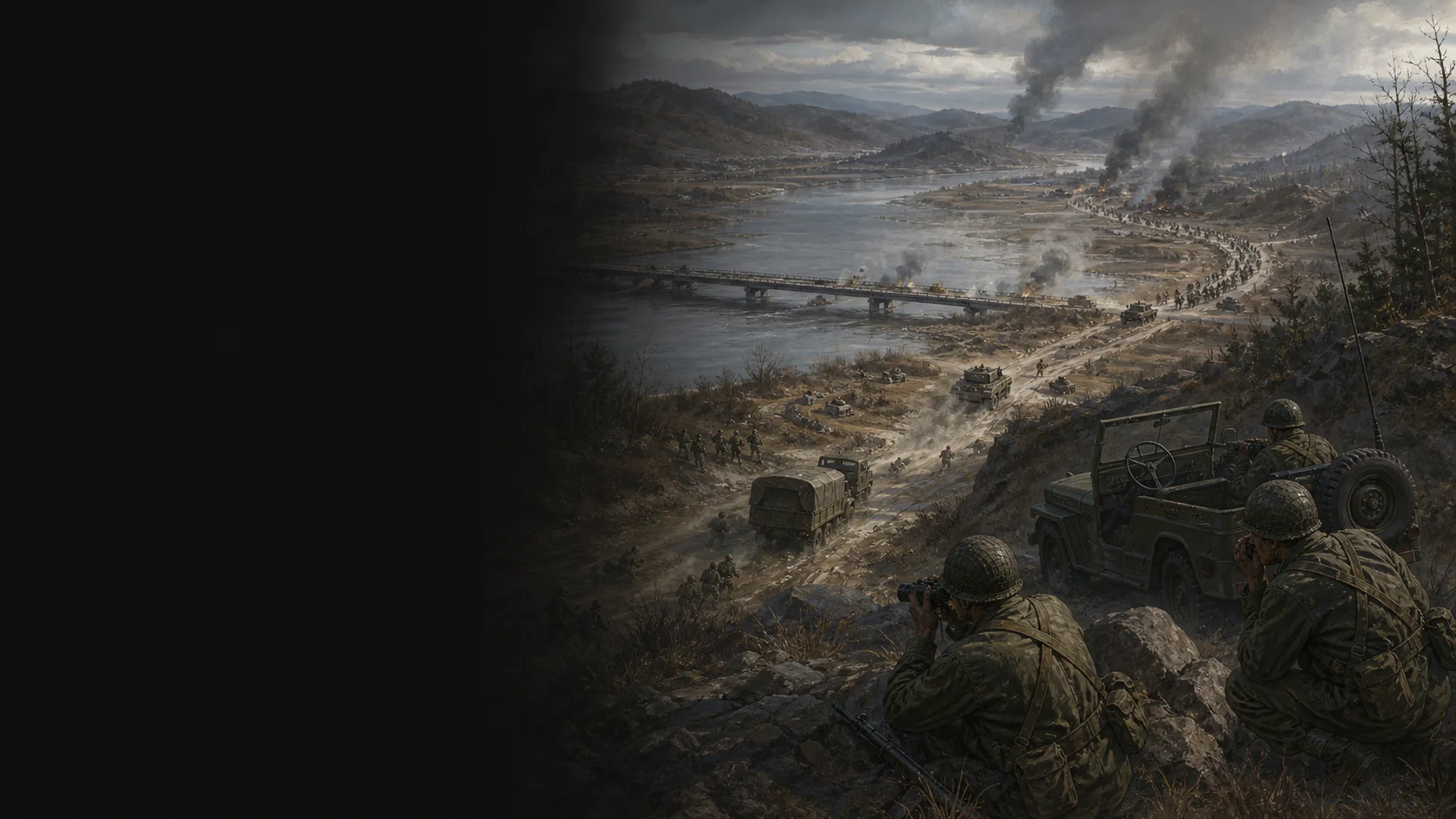
From 22 to 25 April 1951, the British 29th Brigade holds a broad sector south of the Imjin to cover the US I Corps' left flank during the Chinese Spring Offensive. The night crossing, exploitation of intervals, and failed relief efforts turn battalion positions into separate pockets. The fighting costs the Glosters dearly, but the brigade's withdrawal and the halting of the Chinese offensive reveal a two-level result: local tactical loss, operational delay useful for the UN to reform its line.

A sector to hold

The 29th Brigade is committed within I Corps' deployment as the UN advances towards the Utah and Kansas lines. Signs of a Chinese offensive exist, but its timing, axis, and strength remain uncertain. The brigade must cover a flank and preserve the possibility of withdrawal, explaining its broad front and dispersed supporting arms.

The crossing makes the intervals decisive

The initial deployment places the Belgian Battalion on the right, Northumberland Fusiliers in the centre, Glosters on the left, and Royal Ulster Rifles in reserve. Once Chinese forces cross the Imjin at night, they need not reduce everything frontally: gaps, communications, and routes to the rear become the principal objects of the battle.

Isolation is a sequence

The Chinese bridgehead south of the river, flank attacks, and infiltration of the seam between the Glosters and Northumberland Fusiliers progressively isolate two Gloster companies. The hills give the position resilience, but replace neither supply nor an open land link.

What the result really permits us to say

The Gloster battalion is largely destroyed or captured as a fighting formation while the brigade withdraws and reconstitutes to the south. UN forces prevent Seoul's capture and gain time to reform a line, but attributing that result to the resistance of one battalion alone would be excessive. Casualty and survivor figures vary with scope.

Military history

Sources

Contemporary primary source, British HansardKOREA (OPERATIONS), House of Commons, 6 June 1951

HC Deb 6 June 1951, vol. 488, cc. 1012–1013, lignes 15–18 de la transcription : dispositif belge/Northumberland/Glosters/RUR, franchissement nocturne et Belges coupés ; lignes 18–23 : Glosters isolés, dégagements, repli et nouvelle ligne au sud du Han.

Initial deployment, night of 22 April, failed relief efforts, withdrawal order, and Gloster breakout groups.

View ↗
Contemporary primary source, British parliamentary statementOperations In Korea, House of Lords, 2 May 1951

Lords Hansard, 2 May 1951, lignes 15–23 : offensive et axes, Glosters isolés à Choksong, tentative philippine du 24, tentative blindée du 25, groupes de sortie et nouvelle ligne au sud du Han ; lignes 24–27 pour les pertes et l'incertitude des pertes chinoises.

Contemporary official chronology, description of isolation, and scope of casualty and survivor figures.

View ↗
Official history, US Army Center of Military HistoryKorean War — Army Campaigns Brief Summaries

Page de campagne, section « CCF Spring Offensive, 22 April–8 July 1951 » : bombardement du 22 avril, franchissement de l'Imjin dans l'I Corps, retrait en lignes successives et arrêt de l'offensive avant Séoul / NO-NAME-LINE fin avril.

Operational context, campaign objectives, crossing of the Imjin, and consequence for the UN line.

View ↗
Official military monograph, US Army Center of Military HistoryHonor and Fidelity: The 65th Infantry in Korea, 1950–1953

PDF pp. 143–152, imprimées pp. 125–134 ; transcription HTML lignes 4649–4707, surtout p. 127 / PDF p. 145 pour la couture Glosters–Fusiliers et p. 128 / PDF p. 146 pour la colonne C-10 BCT + M24 + Centurions arrêtée dans la gorge ; Map 8, PDF p. 147.

Sector details and relational cartographic control; composition of relief columns and development of the situation from 23 to 25 April.

View ↗
Official history, US Army Center of Military HistoryBilly C. Mossman, Ebb and Flow: November 1950–July 1951

Chapitre XXI, pp. 383–389 pour le dispositif et les combats du 22–23 avril ; Map 34, p. 423, « The British 29th Brigade Sector, 25 April 1951 », pour l'ordre relatif des hauteurs, routes, rivières et axes de retrait.

Relative positions of the Glosters, Fusiliers, RUR, and Belgians; Route 5Y, Route 11, Imjin–Hantan bridges, Hill 235, Kamak-san, and withdrawal axes on 25 April.

View ↗
Specialist academic monograph, Indiana University PressS. P. MacKenzie, The Imjin and Kapyong Battles, Korea, 1951

Table des matières JSTOR lignes 97–132 : chapitres « Imjin: The First Day » pp. 38–53, « Second Day » pp. 54–73, « Third Day » pp. 74–93 et « Final Day » pp. 94–131 ; épilogue pp. 188–209, lignes 172–187, sur pertes, survivants et mémoire.

Daily sequence, isolation of companies, limits of the heroic narrative, and distinction between established facts and memorial reconstruction.

View ↗
Institutional museum source, National Army MuseumBattle of the Imjin River

Transcription de la page : lignes 71–76 pour les forces et commandements ; lignes 82–107 pour le terrain, le franchissement et l'isolement ; lignes 112–145 pour les chars, la sortie, les captures et la conséquence opérative ; lignes 140–142 pour la lettre d'Arthur Stone du 29 avril 1951.

Command of Brodie, Carne, Peng Dehuai, and Yang Dezhi; terrain, consequences, cautious casualty bounds, and relationship between memory of sacrifice and operational effect.

View ↗
South Korean institutional source, Ministry of Patriots and Veterans AffairsKey Battles — Battle of Jeokseong

Page « Key Battles », entrée « Battle of Jeokseong (1951. 4. 22~25) », lignes 235–240 : 63rd Army Corps, 187th–189th Divisions, environ un quart de pertes et 39 membres du Gloster Battalion sortis.

Institutional identification of the Jeokseong/Imjin sector, Chinese units, brigade result, and order of magnitude for losses.

View ↗

Edited by BattlesInMotion.com