1. Home
  2. Contemporary World
  3. Korean War
  4. Triangle Hill

Battle

Triangle Hill

14 October — 25 November 1952

A limited attack becomes a battle of attrition in which tunnels and reliefs make possession of the ridges unstable.

Military history

Why did an attack planned for a few heights become a battle lasting several weeks at Triangle Hill?

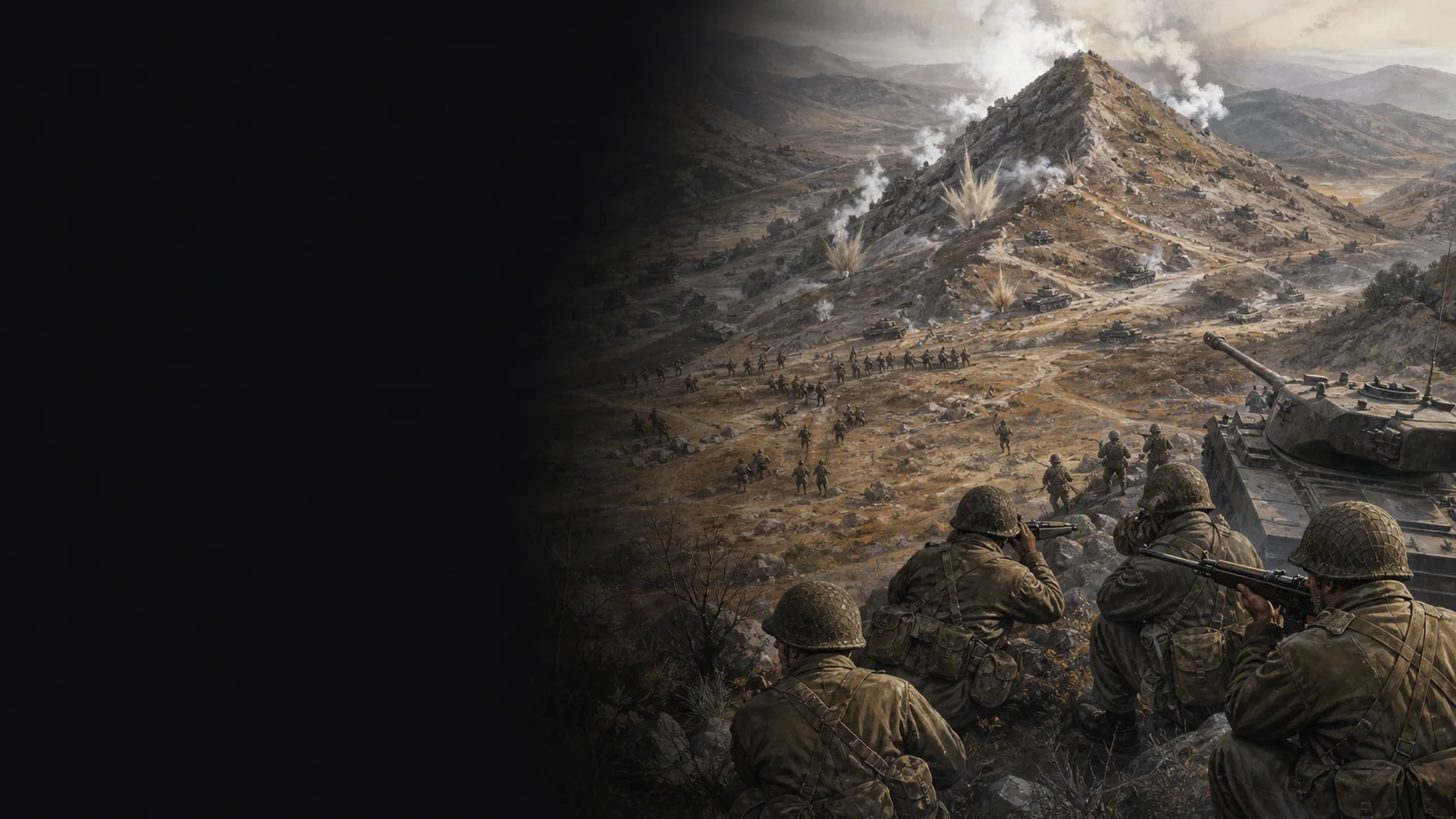
Operation Showdown was conceived as a limited attack north of Kumhwa: improve IX Corps's line by taking Triangle Hill and Sniper Ridge, using two battalions over a few days of fighting. On October 14, artillery and aircraft opened the positions; South Korean forces advanced on Sniper Ridge while the U.S. 31st Infantry Regiment broke against the defences of Hill 598. Tunnels, night counterattacks, and the repeated arrival of fresh battalions then turned the capture of heights into a battle of attrition. The U.S. 7th Infantry Division gave way to the South Korean 2nd Infantry Division on October 25; Chinese counteroffensives retook Triangle Hill on October 30 and November 1, and IX Corps suspended attacks on the complex on November 5. Sniper Ridge remained contested until late November. The account separates established facts, the spatial reconstruction needed for the map, and totals that change with the scope.

An offensive that was genuinely limited at first

Eighth Army command approves Showdown to regain the initiative after the Chinese attacks of September and improve IX Corps's line north of Kumhwa. The initial plan combines two battalions, five days, and about 200 casualties; its objective is not a theatre breakthrough. Air and artillery assets prepared for the operation are nevertheless reduced or diverted by the fighting at White Horse, while the plan itself is already expanding before October 14.

Two ridges, one defensive complex

Hill 598 forms the southern summit of a V-shaped complex: Pike's Peak to the west and Jane Russell and Sandy Ridge on the eastern arm. Sniper Ridge lies across a ravine to the east. Chinese positions are connected by trenches, shelters, and tunnels, allowing a height lost on the surface to be reinforced through protected routes. This geometry explains why taking a summit does not automatically mean controlling the complex.

October 14 separates the two battles

After the preparatory strikes, the 3rd Battalion of the U.S. 31st Infantry attacks Hill 598 and remains pinned in the outer trenches below the crest; the 1st Battalion temporarily takes Sandy Ridge and Jane Russell before being driven off. On Sniper Ridge, South Korean units likewise gain initial positions that are soon contested. Chinese night counterattacks, ammunition expenditure, and casualties prevent these separate advances from becoming a breakthrough.

Reliefs widen the battle

On October 15 and 16, fresh battalions of the 7th Division enter the complex; command passes to Colonel Joseph Russ, then the 17th Infantry gradually replaces exhausted units. Jane Russell changes hands, but Pike's Peak remains the hard point. The attacks of October 17–20 alternate between taking positions, falling back behind the crests, and counterattacks supplied through the tunnels.

Military history

Sources

Modern official history — U.S. Army Center of Military HistoryWalter G. Hermes, Truce Tent and Fighting Front, CMH Pub 20-3

Chapitre XIII, « Stalemate », section « Operation SHOWDOWN », pp. 310–318 ; carte 6, « The Triangle Hill Complex », p. 312 ; la note de sources de l'édition renvoie aux rapports et journaux des 31e, 32e et 17e régiments et de la 7e division pour octobre 1952.

Operational mapping of the Triangle Hill complex based on Map 6; geometry of Hill 598, Pike's Peak, Jane Russell, and Sniper Ridge, chronology, reliefs, Chinese recaptures, November 5 suspension, and distinction among territorial outcomes.

View ↗
Contemporary primary source — divisional medical report7th Infantry Division Surgeon, Annual Report Medical Service Activities 1952

Sections HTML « A. Tactical Operations » (secteur Kumwha–Chorwon, relève de Hill 598 le 25 octobre et combats jusqu'au 14 novembre) et « Annual Report by the Division Neuropsychiatrist », paragraphe débutant par « On 14 October 1952 » (Showdown, manque de repos et de nourriture, attente sous le feu, fatigue et épuisement au combat) ; NARA RG 112, box 221.

Contemporary evidence for the 7th Division's medical and operational sequence, exhaustion, and scope of losses; independent check on Hermes's tactical account.

View ↗
Primary oral testimony — state institutional museumThomas Martin, Korean War Oral History Interview

National Guard Militia Museum of New Jersey, résumé de l'entretien du 13 septembre 2001 : paragraphes sur l'affectation au 2nd Battalion, 31st Infantry, l'attaque des 1st et 3rd Battalions le 14 octobre, les 96 tués et 337 blessés, les combats sur Triangle Hill et le transfert à la 2e division sud-coréenne.

Combatant's view of the first day, a regiment's losses, and supply constraints; bounded individual testimony, not a general total.

View ↗
Contemporary institutional dossier — Defense POW/MIA Accounting AgencyPfc Clifton Eugene Gibson, 2nd Battalion, 31st Infantry

Profil DPAA, récit sur l'attaque de Hill 598 le 14 octobre, les positions chinoises enterrées, les contre-attaques nocturnes, la pénurie de munitions et le statut MIA du 15 octobre ; notice individuelle. Une histoire globale dépasse l’usage documentaire retenu ici.

Institutional corroboration at the level of one unit and day: buried defence, counterattacks, ammunition, and losses of the 31st Infantry.

View ↗
Specialist monograph — operational historyBryan R. Gibby, Korean Showdown: National Policy and Military Strategy in a Limited War, 1951–1952

Chapitre 12, « Operation Showdown, October–November 1952 », pp. 242–273, en particulier pp. 243, 247, 249, 251–261 et 267–271 : conception limitée, diversion des feux par White Horse, tunnels, engagement des régiments, reprises des 30 octobre et 1er novembre, suspension du 5 novembre et bilan de 42 jours.

Specialist interpretation of the initial decision, errors of proportion, role of reserves, and comparative casualty totals; a secondary source based on American, Korean, and Chinese archives.

View ↗
Specialist academic article — Journal of Chinese Military HistoryBryan R. Gibby, « The Battle of Shangganling, Korea, October–November 1952 »

Journal of Chinese Military History, vol. 6, n° 1 (2017), pp. 60–70 (plan, terrain, tunnels et régiments de la 45e division), 72–80 (séquence des combats et reprise du 30 octobre), 82–86 (résultats et bilans), DOI 10.1163/22127453-12341308.

Specialist Chinese perspective and comparison of defensive methods, tunnels, reserves, and losses; used to preserve disagreements without turning a national claim into an isolated fact.

View ↗
Chinese institutional source — China Military OnlineBattle of Shangganling, China Military Online

Dossier « 70th Resist US Aggression and Aid Korea », entrée « Battle of Shangganling » : 14 octobre, Kimhwa Offensive, défense des positions, tunnels et récit des 43 jours ; les bilans PVA/ONU sont conservés comme revendications institutionnelles à comparer.

Chinese institutional perspective on Shangganling, its narrative chronology, and claimed figures; explicitly used as a situated documentary tradition, not as sole arbiter.

View ↗
South Korean institutional encyclopaedia — Academy of Korean StudiesKorean Studies Encyclopedia, entrée Iron Triangle / Sniper Ridge

Entrée E0056164, paragraphes sur le Triangle de fer, la fonction de Cheorwon–Kimhwa–Pyonggang et la bataille de Sniper Ridge du 14 octobre au 24 novembre 1952 ; la notice rapproche parfois ce sous-combat d'un récit plus large, point conservé comme dispute de périmètre.

Geographical context and South Korean perspective; check on name variants and indication of the distinction between Sniper Ridge and the Triangle Hill complex.

View ↗

Edited by BattlesInMotion.com