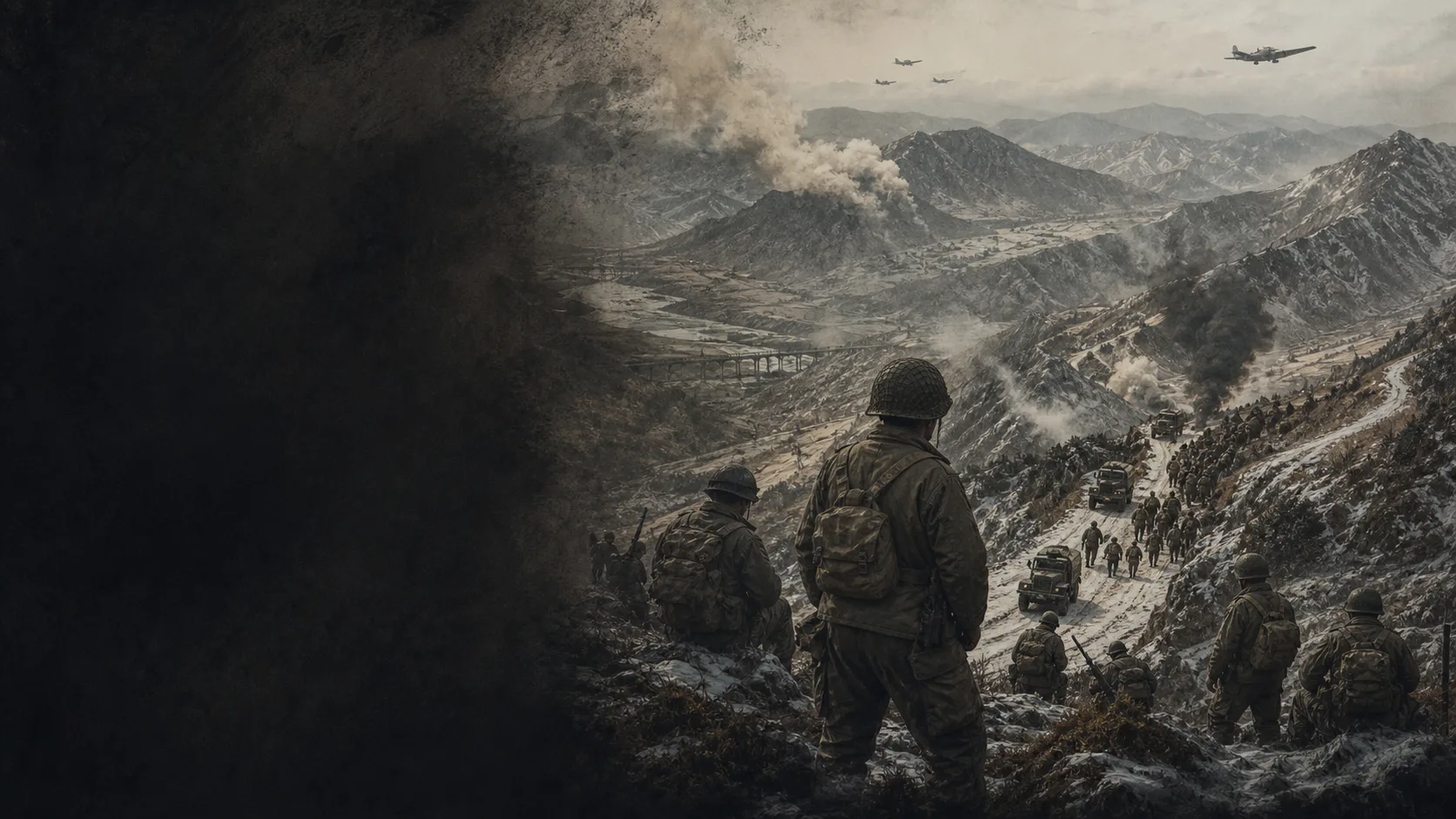
The North Korean offensive and Pusan
North Korean forces advance rapidly, but the Pusan Perimeter retains a port, a logistical base and sufficient depth to receive international reinforcements.
War
Land, encircle, retreat: a war that refuses final decision
Military history
The Korean War begins with a rapid offensive and becomes an international conflict in which the peninsula, mountains and roads impose limits on every army. The UN survives the initial collapse thanks to the Pusan Perimeter, reverses the campaign at Inchon, then discovers at Chosin and beyond that an operational victory can open a new war.
North Korean forces advance rapidly, but the Pusan Perimeter retains a port, a logistical base and sufficient depth to receive international reinforcements.
The Inchon landing cuts the rear, Seoul is retaken and the North Korean army withdraws. Success drives the UN beyond the simple objective of defending the South.
Chinese intervention encircles forces at Chosin, then stabilizes a front around the 38th parallel. Fighting becomes a war of artillery and positions under nuclear and diplomatic constraint.
Explore
Military history
Chronologies of Inchon, Pusan, Chosin and stabilization operations.
Command, fighting, losses and the evolution of the conflict.
Encirclement, routes, the UN forces’ breakout and the military significance of Chosin.
PDF pp. 31–39 (pages affichées 32–40) : extrait du 23d Infantry Regiment Command Report, surtout pp. 31–32 pour les directions d'attaque, pp. 34–36 pour les largages, pénuries et Company G, puis pp. 37–39 pour les contre-attaques et la jonction ; la médiation éditoriale est explicitement signalée
Check on times and tactical causality: multidirectional attacks, registered fires, shortages of M1 clips and mortar ammunition, G's breach, internal counterattacks, and arrival of the armoured column. Editorial mediation is noted: this PDF is not the original archive. Limited to the case of Battle of Chipyong-ni; this reference does not cover the whole conflict.
View ↗