218–217 · Hannibal in Italy
From Spain, Hannibal crossed the Alps in 218 BC. He defeated the Romans at the Trebia, then at Lake Trasimene in 217. His aim was to detach from Rome the Italian peoples who supplied it with soldiers and resources.
Battle
How Hannibal turns Rome’s numbers against it
Military history
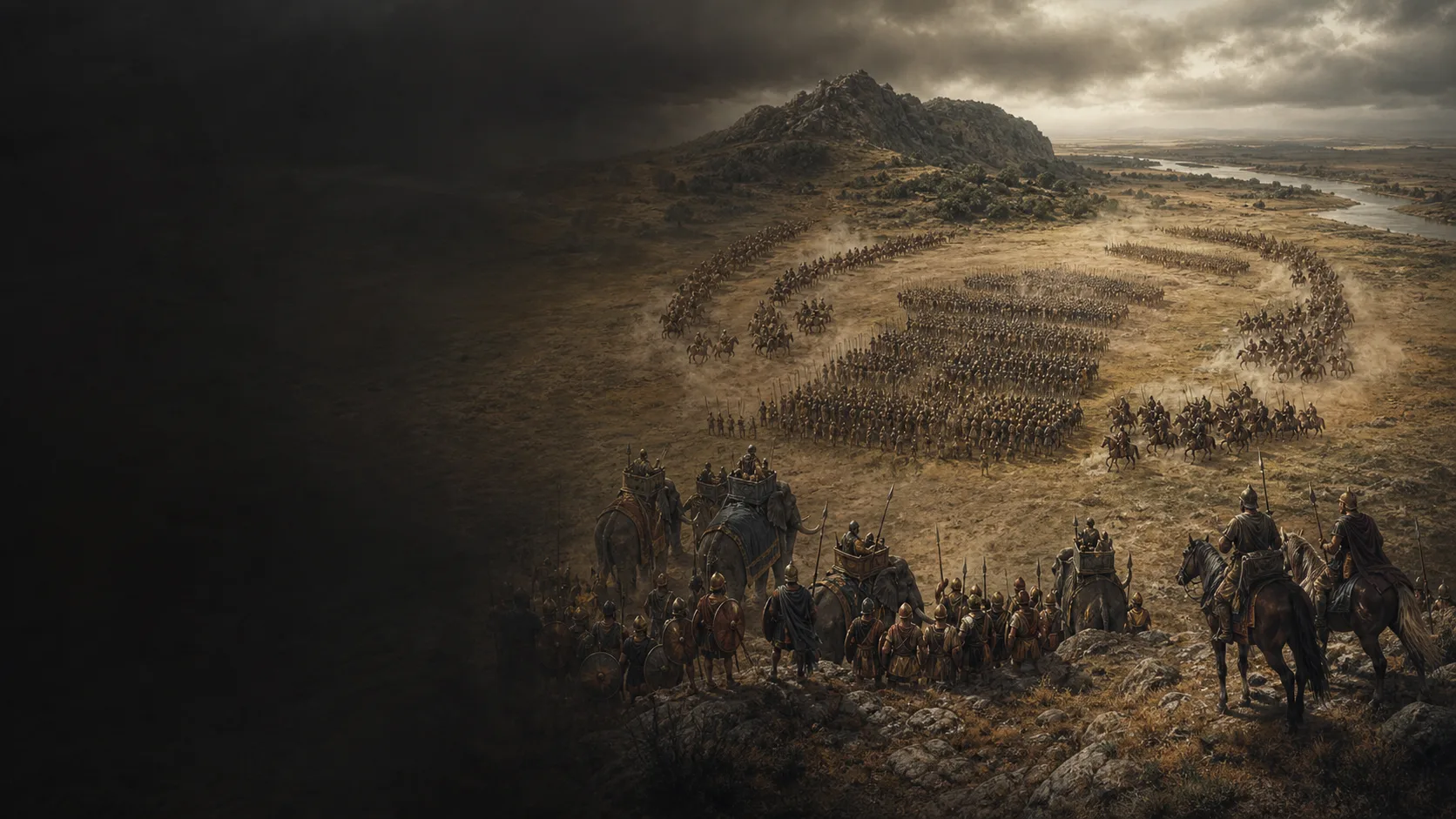
On 2 August 216 BC, Hannibal inflicts a major defeat on Rome. The legions break through his centre but lose protection on their flanks. African infantry attacks from the sides; cavalry returns against their rear. The double envelopment turns a Roman advance into disaster.
From Spain, Hannibal crossed the Alps in 218 BC. He defeated the Romans at the Trebia, then at Lake Trasimene in 217. His aim was to detach from Rome the Italian peoples who supplied it with soldiers and resources.
After Trasimene, Fabius Maximus avoided a major battle and disrupted the enemy’s supplies. In 216, Rome assembled eight legions with their allies. The consuls, Paullus and Varro, had to regain the initiative.
Hannibal seized Rome’s supply depot at Cannae in Apulia. The loss of provisions and the devastation made waiting costly. The plain near the Aufidus chiefly offered room for his numerically superior cavalry.
Rome compressed its infantry into a deep formation to add weight at the centre. This intention is plausible, but no order survives. Hannibal advanced the Iberians and Gauls, held the Africans back on the flanks, and concentrated his cavalry near the river.
Explore
Military history
III.50–56 (Alpes), 72–74 (Trébie), 82–89 (Trasimène et Fabius), 107 et 113–118 (Cannes)
Capture of the Cannae depot, Roman decision to concentrate eight legions, terrain, reported strengths, deployment, tactical sequence, casualties and first consequences.
View ↗XXII.44–59, en particulier 46–52 pour la bataille et les pertes, 54–58 pour la réaction romaine
Parallel account of terrain and fighting, survivors and camps, reported casualty totals, panic and then new levies at Rome.
View ↗XXIII.1–11, en particulier 2–7 sur Capoue et 11 sur le rapport de Mago
Political opening created by Cannae, negotiation and alliance with Capua, immediate limits of the tactical decision.
View ↗Militärgeschichtliche Mitteilungen 47.1 (1990), p. 7–32 ; surtout p. 7–10 sur les sources et p. 21–26 sur la reconstruction
Criticism of the accounts’ reliability and biases, debates over strengths and command, constraints of the deep line, and alternative to the image of a perfectly sealed circle.
View ↗Studia Quaternaria 41.1 (2024), p. 37–42 ; surtout p. 39–40 sur la plaine, les terrasses, le déplacement du fleuve et les localisations concurrentes
Geomorphological framework, cautious cartographic reconstruction and disputed modern location of the battlefield and ancient course of the Aufidus; tactical hypotheses specific to the article are not adopted as facts.
View ↗VI.22–23 : armement des fantassins légers et lourds ; description générale de l’armée républicaine
Javelins, the pilum, swords and shields; these categories do not imply uniform equipment at Cannae.
View ↗