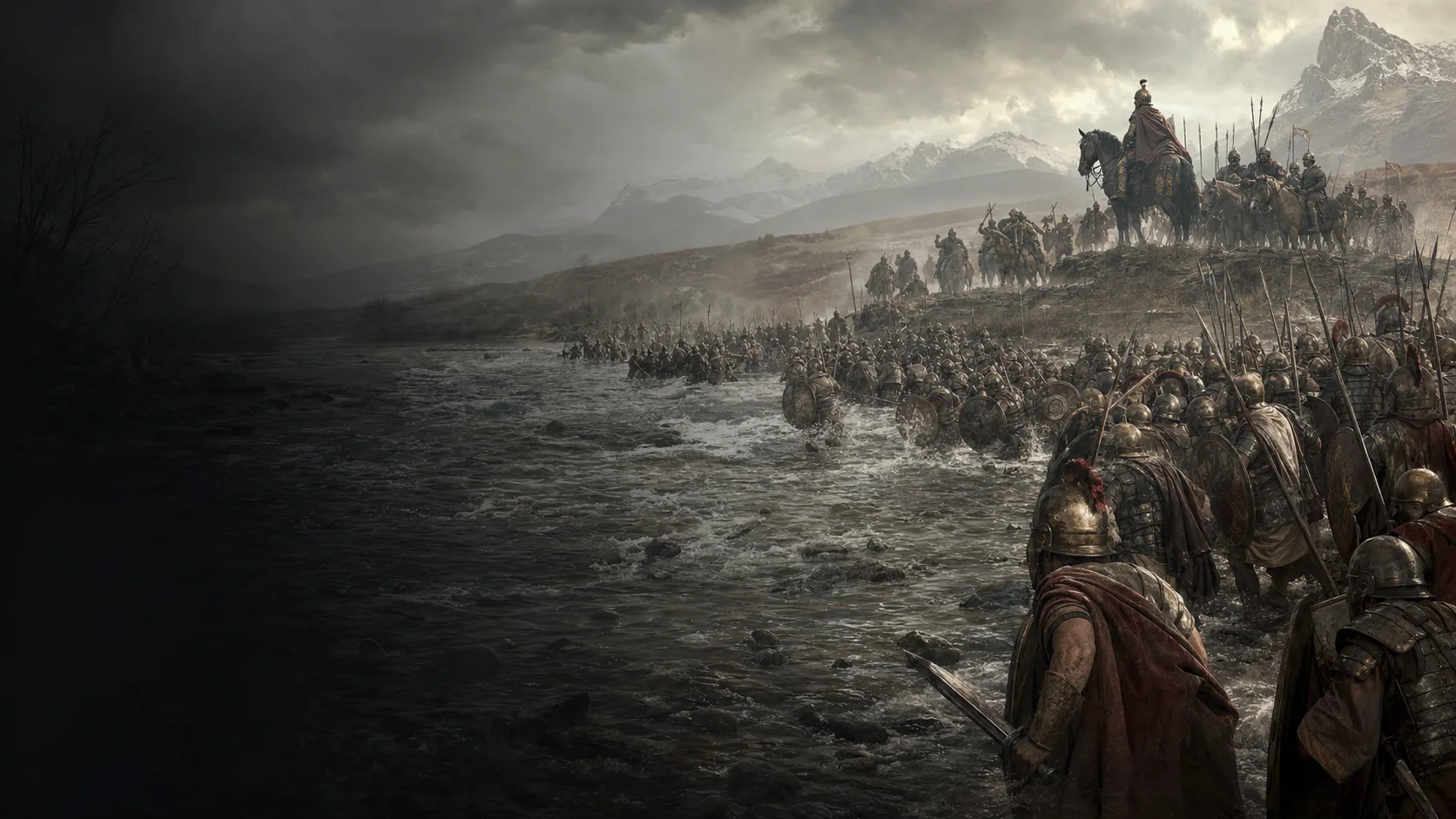
Two consuls face Hannibal
After the Ticinus, Scipio is wounded. Sempronius arrives with a second army. The Romans have substantial forces but must decide when to fight.
Military history
In late 218 BCE, Hannibal draws the Romans across the Trebia. The cold and the crossing wear them down before battle. Punic cavalry drives off their flank guards, then Mago's detachment attacks the rear. Yet, according to Polybius, at least 10,000 Romans break through and reach Placentia.
After the Ticinus, Scipio is wounded. Sempronius arrives with a second army. The Romans have substantial forces but must decide when to fight.
A favourable skirmish strengthens his desire to fight. Polybius and Livy attribute to Hannibal the intention to exploit this disposition.
On the day of battle, Numidian cavalry draws the Romans out of camp. They cross without having eaten, while Hannibal’s men prepare and warm themselves.
Mago waits with a mixed detachment in a brush-lined watercourse. The exact locations of the camps, crossing, and hiding place remain disputed.
Explore
Military history
III.69–74, rubriques « Hannibal Prepares An Ambush », « Preparations for Battle », « The Battle of the Trebia » et « The Romans Retreat to Placentia »
Preliminary skirmish, motives attributed to the commanders, Mago's detachment, army preparations, reported strengths, sequence of centre and wings, survivors, and retreat.
View ↗XXI.52–57, surtout 52–54 pour la décision et la cache, 55–57 pour la bataille et la retraite
Parallel account of the skirmish, advice to delay, preparation of the ambush, crossing, fighting, losses, and Roman escapes.
View ↗Militärgeschichtliche Mitteilungen 47.1 (1990), pp. 20–21, section « Battle of the River Trebia »
Reconstruction of orders of magnitude and deployment, role of light troops and cavalry, and Mago's rear attack; these calculations remain a modern interpretation.
View ↗Berlin, 1912, pp. 47–103; surtout 48–57 « Die Kontroverse », 57–78 opérations et champ de bataille, 94–98 effectifs, 99–103 Polybe et Tite-Live
State of the topographical controversy, discussion of operations and battlefield, critical comparison of the narratives, and strength tables.
View ↗Journal of Roman Studies 9 (1919), pp. 202–207, notice et extrait sur la localisation disputée et la fiabilité comparée de Polybe et Tite-Live
Historiographical boundary on locating the engagement: the controversy concerns not merely cartographic curiosity, but also interpretation of the sources.
View ↗Extrait public de l’entrée : 36 000 fantassins et 4 000 cavaliers romains conduits sur la rive gauche, environ 29 000 fantassins et 11 000 cavaliers chez Hannibal
Modern check of the battlefield bank, orders of magnitude, and Punic cavalry superiority; precise local placement remains bounded by Frank and Kromayer.
View ↗Entrée « La battaglia della Trebbia », §§ sur le contexte, la date, le dispositif, le combat, les pertes et les conséquences
Institutional synthesis of the sequence, orders of magnitude, general river topography, breakthrough towards Placentia, and limits of casualty figures.
View ↗Carte créditée au Department of History, United States Military Academy, publiée le 26 avril 2012; fiche « Map of the Battle of Trebia »
Independent relational check of the river–camps–movements axis; the map is an educational reference, not proof of precise local coordinates.
View ↗Notice touristique officielle sur la bataille de 218 av. J.-C., propositions de campements et retraite vers Plaisance
Local evidence of location hypotheses around Piacenza; used only to flag those proposals, without turning a local tradition into certainty.
View ↗