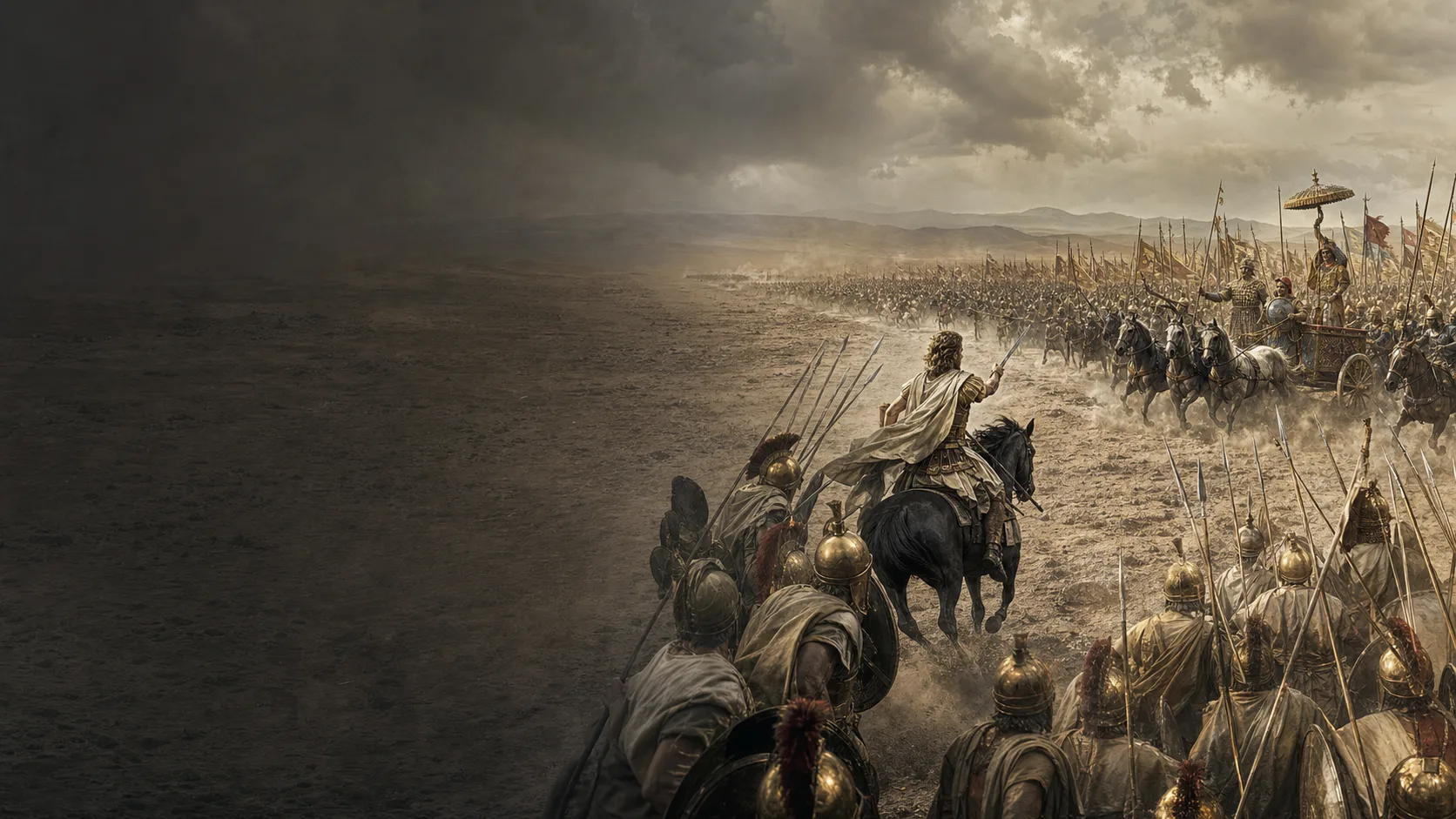
A prepared plain
After Issus and the conquest of the coast, Alexander crosses Mesopotamia. Darius gathers a new army and has open ground prepared for his chariots and cavalry.
Battle
Alexander's right opens a gap while Parmenion holds a pressured left.
Military history
In 331 BC, Darius offers battle on a wide plain prepared for his cavalry and chariots. Alexander shifts his right, then strikes through an opening towards the royal centre. But the Macedonian left remains under pressure and Persian cavalry reaches the baggage. Darius’s flight opens the way to victory without immediately ending all the fighting.
After Issus and the conquest of the coast, Alexander crosses Mesopotamia. Darius gathers a new army and has open ground prepared for his chariots and cavalry.
Alexander commands the right and Parmenion the left. A second line protects the rear: the greater Persian width creates a risk of being outflanked.
The charge towards Darius does not settle everything. Mazaios pressures the Macedonian left and Persian cavalry reaches the baggage; these crises must be followed separately.
Explore
Military history
Arrien, Anabase, III.8–15 ; surtout III.13–15 pour les chars, la brèche, les bagages et le retour.
Principal narrative sequence, checked against Iranica's critical reservations about transmission of the accounts.
View ↗Vol. X, fasc. 3, pp. 332–333, paragraphes sur le déploiement, la seconde ligne, les chars, la brèche, la poursuite de Darius, la pression de Mazaios sur Parmenion et la pénétration perse/indienne au camp ; bibliographie des sources antiques.
Principal historical control: wings of Parmenion and Mazaeus, second line, gap, camp/baggage, uncertainty over Parmenion's appeal and Alexander's reaction, and reservations about the ancient sources.
View ↗§ “Gaugamela and Babylon” : Mazaios à la droite perse avec la meilleure cavalerie ; troupes légères, Cadusiens et Scythes envoyés par la brèche vers le camp ennemi plusieurs milles derrière la ligne ; pression sur Parmenion, puis repli et reddition de Babylon.
Check of the identity of Mazaeus's right wing, its position opposite Parmenion, and the distinct axis of the raid towards the Macedonian camp.
View ↗Pharos 21/2 (2015), pp. 31–62 : discussion des hypothèses de localisation et des relations entre terrain, orientation et récit antique.
Cartographic debate and caution over the battlefield's modern geometry.
View ↗Carte comparative des positions, ailes, centre de Darius et axes de mouvement ; utilisée comme contrôle de lisibilité relative, avec une fonction distincte de celle d’une preuve de géolocalisation.
Graphic relationship among the two lines, the Macedonian right's charge, and depth to the camp.
View ↗