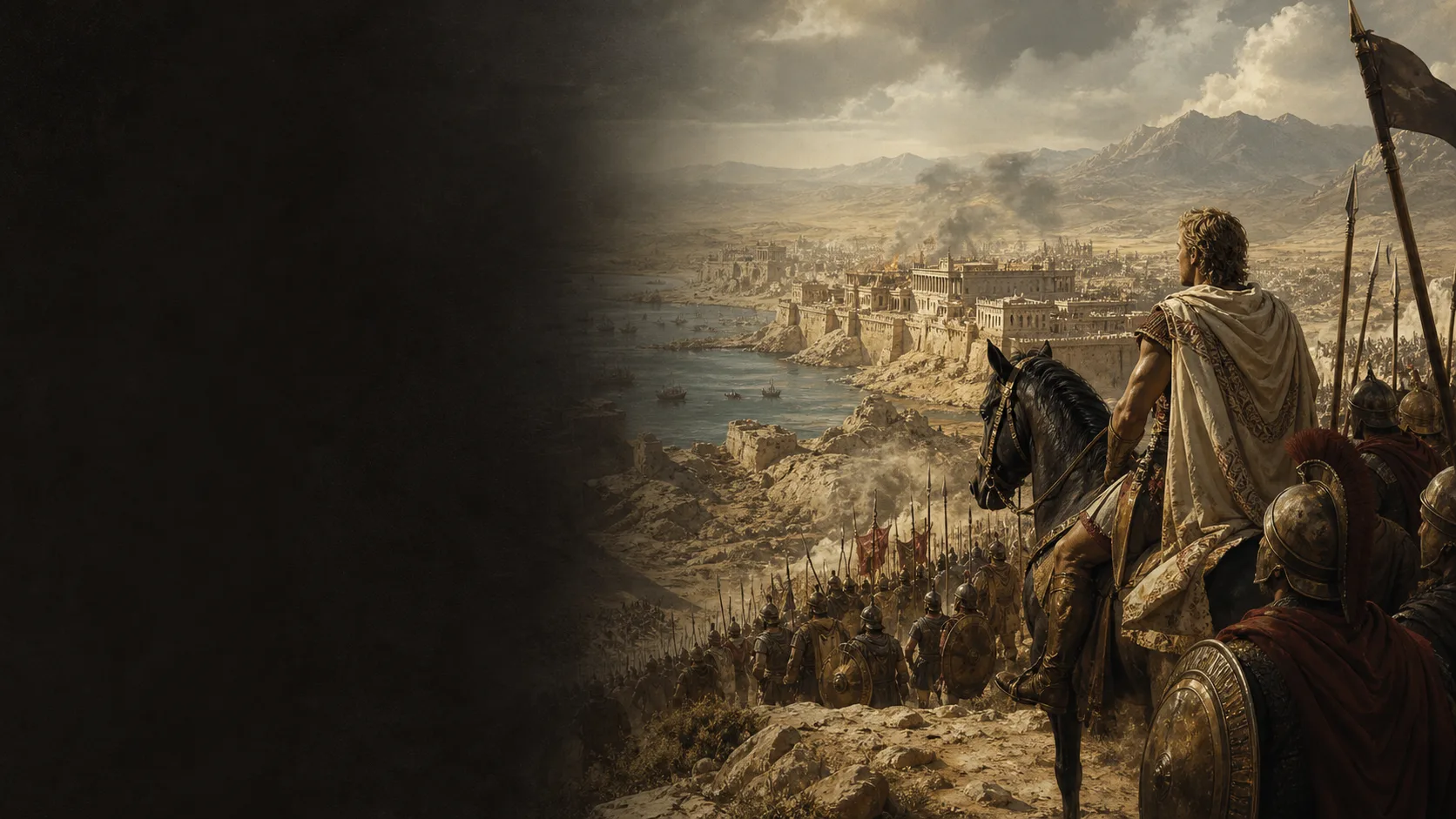
The gateway to Asia Minor
The crossing of the Hellespont, the Granicus and Issus give Alexander ports and an initiative that reduces Persia’s ability to choose the theatre.
Military history
Alexander’s conquest does not rest on the Macedonian phalanx alone. It combines a trained army, breakthrough cavalry, sieges, port bases and a succession of decisions that prevent the Achaemenid Empire from rebuilding a political centre. Gaugamela is the best-known battle in this dynamic, not its sole cause. After the fall of Achaemenid rule, operations continued in Central Asia and towards the Indus. At the Hydaspes in 326 BCE, Alexander faced Porus in a different political setting; this dossier covers these campaigns through Alexander’s death in 323 BCE.
The crossing of the Hellespont, the Granicus and Issus give Alexander ports and an initiative that reduces Persia’s ability to choose the theatre.
The sieges in the Levant secure the coast and Egypt provides a base. At Gaugamela, Alexander opens the Persian centre without allowing his phalanx to break apart.
Persepolis falls, then the campaign extends to Bactria, Sogdiana and India. Military victory becomes a problem of administration, distance and succession.
Explore
Military history
Arrien, Anabase, III.8–15 ; surtout III.13–15 pour les chars, la brèche, les bagages et le retour.
Principal narrative sequence, checked against Iranica's critical reservations about transmission of the accounts. Limited to the case of Gaugamela; this reference does not cover the whole conflict. Case reference for Gaugamela: the course and constraints of this battle. Its scope alone does not cover the entire conflict.
View ↗Chronology of the conquest and competing traditions about events.
Sources, administration, violence and the limits of heroic interpretations of the conquest.