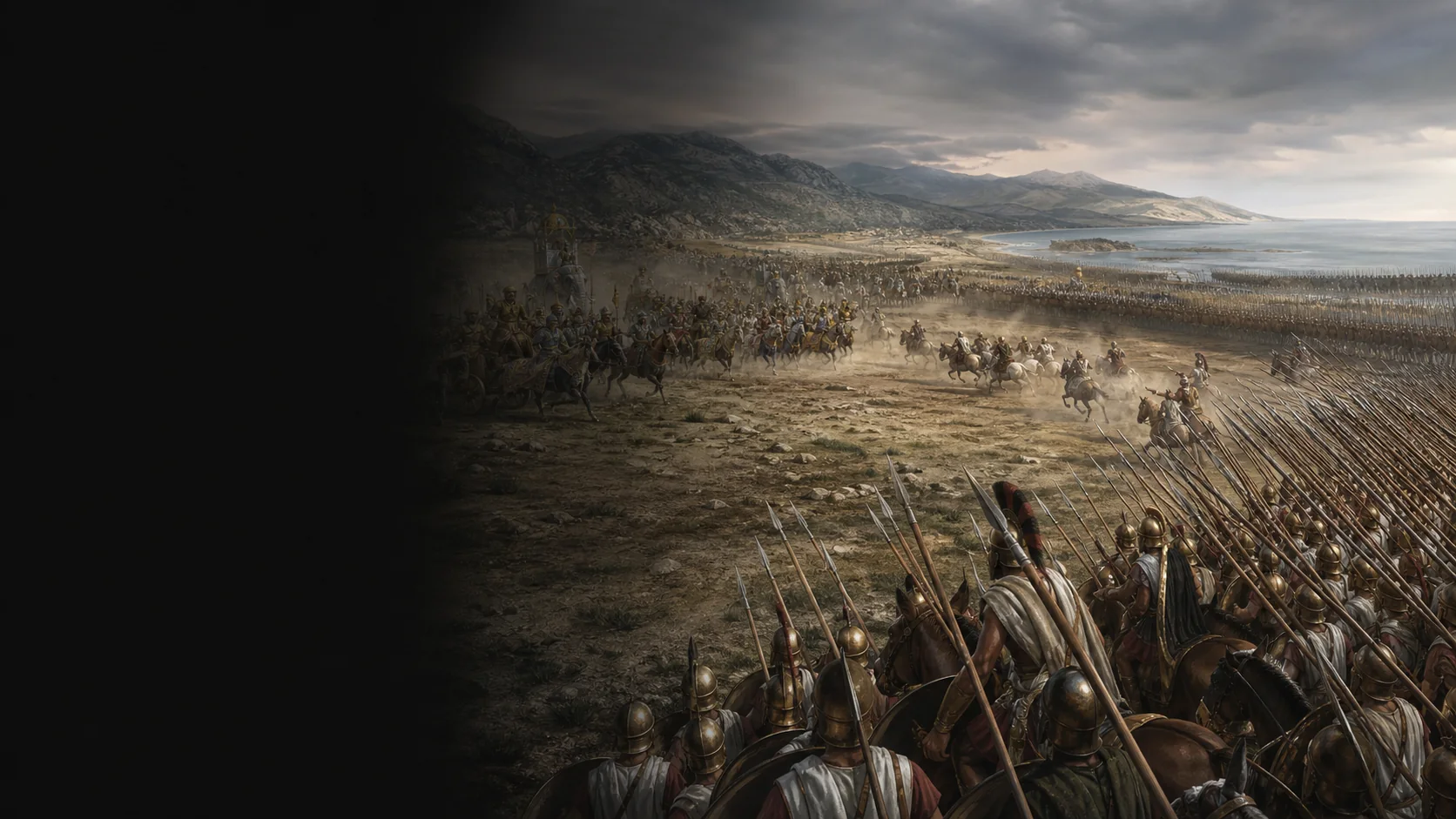
Darius moves behind Alexander
Darius crosses the Amanus and reaches Issus north of the Macedonian army. Alexander turns back towards him: the campaign front reverses.
Battle
A forced return to a constricted bank, a local breakthrough and a king's flight
Military history
In 333 BC, Darius moves behind Alexander, who turns back to fight him at Issus. Between sea and mountains, the Persian army has little room to deploy. Alexander crosses the Pinarus on his right, but his centre is in difficulty. The victorious wing’s turn and Darius’s flight decide the battle.
Darius crosses the Amanus and reaches Issus north of the Macedonian army. Alexander turns back towards him: the campaign front reverses.
The sea and the Amanus foothills limit the available width. The Pinarus protects the Persian line, but its banks also complicate the Macedonian crossing.
Reconstructions of the Macedonian army range from just over 30,000 to about 47,000 men. The enormous Persian totals in ancient accounts remain disputed.
Alexander needs to preserve his army and access to Syria. Darius seeks to stop the invasion; losing the battle does not yet deprive him of all the empire’s resources.
Explore
Military history
Livre II, 2.6.1-2.12.1; édition en ligne, chapitres VI-XII, avec les passes et le retour d'Alexandre, l'ordre sur le Pinaros, le franchissement, la crise du centre, la fuite de Darius et la poursuite.
Operational chronology, Arrianic order of battle, crossing of the bank, interactions among the wings and center, immediate consequences and constraints on casualty figures.
View ↗Livre XVII, 17.34.2-7; extrait traduit consacré à l'approche d'Alexandre, au combat autour du char, à la blessure d'Alexandre et à la fuite de Darius.
A second ancient narrative tradition, set against Arrian on the king's flight rather than merged with his tactical sequence.
View ↗Sections « Preliminary Movements », « Date », « Darius' Decision to Fight », « Battle Arrangements » et « Macedonian Maneuvers »; passages sur les passes, les effectifs macédoniens, la plaine côtière, le Pinaros, les ailes et l'après-bataille.
Campaign context, alternative date, topographical reconstruction and general sequence of deployments and movements.
View ↗Historia 41.4 (1992), pp. 395-406; surtout pp. 395-400 sur le Pinaros, Callisthène et les chiffres, pp. 401-405 sur l'ordre des unités, le franchissement et la nature de la charge.
Critique of numerical and propagandistic claims, Hammond's case for identifying the Payas, debate over the infantry Guard versus cavalry and the cohesion of the phalanx.
View ↗Chapitre 4, version en ligne, lignes 240-299 et 343-382 sur les distances, les effectifs et la largeur disputée; lignes 415-494 et 518-527 sur les berges, la géomorphologie et les limites de l'inférence; conclusion aux lignes 560-564.
Comparative topography, relational mapping, changes in the watercourses and limits of reconstructing the Pinarus.
View ↗