1. Home
  2. Antiquity
  3. Conquest of the Achaemenid Empire
  4. Siege of Tyre

Battle

Siege of Tyre

January — July 332 BC

From a vulnerable causeway to a combined assault

Military history

How did Alexander turn a vulnerable construction project into a combined siege and then the capture of Tyre?

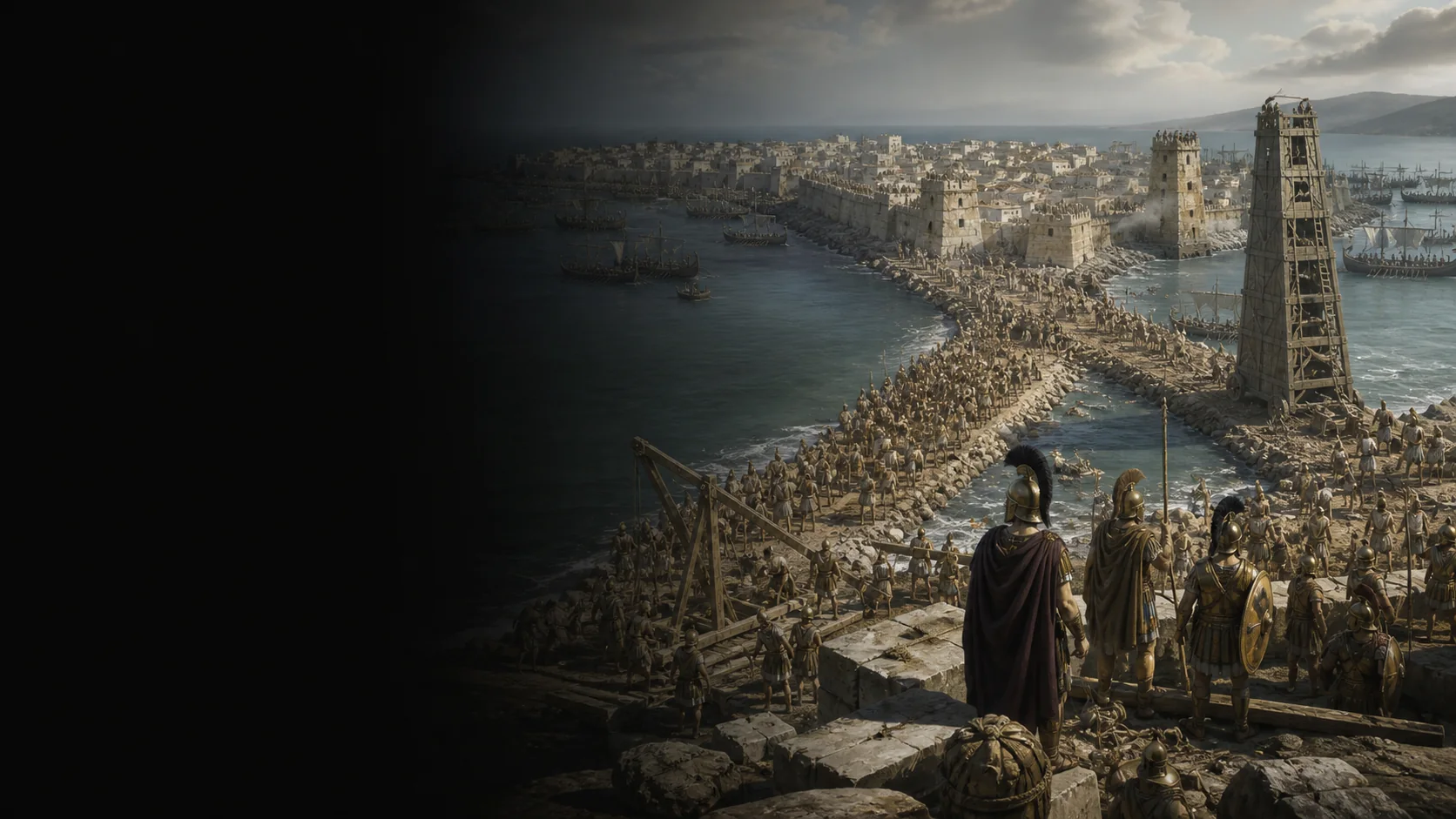
After Issus, Byblos and Sidon submitted to Alexander. Tyre, still connected to the Achaemenid Empire—its king Azemilcus was then serving in Autophradates's fleet—nevertheless attempted conditional obedience: the civic delegation promised to carry out Alexander's demands while refusing Macedonians and Persians alike entry to the island. This distinction between the service of the king and fleet, on the one hand, and the city's negotiated decision, on the other, was not neutrality. Alexander turned the refusal of access into a siege. His first instrument, a causeway driven from the mainland, advanced over natural shallows and then became exposed to Tyrian walls and ships. The siege did not turn on the genius of earthworks alone: its nature changed when the Phoenician and Cypriot squadrons arrived, sealed both harbours, and allowed engines to be brought against several faces. Even then, sorties, divers, underwater obstacles, counterwalls, and repelled assaults kept the outcome open. The final capture resulted from simultaneous attacks on the southern breach and the harbours; accounts of the dead, crucified, captured, and spared diverge too greatly to be merged into one total.

A city tied to the Achaemenids, a conditional civic decision

Arrian clearly places King Azemilcus and the Tyrian ships in Autophradates's Achaemenid fleet. The civic delegation nevertheless adopts a distinct line: accept Alexander's other demands but admit neither Persian nor Macedonian to the island while the war remains undecided. This is not neutrality by the city; it is an attempt at conditional accommodation within a still-active imperial relationship. Diodorus adds loyalty to Darius, the desire to gain time, and Carthaginian hopes; Quintus Curtius stresses Tyrian confidence. These motives do not add up to one certain plan. For Alexander, sacrifice to Melqart-Heracles is also political entry into a city that still controls its own enclosure.

The maritime problem after Issus

The strategic speech in Arrian presents Tyre as a threat on the route to Egypt, to Alexander's rear, and as far as the Aegean. It is consistent with the city's naval value but remains a speech reconstructed by a late author. John Nash stresses the tension between the foresight attributed to Alexander and his initial choice of a land solution that the Tyrian fleet could strike. The siege was therefore important without proving that Alexander had foreseen all its transformations.

A causeway over already favourable relief

Arrian describes shallow, muddy water near the mainland and deeper water towards the city; Diodorus and Quintus Curtius give a distance of four stadia. Geoarchaeology shows that a submerged sandy bar, protected by reefs and already within one or two metres of sea level, almost joined the two shores. The engineers therefore did not fill a uniform abyss: they consolidated and raised a passage whose end, near the walls, remained the most dangerous part.

The defence learns as much as the attacker

The Tyrians answer the construction with missiles, ships, a fireship, submerged stones, cable cutters, divers, incendiary projectiles, and breach repairs. The Macedonians widen the causeway, protect their anchors, replace ropes with chains, dredge the obstacles, and move their engines onto vessels. This duel of adaptation explains the duration better than one invention.

Military history

Sources

Primary textual source for the tradition — late ancient account, postdating the events, available in direct translationArrian, The Anabasis of Alexander, traduction E. J. Chinnock

Livre II, chap. XVI–XXIV, soit II.16.7–II.24.6 ; II.18–19 pour la chaussée et le brûlot, II.20 pour les flottes, II.21–22 pour contre-mesures et sortie, II.23–24 pour l’assaut et les bilans.

Initial connection of Azemilcus and Tyrian ships to Autophradates's fleet, conditional civic decision, operational sequence, channel topography, naval components, sortie of thirteen ships, southern breach, combined assault, refuge in the temple, and figures attributed to Arrian.

View ↗
Primary textual source for the tradition — late ancient account, postdating the events, Loeb edition available directlyDiodorus Siculus, Library of History, Book XVII, traduction C. Bradford Welles

XVII.40.1–46.5 ; 40–42 pour motifs, distance, flotte et revers du môle, 43–45 pour contre-mesures et assauts, 46 pour prise, sept mois et bilans.

Parallel tradition on intentions, 80 Tyrian triremes, storm and repairs, defensive devices, dramatisation of hesitation, duration, and categories of victims.

View ↗
Primary textual source for the tradition — late ancient account, postdating the events, Teubner Latin text available directlyQuintus Curtius Rufus, Historiae Alexandri Magni, livre IV

IV.2.1–IV.4.19 ; IV.2 pour négociation et premier môle, IV.3 pour brûlot, tempête, flotte de 190 et contre-mesures, IV.4 pour sortie, assaut et bilans.

Check on divergences concerning heralds, Carthaginian aid, the reverse's sequence, naval total, Alexander's hesitation, the assault, and people killed, crucified, or saved.

View ↗
Peer-reviewed geoarchaeological article — direct PDFNick Marriner, Christophe Morhange et Samuel Meulé, « Holocene morphogenesis of Alexander the Great’s isthmus at Tyre in Lebanon »

PNAS 104.22 (2007), pp. 9218–9223 ; surtout p. 9218 pour la question et les données, p. 9220 pour les carottes et le proto-tombolo, p. 9222 pour le modèle morphologique et l’évolution postérieure à 332.

Cautious reconstruction of the underwater relief, approximate causeway length, role of reefs, and distinction between the ancient proto-tombolo and modern broad isthmus; relational map markers, not a metric plan.

View ↗
Doctoral thesis — institutional repositoryJohn Nash, Rulers of the Sea: Maritime Strategy and Sea Power in Ancient Greece 550–321 BC

Australian National University, 2019, PDF pp. 190–192, section « Alexander » ; discussion du discours d’Arrien, de la chaussée exposée, du caractère fortuit des ralliements et de la nécessité de la flotte.

Critique of strategic teleology: Tyre's real importance, tension between the maritime speech and first land plan, then the operational reversal produced by the allied squadrons.

View ↗
Peer-reviewed philological articleDavid A. Guenther, « Diodorus Siculus and the Purgos at Tyre: Did Alexander Put Towers on Ships? »

Abstract de la page éditeur consulté ; article référencé comme Classical Philology 119.3 (2024), pp. 421–426. Le dossier n’emploie que la conclusion explicitement formulée dans cet abstract sur l’absence de preuve littéraire de tours de siège embarquées.

Preventing the map and account from turning engines mounted on vessels into certain floating siege towers.

View ↗

Edited by BattlesInMotion.com