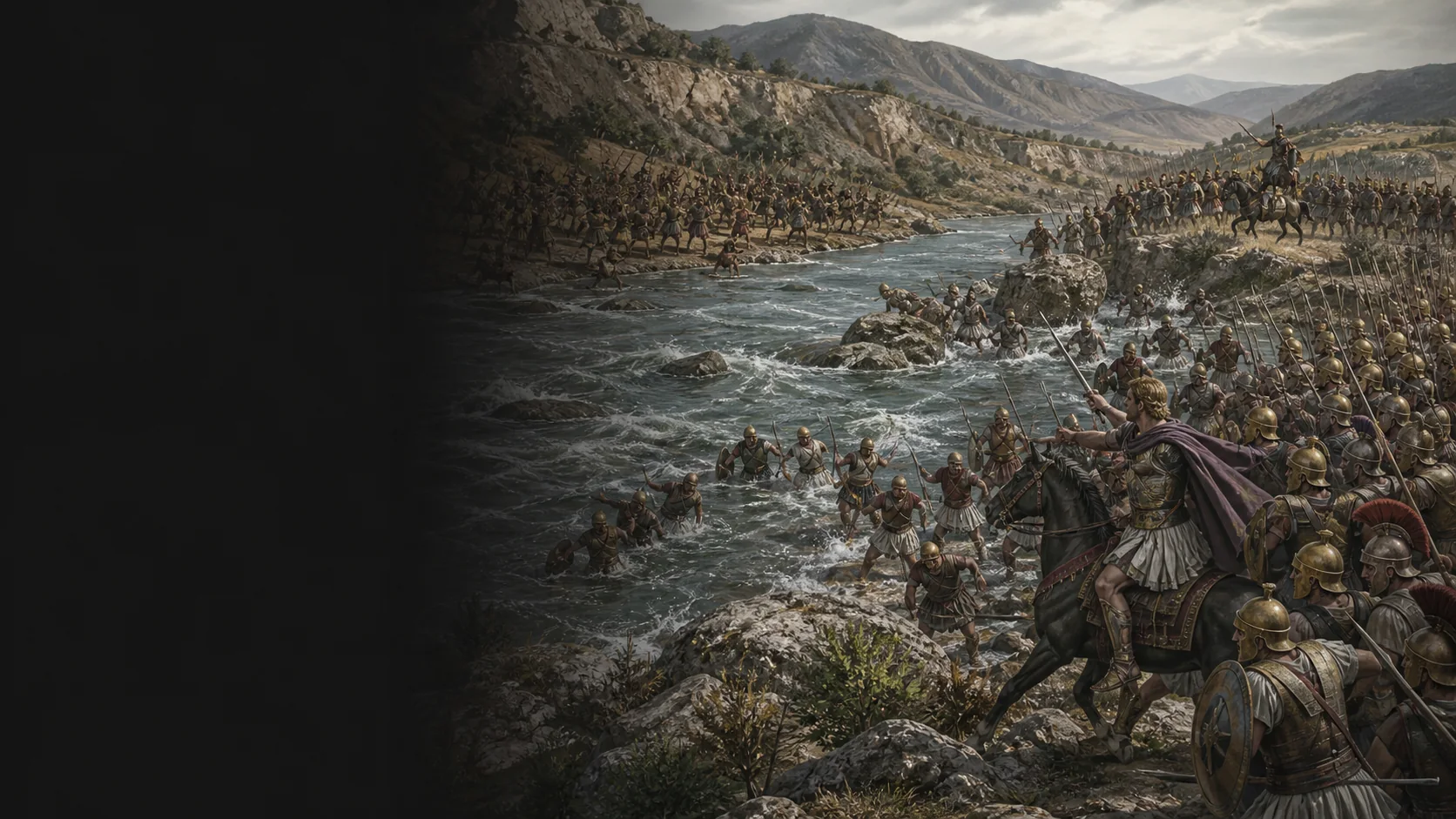
An invasion in progress
Alexander has just crossed into Asia. Darius III has not yet assembled the royal army; the Anatolian satraps and Memnon must stop the invasion with their regional forces.
Battle
Cross under pressure, widen the fight, isolate the infantry
Military history
In 334 BC, Alexander has just crossed into Asia. Persian satraps block his route at the Granicus with their cavalry; Greek mercenaries wait behind them. The contested crossing becomes a fight along the bank, then a break in the mounted line. This first victory opens western Anatolia to the Macedonians without overthrowing the Persian Empire.
Alexander has just crossed into Asia. Darius III has not yet assembled the royal army; the Anatolian satraps and Memnon must stop the invasion with their regional forces.
The accounts attribute a scorched-earth proposal to Memnon. Arsites refuses to ravage his province: preserving its resources means risking an immediate battle.
Arrian and Plutarch describe a defended bank. Diodorus recounts an unopposed crossing at dawn. The map follows the first account without merging the two chronologies.
The advance force suffers losses before Alexander arrives. Its fixing effect is clear; the idea that it was deliberately sacrificed remains a modern interpretation.
Explore
Military history
I.11.3 : plus de 30 000 fantassins et plus de 5 000 cavaliers ; I.12.6–10 : conseil de Zélée et proposition attribuée à Memnon ; I.13.1–7 : approche, renseignement, avis de Parménion et décision d’attaquer ; I.14.1–7 : ordres de bataille et première vague ; I.15.1–8 : difficulté de la sortie, engagement oblique et mêlée ; I.16.1–7 : rupture, poursuite limitée, mercenaires, pertes et prisonniers ; I.17.1–3 : Sardes.
Structure of the map and main narrative, force composition, decisions, movements, the separate fight against the mercenaries, casualties, and immediate consequences.
View ↗XVII.17.3–5 : catalogue de 32 000 fantassins ; le total déclaré de 4 500 cavaliers contredit ses postes, qui en additionnent 5 100 ; XVII.18.2–19.6 : conseil perse, effectifs achéménides et franchissement à l’aube sans opposition ; XVII.20.1–21.4 : combat de cavalerie et rupture ; XVII.21.5–7 : pertes, prisonniers et reddition de Sardes.
The incompatible opening, a second force catalog, another account of the fighting, and a divergent casualty range.
View ↗§16.1–3 : passage difficile, courant, boue et treize escadrons de cavalerie ; §16.4–6 : mêlée, combat personnel et intervention de Cleitos ; §16.7–8 : phalange, demande de quartier des mercenaires et traditions de pertes.
A parallel biographical tradition on the defended crossing, close combat, the mercenaries’ position, and the alternative death toll; it is not treated as independent contemporary testimony.
View ↗PDF p. 1 / p. 187 : fin mai, identification au Kocabaş Çayı, basses hauteurs de 3–4 m, effectif perse irrécupérable, berges raides alternant avec des plages de gravier et première vague reconstruite comme appât ; PDF p. 2 : mercenaires, Arsitès et portée immédiate.
Topographical checks, criticism of the reported strengths, a modern reconstruction of the first crossing presented as a hypothesis, and the limits of reconstruction.
View ↗HTML, p. 827, paragraphes 3–5 : débarquement de 334, armée royale pas encore pleinement mobilisée, victoire du Granique et limites de la soumission réelle en Anatolie ; section « Resistance to Alexander », pp. 829–830 : défaite militaire sans effondrement immédiat et résistance à Halicarnasse.
Achaemenid context, Darius’s absence from the Granicus, regional consequences, and rejection of a teleological reading of its strategic significance.
View ↗p. 276 : confrontation des pertes macédoniennes d’Arrien et de Plutarque, total d’environ 115 chez Arrien ; p. 277 : la première vague interprétée explicitement comme une « feint » et critique de l’amplification héroïque et stratégique du Granique.
Criticism of casualty figures and heroic framing; the modern first-wave-decoy hypothesis retained conditionally and never converted into an attested intention.
View ↗PDF p. 1 / revue p. 107–108 : hypothèse d’un champ plus méridional et de Höyükbayırı Tepe ; PDF p. 6 / revue p. 113 : plaine classique marécageuse au IVe siècle, évolution alluviale et absence de mobilier de bataille ; PDF p. 14–15 / revue p. 121–122 : résultats encore provisoires et poursuite des sondages.
Updating discussion of the site, paleochannel, and final rise without converting a survey proposal into a certain location.
View ↗p. 73, résumé et ouverture : divergence des sources sur l’heure et le but du passage, problème du mouvement latéral et inadéquation partielle entre topographie ancienne et terrain moderne ; n. 34 : contradiction entre le total déclaré de 4 500 cavaliers chez Diodore et les 5 100 obtenus par addition.
Identifying chronological, oblique-advance, and topographical problems; arithmetic check of Diodorus’s catalog, without imposing the article’s cartographic solution.
View ↗