Taxila and Porus
Taxiles welcomes Alexander and provides allies. Porus refuses submission and can delay behind the Hydaspes, while the conqueror seeks battle before further reinforcements arrive.
Battle
Shift the crossing, dislocate the wings, survive the elephants
Military history
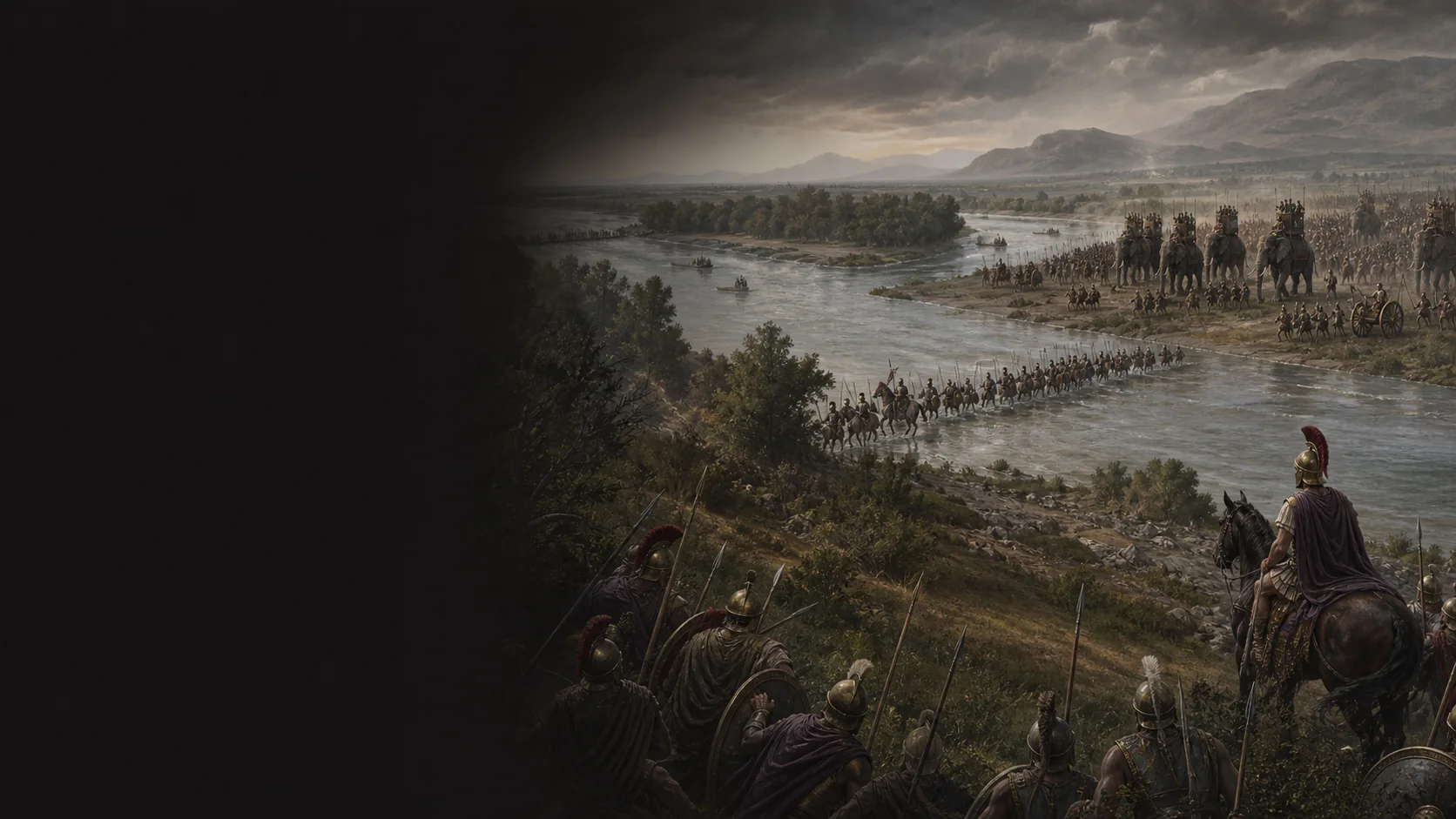
In 326 BC, Porus blocks Alexander’s crossing of the Hydaspes, in present-day Pakistan. The Macedonian king secretly crosses upstream, then faces an army protected by its elephants. His cavalry disrupts the wings; infantry must then withstand the animals’ charges. Defeated, Porus retains his kingdom under Alexander’s authority.
Taxiles welcomes Alexander and provides allies. Porus refuses submission and can delay behind the Hydaspes, while the conqueror seeks battle before further reinforcements arrive.
The current and elephants make a landing vulnerable. Alexander stages visible preparations to maintain several threats and conceal the chosen crossing.
Craterus remains at the main camp under conditional orders. Alexander crosses upstream with a selected force: the surprise he achieves also exposes him to battle before the whole army can reunite.
Sources differ on the detachment that responds to the crossing. The map distinguishes this skirmish from the main battle, for which Porus chooses firm ground according to Arrian.
Explore
Military history
V.8–10 : Taxila, refus de Poros, garde des passages et feintes ; V.11–13 : ordres conditionnels à Cratère, point boisé, île et bras profond ; V.14 : force avancée et variantes du premier contact ; V.15 : petite armée et quelques éléphants laissés au camp, distincts des 200 éléphants emmenés par Poros, puis ordre de bataille ; V.16–17 : cavalerie et combat des éléphants ; V.18–19 : pertes, sortie de Poros, règlement, Nicaea, Bucephala et mois Munychion
Principal narrative source for chronology, marching orders, formation states, and ancient figures; ancient but late, it is not a contemporary record.
View ↗§60.1–7 : surveillance, fausses alertes, nuit orageuse, île, second bras et traversée ; §60.8 : 1 000 cavaliers et 60 chars sans chef nommé ; §60.9–11 : Poros avance, Alexandre à gauche, Coenus à droite et combat jusqu’à la huitième heure ; §60.12–15 : Poros blessé, capture, traitement royal et territoire ajouté
Biographical tradition for the crossing, 1,000 cavalry and 60 chariots without a named commander, battle duration, capture of Porus, and addition of territories.
View ↗XVII.87.1 : bataille placée sous l’archonte Chremes ; XVII.87.2–5 : effectifs, attente d’Embisaros, cavalerie aux ailes, éléphants au front et infanterie dans les intervalles ; XVII.88.1–7 : chars, action des éléphants, Poros blessé qui s’effondre tandis que l’armée fuit ; XVII.89.1–6 : pertes, captifs, 80 éléphants, soins, rétablissement de Poros sur le pays qu’il gouvernait auparavant, sans agrandissement immédiat
Competing tradition for chronology, strengths, action of the elephants, losses, Porus's collapse, and restoration of his former kingdom; its figures and settlement are not combined with Arrian's.
View ↗Extrait Cambridge : les grandes lignes sont claires mais la tactique de cavalerie reste disputée et les ordres à Coenus sont le nœud du problème ; notes visibles 2 et 11–12 : absence d’appui textuel pour plusieurs reconstructions de la ligne ; notice bibliographique, p. 26–31
Dispute over the geometry of the mounted engagement and caution in reconstructing Coenus's manoeuvre.
View ↗PDF p. 7–8 / pagination de revue p. 713–714 : franchissement, début des pluies vers le milieu de l’été, chars, ligne d’éléphants, cavalerie arrière et durée du combat ; PDF p. 13–14 / pagination de revue p. 719–720 : discours et armes chez Quinte-Curce, motif du retournement des éléphants, contraste avec le va-et-vient d’Arrien
Modern synthesis on the role of elephants, rainy season, figures transmitted by Arrian, and limits of the ancient traditions.
View ↗VIII.13.1–28 : refus de Poros, dispositif de rive, îles, feintes, leurre royal, orage et passage ; VIII.14.1–10 : Spitacès, 3 000 cavaliers, 100 chars et sol boueux ; VIII.14.11–45 : déploiement, combat des éléphants, blessures et règlement avec Poros
Distinct Latin tradition concerning the advance guard's identity, figures, and elephant fighting; its speeches and spectacular details are not merged into Arrian.
View ↗p. 31–33 : problème ancien et absence de solution définitive ; p. 33–35 : déplacements du fleuve et méthode topographique ; p. 42–44 : hypothèse du camp vers Haranpur et du passage vers Jalalpur, pointe boisée, île et ravine ; p. 44–46 : impossibilité de fixer exactement le champ et Nicaea
Working hypothesis for the camp–crossing–terrain relationship and justification for a non-georeferenced map; no modern coordinate is presented as established.
View ↗PDF p. 46–52 : examen des récits de victoire, capture ou arrêt du combat et distinction entre résultat militaire et maintien de Poros ; p. 60–61 : campagne contre les Glausae et ajout ultérieur de leur territoire au royaume de Poros
Minority modern reading of the political significance: used to distinguish battlefield victory from a favourable settlement for Porus. Cancelling the military result attested by the sources would go beyond the documentary use adopted here.
View ↗