A punitive expedition
Darius sends Datis and Artaphernes against Eretria and Athens after the Ionian Revolt and Athenian aid at Sardis. Eretria falls before the Persians reach Marathon.
Battle
A thinned centre holds long enough for the wings to return
Military history
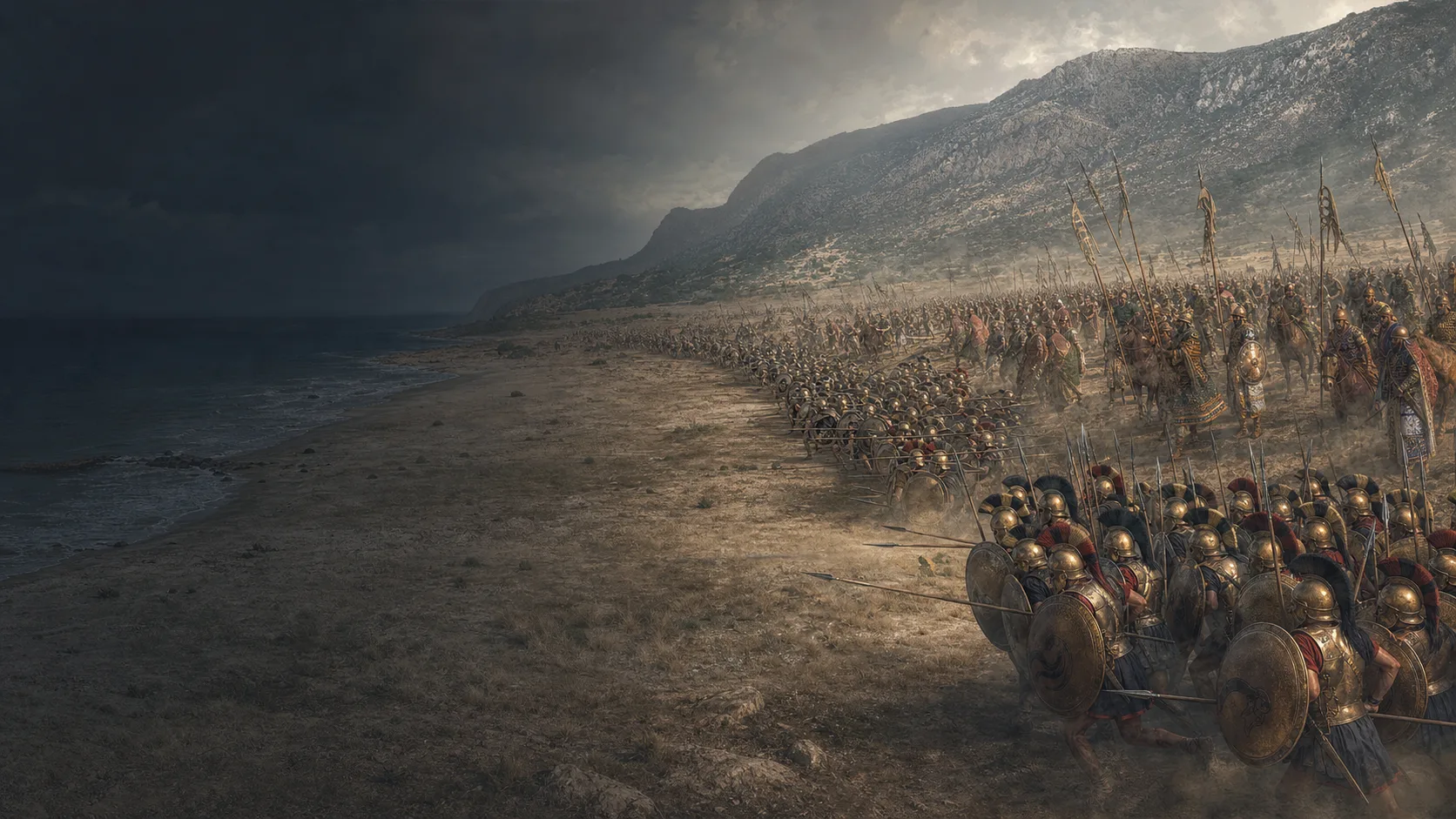
In 490 BC, the Athenians and Plataeans face the Persian expedition on the plain of Marathon. Their shallower centre gives ground; their wings prevail and then turn against the enemy centre. The Persians return to their ships. Athens is saved for this campaign, but the war with the Persian Empire continues.
Darius sends Datis and Artaphernes against Eretria and Athens after the Ionian Revolt and Athenian aid at Sardis. Eretria falls before the Persians reach Marathon.
Herodotus presents Marathon as the part of Attica best suited to horses and closest to Eretria. Hippias therefore leads the Persians to a favourable landing place; the passage does not, however, say what their cavalry does during the battle.
The Athenians march with the Plataeans. The Spartans promise help, but their religious calendar delays their departure: the battle is decided before they arrive.
To make their line as long as the Persian line, the Greeks make the centre shallower than the wings. Herodotus describes this deployment and its result; he does not allow us to claim that Miltiades had devised a complete trap in advance.
Explore
Military history
Livre VI, sections 94 à 117, notamment 102, 108 à 117
Persian expedition, Hippias’s role, choice of Marathon, Athenian march, decision to fight, order of the line, advance dromō, different outcomes in centre and wings, ships captured and reported losses.
View ↗Pages 3 à 22 de l'ouvrage, surtout pp. 10 à 19 du chapitre (PDF, pages 14 à 22)
Absence of totals in Herodotus, modern ranges, interpretation of the thinned centre, meaning of dromō, topography, cartographic reconstruction, losses and the disputed chronology of the return to Athens.
View ↗Acta Classica Universitatis Scientiarum Debreceniensis 58 (2022), pp. 3 à 18, surtout pp. 11 à 13
Herodotus’s silence on cavalry action at Marathon, the fragility of the “without cavalry” testimony and modern disagreement over its employment.
View ↗