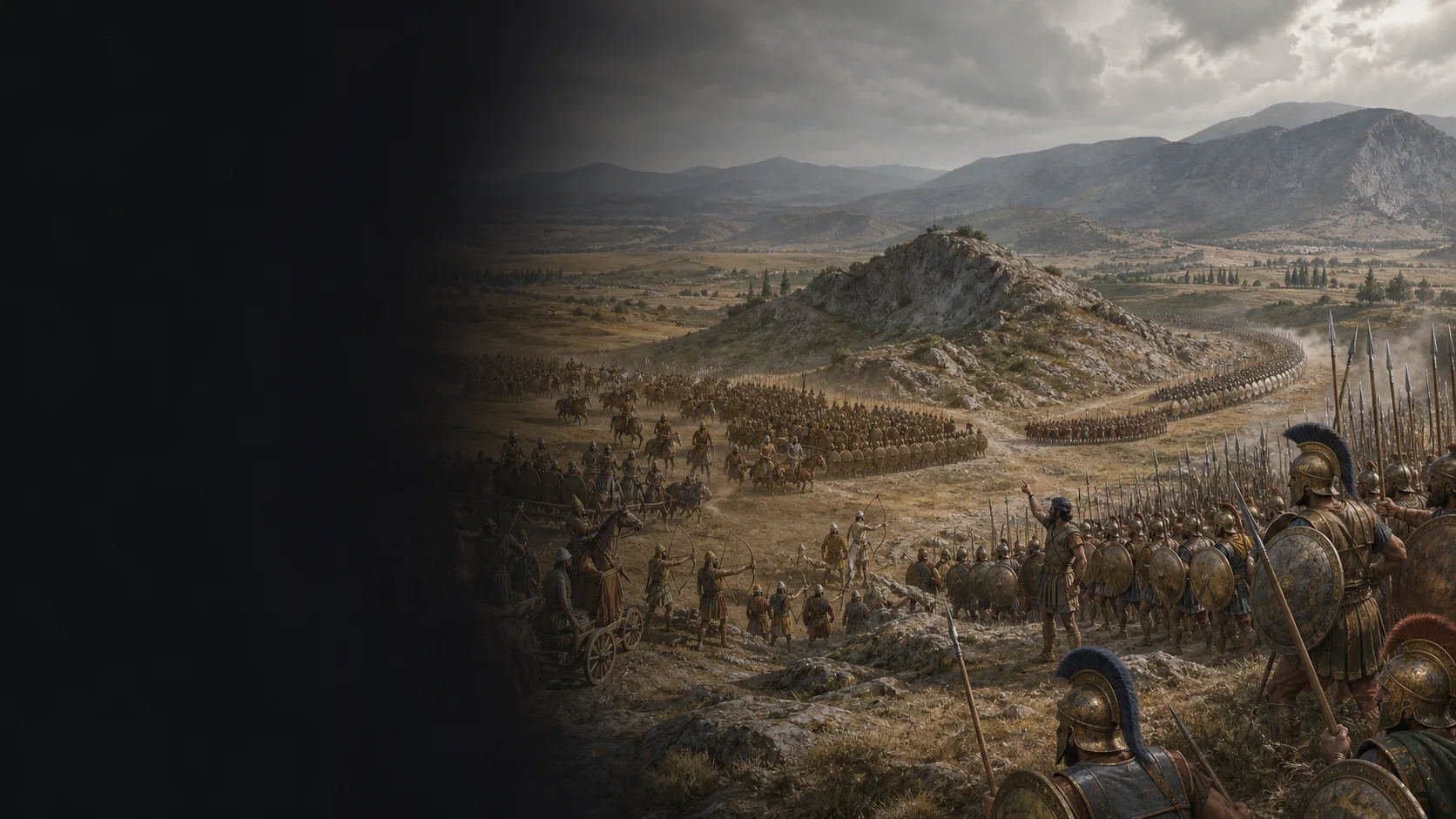
The war continues after Salamis
Mardonius continues the land campaign. Boeotia and Thebes’ support provide a plain suited to his cavalry; Pausanias leads the Greeks at the foot of Mount Cithaeron.
Battle
Cavalry deprives the coalition of water before its pursuit breaks apart
Military history
In 479 BC, Mardonius’s cavalry threatens the Greek coalition’s water and supplies in Boeotia. His night withdrawal falls into disorder. The Persians pursue, but meet two separate lines of resistance: the Spartans and Tegeans on one side, the Athenians on the other. Mardonius is killed and his army gives way; the Persian camp is then taken.
Mardonius continues the land campaign. Boeotia and Thebes’ support provide a plain suited to his cavalry; Pausanias leads the Greeks at the foot of Mount Cithaeron.
The death of Masistios in an earlier skirmish is a Greek success. It does not prevent Persian cavalry from later threatening the convoys and access to water.
The contingents follow their own commanders. During the night withdrawal, the groups do not take the same route or keep the same pace.
Herodotus adds the Greek categories to 110,000 men and gives much higher Persian totals. These ancient figures are not verifiable counts.
Explore
Military history
IX.20–25 pour le combat de cavalerie et Masistios ; IX.26–32 pour les lignes et contingents ; IX.39–42 pour le convoi et le débat Artabaze–Mardonios ; IX.49–58 pour l'eau, l'« Île » et le repli ; IX.59–70 pour la poursuite, les deux combats, la mort de Mardonios et le camp
Backbone of the sequence, named references, relative positions, actions, and limits of ancient figures.
View ↗XI.28–30 pour la campagne et les effectifs ; XI.30.2–31.2 pour la tradition alternative du terrain et de l'avance ; XI.31.3–33.4 pour le camp, les pertes et les suites
Divergent testimony on manoeuvre and numbers; used to preserve the dispute rather than merge two accounts.
View ↗Aristide 14 pour Masistios ; 16–18 pour l'échange des ailes, le repli et Amompharète ; 19 pour les deux combats, Mardonios, le camp et les pertes
Check of a late tradition centred on Aristides and comparison of details on withdrawal, fighting, and losses.
View ↗Entrée de référence, résumé en trois étapes : contreforts du Cithéron et cavalerie ; déplacement vers l'Asopos, harcèlement et source Gargaphie ; repli nocturne, deux combats et défaite de Mardonios
Modern check of the causal chain and relational Cithaeron–Asopos–Gargaphia–Plataea map.
View ↗Historia 61.1 (2012), pp. 1–17 : pp. 2–7 pour les sources et l'équipement ; pp. 7–11 pour cavalerie et tactiques ; pp. 11–17 pour logistique, poursuite, combat et pertes
Avoid a simplistic narrative of automatic hoplite superiority; cross-check mobility, missiles, logistics, cohesion, and collapse of command.
View ↗Présentation et sessions : gestion des armées multinationales ; coopération Perses–Thébains ; contexte du commandement de Mardonios ; quête topographique de Gargaphie, Héra et Déméter ; portée de Platées dans la mémoire de la guerre
Distinguish coalition, enemy cooperation, construction of blame around Mardonius, memorial topography, and strategic significance.
View ↗pp. 14–15 et figures 1–4 : secteurs recherchés, orientation relative de Platées, Gargaphie, Asopos et Déméter ; anomalies UAV et GPR non transformées en identification certaine
Bound the topographical reconstruction and justify directional relationships instead of asserted modern coordinates.
View ↗Paragraphes sur la plaine au nord de Platées, la rivière, la source et le camp ; paragraphe sur Hérodote comme source principale et sur la confusion des marches
Comparative check of the mechanism and caution over the Greek manoeuvre.
View ↗