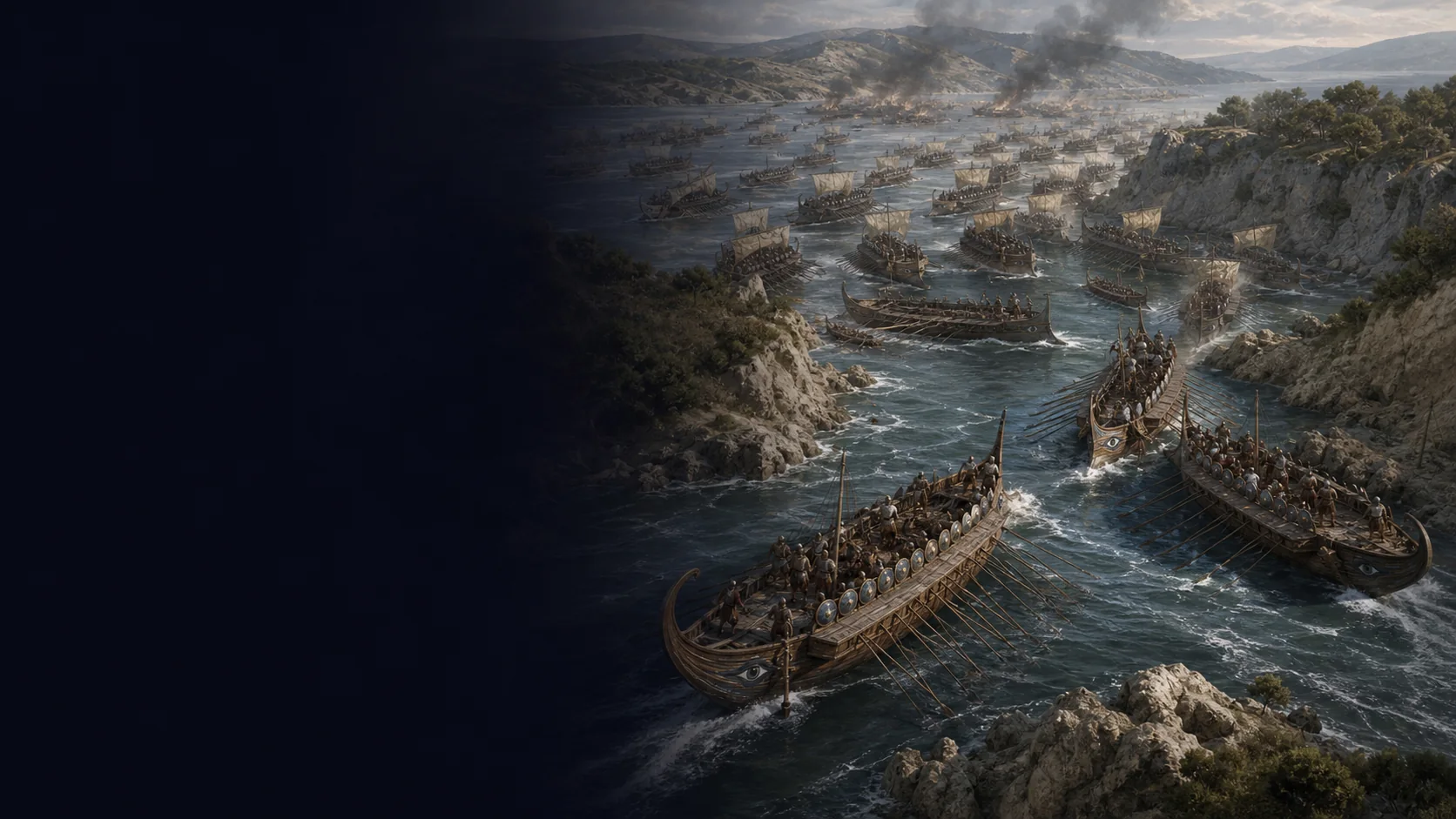
A divided coalition, a night closure, and imperial depth turned into congestion
Military history
How did Greek division lead Xerxes to commit his fleet in a strait that compressed its depth?
In 480 BC, the Greek allies hesitate over whether to remain near Salamis. The message from Themistocles prompts Xerxes to watch their exits. Forced to fight together, the Greeks exploit the congestion of the opposing squadrons in the strait. The victory removes the immediate naval threat but does not end the Persian invasion.
A coalition divided over the choice
Eurybiades held formal command, but Athens supplied 180 of the 378 triremes in Herodotus's catalogue. After the Acropolis fell, several Peloponnesian commanders wanted to protect the Isthmus; Athenians, Aeginetans, and Megarians preferred to remain near their territories and evacuees. Themistocles swayed the council without possessing absolute authority.
A credible opportunity for Xerxes
Sicinnus announced an enemy fleet divided and ready to flee. The message seemed plausible because it matched a real debate and promised to prevent a dispersal that would deprive Xerxes of a decisive battle. Season, supply, and the need to coordinate fleet and army also made delay costly.
Closure also commits the attacker
During the night, the imperial fleet moved to the strait's approaches and soldiers occupied Psyttaleia. The manoeuvre removed the Greeks' option of separate departure, but imposed a prolonged watch on imperial crews and placed several ranks in a space where orders, replacements, and retreats travelled poorly.
Accounts incompatible in detail
Aeschylus, Herodotus, Diodorus, and Plutarch agree on the deceptive message, night watch, and imperial defeat, but diverge on numbers, wings, guarded approaches, and the first clash. Roux and Tuplin show why no synthesis can turn these variants into one plan. The Hellenic Maritime Museum's scholarly publication confirms that palaeogeography, topography, and reconstruction remain distinct fields of research.
Ancient sourceHérodote, Histoires VIII, traduction A. D. Godley, Loeb Classical Library
VIII.40–48 ; 56–64 ; 67–76 ; 79–96, avec VIII.75–76 pour Sicinnos et la fermeture, VIII.84–86 pour le choc, VIII.91–95 pour le repli et Psyttalie.
Establish the refuge, Greek catalogue, divided councils, message, night closure, confirmations, disputed first clash, congestion, Aeginetan interception, and Psyttaleia.
Academic and cartographic synthesisChristopher J. Tuplin, « Salamis », Encyclopaedia Iranica, figures cartographiques 1–2
Section « The Battle of Salamis », du paragraphe commençant par « Knowledge of the battle » à celui commençant par « The Persian defeat » ; figures 1 et 2 pour les reconstructions concurrentes.
Compare discontinuities among sources, distinguish major closure reconstructions, check the Salamis–Attica–Cynosura–Psyttaleia relationship, and reconstruct the reasons for Xerxes' calculation.
Specialist academic articleGeorges Roux, « Eschyle, Hérodote, Diodore, Plutarque racontent la bataille de Salamine », Bulletin de correspondance hellénique 98.1
1974, p. 51–94 ; p. 51 sur l'absence d'un récit opérationnel continu, p. 80 sur les reconstructions transversale et longitudinale, p. 90 sur une lecture de l'interception éginète ; DOI 10.3406/bch.1974.2097.
Separate the four narratives, identify incompatible reconstructions, and treat Roux's own proposals as historiographical arguments rather than established geometry.
Institutional overviewMinistère grec de la Culture, exposition numérique « The Naval Battle of Salamis »
Section « The Naval Battle of Salamis », du paragraphe commençant par « On the morning of September 28 or 29 » à celui commençant par « The victory of the Greeks » ; crédits institutionnels en pied de page.
Compare the institutional commemorative account—very precise day, strengths, breeze, and sequence—with the limits retained by academic syntheses.
Specialist institutional publicationHellenic Maritime Museum, « Salamis 480 B.C. », volume collectif dirigé par Giannos Lolos et Christina Marabea
Notice du volume, paragraphes commençant par « This collective volume » et « The topics covered » ; 2020, 456 p., ISBN 978-618-82181-7-8.
Document the institutional field of research into sources, palaeogeography, ancient topography, archaeology, and surveys; the notice is not used as evidence for a tactical movement.