An army marching from Harfleur
After capturing Harfleur, Henry V leads a depleted army towards Calais. The French assemble forces to block his route.
Battle
A narrow front turns French numerical superiority into a deadly bottleneck.
Military history
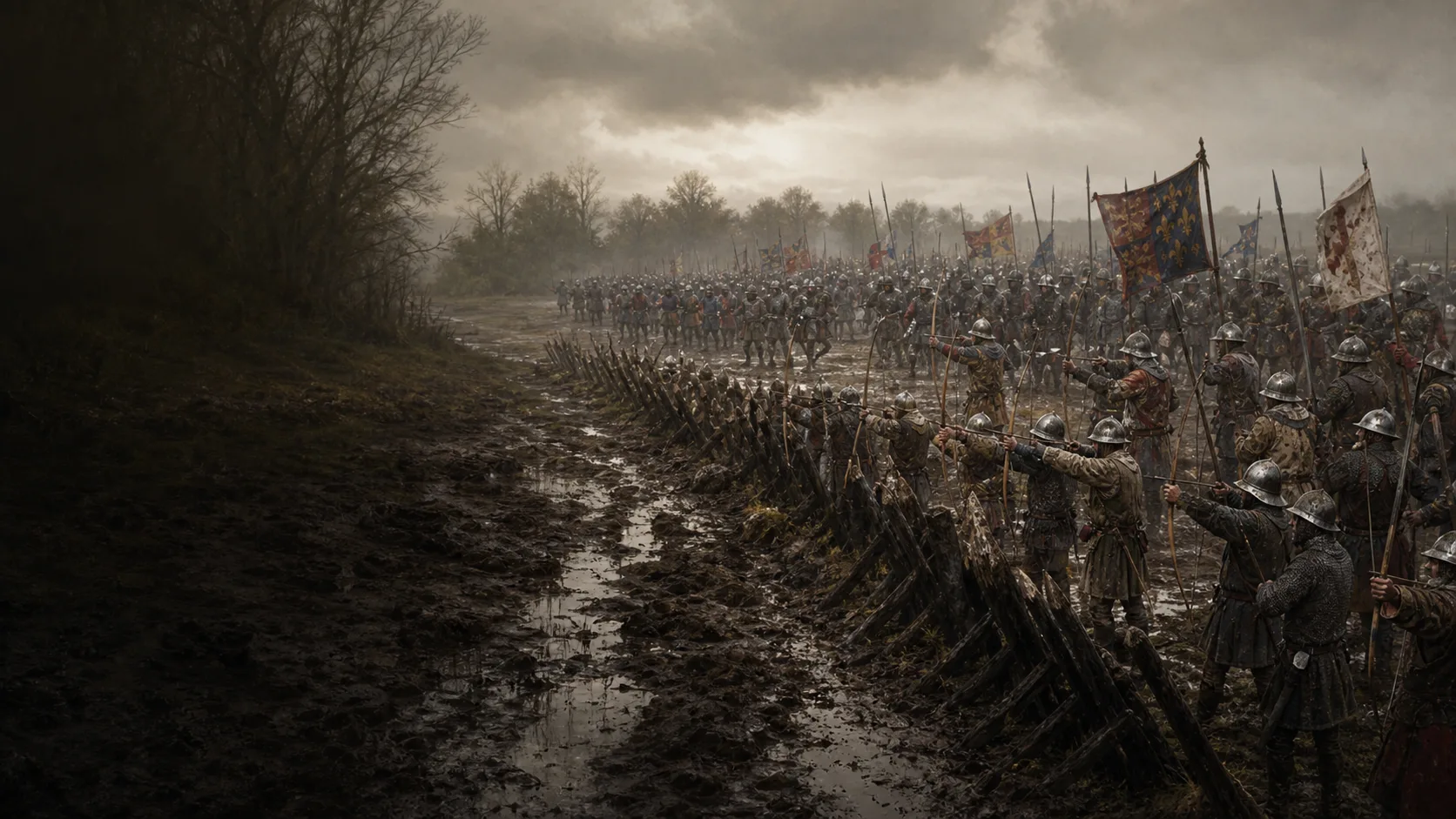
On 25 October 1415, Henry V’s army, weakened after Harfleur, finds its route to Calais blocked. Between two woods, French attacks concentrate against the English archers and men-at-arms. The waterlogged ground, shooting, and congestion compound one another. The English victory is followed by the execution of many prisoners.
After capturing Harfleur, Henry V leads a depleted army towards Calais. The French assemble forces to block his route.
The ground available between Tramecourt and Agincourt woods limits the usable front. Recent rain and mud impede movement, especially for large, heavily equipped bodies of men.
The English fight mainly on foot. Their archers stand on the wings and can protect their positions with stakes, while the men-at-arms form the core of the line.
Estimates differ over exact strengths but agree on clear French numerical superiority. The narrow space reduces the number of men able to fight simultaneously against a prepared line.
Explore
Military history
Traduction Southampton, PDF pp. 2–3 : attente, avance anglaise, pieux et attaques montées ; pp. 3–4 : mêlée ; p. 5, « The killing of the prisoners » : alerte, exécutions et retrait français.
Henry V’s march, terrain, deployment, attacks and immediate outcome.
View ↗Journal of Medieval History, 2017
Campaign context and debates over strengths, terrain and the significance of victory.
View ↗Notice institutionnelle sur la bataille du 25 octobre 1415
Date, dynastic context and caution over the battle’s figures.
View ↗Dossier patrimonial sur la bataille du 25 octobre 1415
Situation map, villages, woods framing the corridor, and the route taken towards Calais.
View ↗