1. Home
  2. Middle Ages
  3. Hundred Years’ War
  4. Castillon

Battle

Castillon

17 July 1453

An artillery camp and its reserves break Talbot's relief march.

Military history

How did the French camp prepared around its artillery turn an English relief march into an assault and then a rupture?

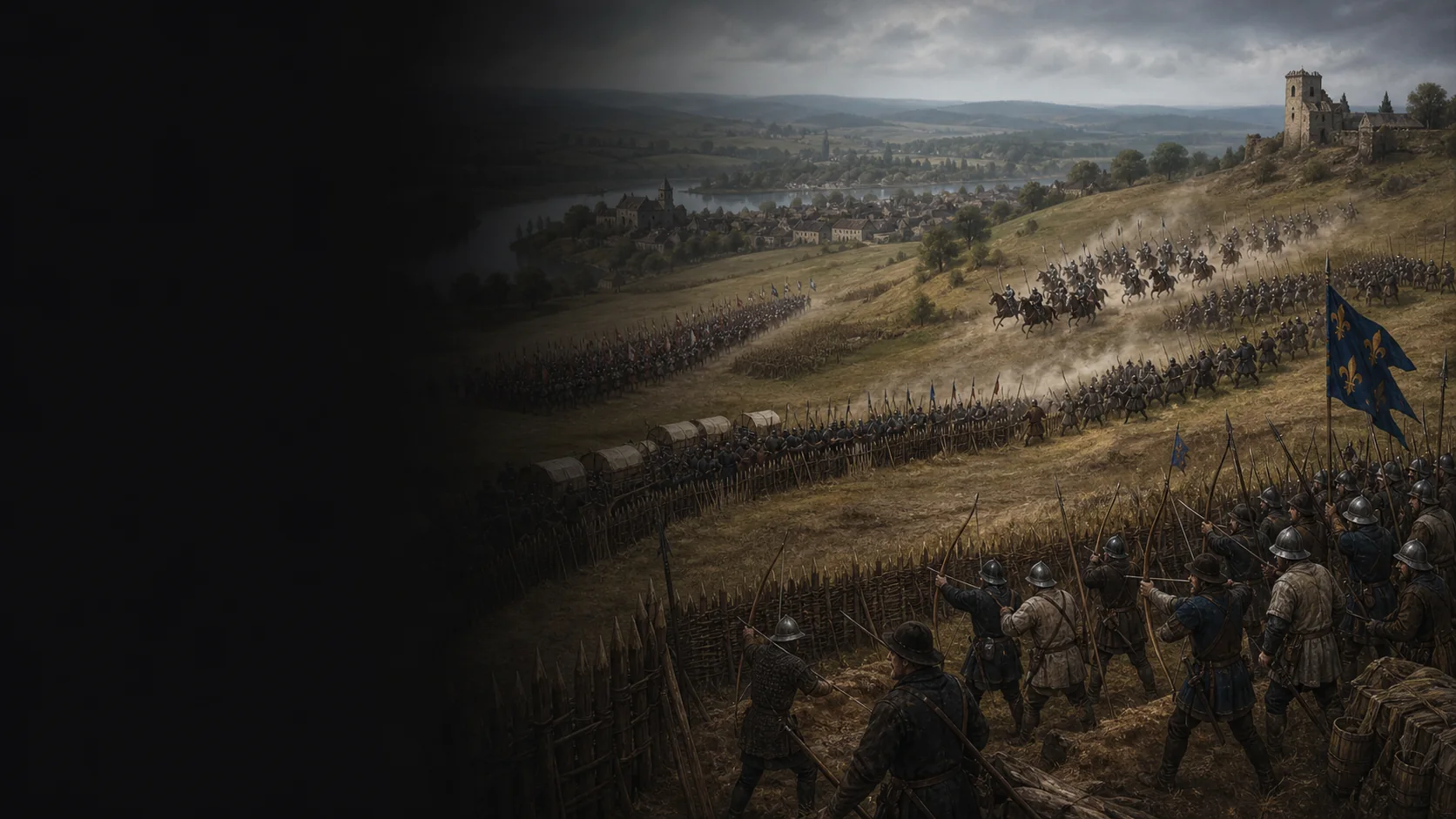
On 13 July 1453, the French army begins the siege of Castillon. Jean Bureau and his pioneers organize an entrenched camp between the Dordogne and Lidoire, while an outpost holds the abbey overlooking the town. On the morning of the 17th, Talbot arrives from Bordeaux to relieve the place; a message from the besieged and a cloud of dust make him believe the French are evacuating. The English vanguard drives back the francs-archers, then the army commits against the ditches and palisades before the Bretons strike its flank. Sustained fire, counterattack and Talbot's death break up the assault. The narrative separates attested facts from the precise location of the camp, strengths and losses, which remain disputed.

Relieving Castillon

The place has been under siege since 13 July. Talbot leaves Bordeaux on the 16th and arrives on the 17th with a force whose total varies by source; his immediate objective is to relieve Castillon. A separate set-piece battle detached from the siege lies outside this dossier's scope.

A camp built to absorb the shock

The French deployment concentrates baggage, artillery and troops in a field enclosed by ditches and palisades. Sources describe a camp between the Dordogne and Lidoire, a post at Saint-Florent and a Breton reserve on the heights; the exact position remains an archaeologically disputed reconstruction.

The information that opens the assault

Castillon's defenders tell Talbot that the French are fortifying themselves out of fear; the withdrawal of French horses then raises a cloud of dust interpreted as an evacuation. The texts establish the English perception but do not prove that the French camp was deliberately presented as a trap.

Figures with consistent scope

The 1,600 to 1,800 men-at-arms and archers and 700 gunners attributed to the French position are not a total for the entire royal army. For Talbot, the royal letter of 22 July gives 6,000 to 7,000 Anglo-Gascons, while the anonymous continuation of the Chronicle of Monstrelet and other chroniclers offer different breakdowns; the dead and captives are likewise reported divergently.

Military history

Sources

Contemporary anonymous continuation of a chronicle, in a teaching source editionContinuation anonyme de la Chronique de Monstrelet — récit de Castillon, 1453

PDF pp. 44–45, source 29 « Defeat in Aquitaine: Battle of Castillon, 1453 » : siège du 13 juillet, fortification du champ, arrivée de Talbot le 17, attaque du camp, feu des couleuvrines et ribaudequins, mort de Talbot et de son fils. L'introduction du recueil, PDF pp. 5–6, précise que les sources 28 à 30 appartiennent à la continuation anonyme après 1444, malgré l'étiquette « Monstrelet » donnée à la source 29.

Chronology of the engagement, organization of the French park, relief march, assault on the camp and outcome; figures are retained with their narrative scope and the collection's critical attribution. Attribution to Monstrelet himself exceeds the documentary use adopted here.

View ↗
Critical edition of a contemporary letterLettre sur la bataille de Castillon en Périgord, 19 juillet 1453

Bibliothèque de l'École des chartes, t. 8 (1847), pp. 245–247 ; l'introduction pp. 245–246 précise que la lettre, copiée dans le manuscrit BnF français 8346, repose sur des nouvelles arrivées à Angoulême le lendemain et n'est pas un témoignage oculaire.

Checking the account's documentary proximity, announcement of victory, Talbot's death and the letter's limits as direct testimony.

View ↗
Specialist historical monographG. du Fresne de Beaucourt, Histoire de Charles VII, tome V

PDF pp. 187–190, chapitre consacré à Castillon et notes 1–9 : message reçu par Talbot, camp entre Dordogne et Lidoire, Saint-Florent, mont Horable, variations d'effectifs, attaque des palissades, sortie bretonne, mort de Talbot, pertes et reddition ; p. 279 pour la transcription de la lettre de Charles VII du 22 juillet.

Cross-checking the chronicles, distinguishing variants in strengths and losses, constructing the tactical chain and locating the edition of the royal letter without turning a late account into sole certainty.

View ↗
Contemporary royal letter transcribed in a historical editionCharles VII, lettre sur la victoire de Castillon, 22 juillet 1453

G. du Fresne de Beaucourt, Histoire de Charles VII, tome V, PDF p. 279 : force adverse de 6 000 à 7 000 hommes, arrivée vers neuf heures, morts de Talbot et de son fils, fuite et catégories de captifs ; la lettre est distinguée de celle écrite à Angoulême le 19 juillet.

Anglo-Gascon strength within the royal scope, reported time, deaths of Talbot and his son, flight and prisoners; these data remain compared with the chronicles rather than merged.

View ↗
Institutional archaeology and cartography reportBilan scientifique 2021, Castillon-la-Bataille : Dordogne et Lidoire

PDF pp. 11–13, notice Castillon-la-Bataille : plaine de Colly, camp supposé à l'est de Castillon entre Dordogne et Lidoire, abbaye de Talbot, gué du Pas-de-Rauzan ; pp. 12–13 et p. 13 signalent les hypothèses cartographiques et la poursuite de la recherche.

Bounding the map, identifying hydrographic constraints and noting that the camp's archaeological location is not definitively fixed.

View ↗
Specialised institutional synthesisLes grandes heures de l'histoire : la bataille de Castillon (1453)

Notice publiée le 6 novembre 2023, paragraphe de présentation : siège du 13 juillet, départ de Talbot le 16, arrivée à l'aube du 17, attaque du camp, feu des pièces, sortie bretonne et mort de Talbot.

Cross-checking the educational chronology and general sequence against an institutional synthesis without using it to fix disputed figures.

View ↗
Specialist military-history studyMichel de Lombarès, « Castillon (1453), dernière bataille de la guerre de Cent Ans, première victoire de l'artillerie »

Revue historique des Armées, 1976, 3/3, pp. 6–31, notice et étude consacrées à Castillon : l'artillerie est traitée dans son emploi tactique et non comme une cause isolée.

Anchoring the specialist military reading of artillery's role and checking that the mechanism combines fire, obstacle, fixation and exploitation.

View ↗
Specialist university articleAndrew D. M. Green, « Regional networks in revolt: opposition to the Valois in Gascony at the end of the Hundred Years’ War, c.1452–1453 »

PDF pp. 0–1 : rôle sous-estimé des troupes gasconnes, estimées jusqu'à un tiers de la force de Talbot ; pp. 12–13 : armée anglo-gasconne d'environ 7 000 hommes, pression pour obtenir une victoire rapide, déroute de Castillon et poursuite de la résistance régionale pendant encore environ trois mois.

Avoiding the shortcut ‘English versus French,’ preserving the Anglo-Gascon coalition, cross-checking the force's order of magnitude and bounding the outcome: field army destroyed and networks struck, but regional campaign unfinished on 17 July.

View ↗
Institutional museum dossierMusée de l’Armée, dossier de presse de l'exposition « Chevaliers et bombardes »

PDF p. 7 : Castillon le 17 juillet 1453, artillerie de Jean et Gaspard Bureau, camp protégé par fossé, attaque de Talbot et mort du chef ; les ordres de grandeur du dossier sont conservés comme synthèse et non comme chiffre primaire.

Cross-checking the institutional presentation of the camp and artillery while distinguishing it from divergent details in the chronicles.

View ↗

Edited by BattlesInMotion.com