1. Home
  2. Middle Ages
  3. Hundred Years’ War
  4. Poitiers

Battle

Poitiers

19 September 1356

Dismount the assault · hold the corridor · turn the mass

Military history

How did a difficult position, successive attacks, and a counterattack allow the Black Prince to defeat a larger army?

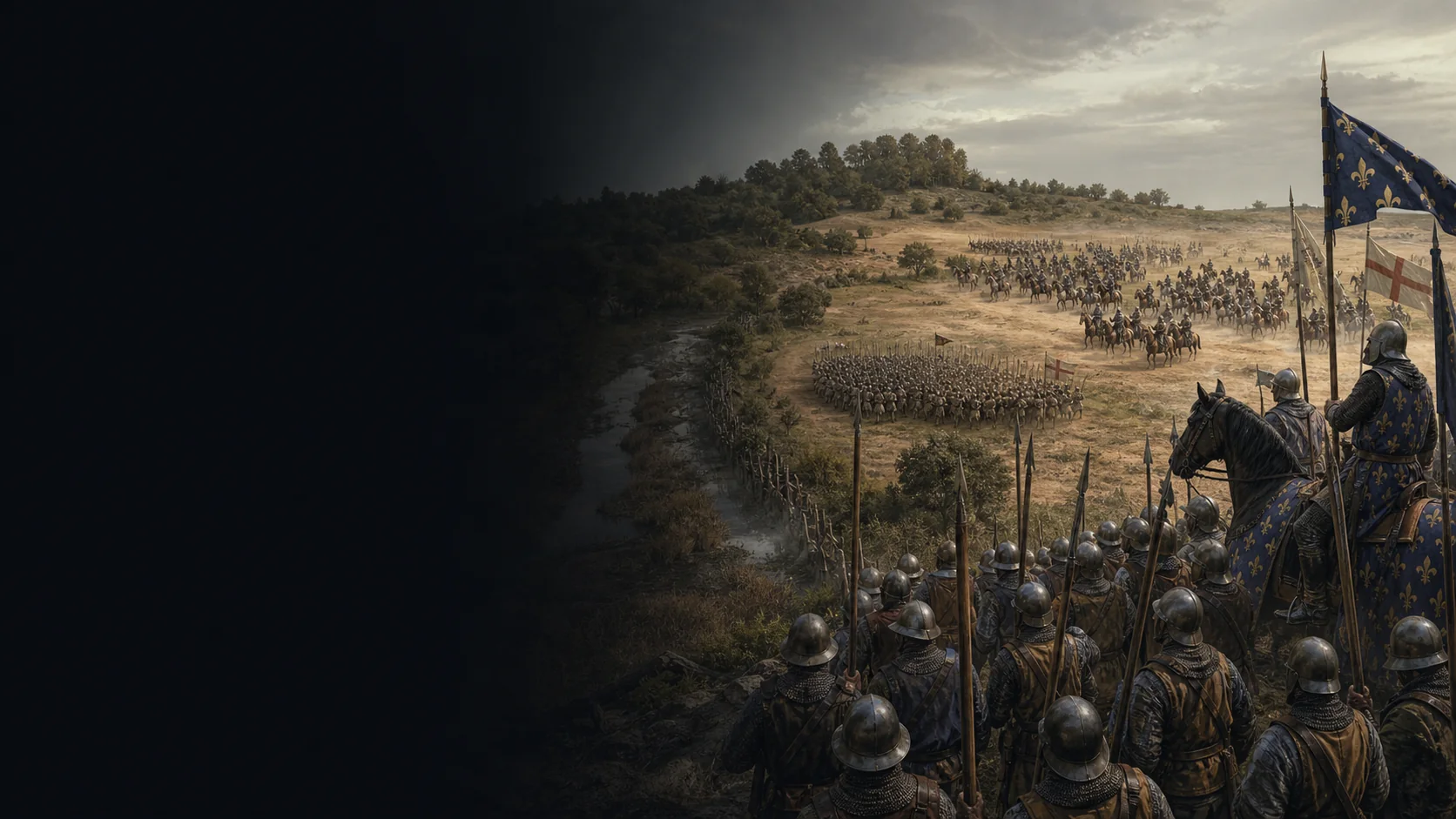
Poitiers is not reduced here to a contest between bow and chivalry. The Black Prince's chevauchée ends under pressure from John II's army; a confined position, hedges, and ditches give the Anglo-Gascon archers and men-at-arms time to absorb several attacks; the French mounted vanguard fails, the dismounted divisions come apart, and the English counterattack then turns French exhaustion into collapse. Captal de Buch's movement and the exact reason for the withdrawal of the Dauphin's divisions remain bounded as reconstructions or disputes.

A chevauchée becomes an escape problem

The Black Prince was returning toward Guyenne after a chevauchée that had reached the Loire and Tours. John II's army progressively closed off his options, while pressure on food and fodder made battle plausible. Whether the Prince specifically sought this engagement or first tried to escape a larger army is a historiographical question, not a fact for the map to settle.

The terrain reshapes the approach

The accounts associate the Anglo-Gascon position with vineyards, hedges, ditches, and a narrow approach; Froissart also mentions mounds and ditches around the archers. The map retains these features as relational zones and axes. It does not claim to reproduce every hedge, the course of the road, or the absolute position of the Miosson exactly.

Dismounting the French mass is not enough

John II sent most of his men-at-arms forward on foot while retaining a mounted vanguard associated with the marshals. The intended effect is legible: force the defended approach, then commit the French divisions in succession. The vanguard's failure, the Dauphin's division withdrawing, and the next division coming apart progressively stripped the French mass of its numerical advantage.

What the sources actually support

The capture of the king and his son is well documented by the chronicles and the Prince's letter. By contrast, strengths, losses, the precise order of the divisions, the course of Captal de Buch's movement, and the reason for the Dauphin's withdrawal vary across accounts and reconstructions. The dossier therefore separates established facts, a working reconstruction of the sequence, and disputes that alter the confidence level.

Military history

Sources

Late medieval chronicle, edited translationJean Froissart, Chronicles of England, France and Spain, trans. Thomas Johnes

London, William Smith, 1848, pp.215–224 : chap. CLX, pp.215–218 (négociations et déploiement) ; chap. CLXI–CLXII, pp.218–222 (maréchaux, division du duc de Normandie, fuite d'Orléans et bataille royale) ; chap. CLXIII, pp.223–224 (capture).

Narrative tradition for the eve and the battle: negotiations, entrenchments, the marshals' vanguard, the archers' effect, withdrawals, the royal division, and the capture; it is compared with other accounts rather than counted as eyewitness testimony.

View ↗
University sourcebook, translated excerpt from FroissartJean Froissart, Battle of Poitiers, Fordham Medieval Sourcebook

Section « The Battle of Poitiers 1356 », passage de « Truly this battle » à « brought him and his son in peace and rest to the prince » : bataille royale, poursuite, reddition de Jean II et de Philippe ; passage suivant sur le souper des prisonniers.

Scholarly access to another translation of the same Froissart narrative for the capture and aftermath; this excerpt is not independent confirmation and does not document the tactical opening.

View ↗
Primary source, contemporary letterLettre du Prince Noir à l'évêque de Worcester, 20 octobre 1356

Ex registro Reginaldi Brien, évêque de Worcester, fol.113 ; transcription publiée d'après Archaeologia, vol.1, pp.213–215, passage « et approchasmes tant q' la bataille se prist » jusqu'à « le dit roi et son fils et plusiers autres g'ntz pris et mortz ».

Contemporary confirmation of the encounter, the French defeat, and the capture of John II and his son; the letter describes neither the order of attacks nor the tactical geometry.

View ↗
Specialist university thesis, campaign studyMatthieu Nicolas, La dynastie des Grailly : une famille noble au cœur de la guerre de Cent Ans

Mémoire de Master 2, Université Toulouse II–Jean Jaurès, 2017, pp.4–8 : pp.4–5 pour campagne, position, forces et avant-garde ; p.6 pour Dauphin et Orléans ; pp.6–7 et notes 11–13 pour le récit de Geoffrey le Baker sur Captal et la rupture.

Critical reconstruction of the sequence, bounds on strengths, role of the vanguard, withdrawals of the divisions, and debate over Captal's initiative.

View ↗
Specialist academic monographPeter Hoskins, In the Steps of the Black Prince, chap. 13 « Battle Joined »

Boydell & Brewer, 2011, chap.13, pp.165–192 ; résumé éditorial sur Nouaillé-Maupertuis, 18–19 septembre, notamment le besoin d'eau et de provisions près du Miosson.

Logistical context, selection of the site, and a modern check on the battle sequence; it is not used to turn the editorial summary into exact coordinates.

View ↗
Specialist academic articlePeter Hoskins, The Itineraries of the Black Prince's Chevauchées of 1355 and 1356

Journal of Medieval Military History VII, 2009, pp.12–37 ; résumé et métadonnées indiquant l'emploi de Geoffrey le Baker et de l'Eulogium et l'incertitude des toponymes de route.

To bound the route of the chevauchée and avoid presenting an operational intention or continuous trajectory as certain.

View ↗
Local institutional source, municipal heritageNouaillé-Maupertuis, Bataille de Poitiers

Page municipale Intramuros, sections sur le 19 septembre : bataille, armées, haies et chemin bordé de fossés, capture de Jean II et de Philippe.

Place-name conventions, local memory of the terrain, and institutional confirmation of the capture; the page's simplified figures are not reused as a definitive count.

View ↗
Historical institutional cartographySamuel Rawson Gardiner, School Atlas of English History, carte de la bataille de Poitiers

Maps ETC, University of South Florida, page 430 : carte et légende mentionnant Miosson, marais, bois de Nouaill et principales formations.

Check on map nomenclature and relative landmarks; no coordinates from this map are copied directly.

View ↗
Specialist work, military synthesisDavid Nicolle, Poitiers 1356: The Capture of a King

Osprey, 2004, synopsis et sommaire éditeur : sections Background to campaign, Chronology, Opposing plans, Campaign et Aftermath ; résumé sur le retournement au sud de Poitiers et la bataille forcée.

Check on the campaign and its political consequence; tactical details are cross-checked against primary and scholarly sources.

View ↗
Specialist monograph, military historyMarilyn Livingstone et Morgen Witzel, The Black Prince and the Capture of a King: Poitiers 1356

Casemate, 2018, description éditorial de la campagne de juillet–septembre, du combat et de ses conséquences politiques et personnelles.

Check on the political scope of the capture and on the distinction among tactical victory, ransom, and the end of the war.

View ↗
Specialist history press, secondary reconstructionThe Past, Banners Advance: The Battle of Poitiers, 1356

Sections The Battle et The Prince's Charge : position dans le couloir, archers, remonte et manœuvre attribuée à Captal ; l'article est utilisé comme reconstruction moderne, avec une fonction distincte de celle d’une source primaire.

Comparative check on the legible sequence and tactical functions; figures and topography remain qualified when not corroborated.

View ↗
Academic journal, topographical historiographyCompte rendu de Tourneur-Aumont, La bataille de Poitiers (Maupertuis, 17–18–19 septembre 1356)

Revue de synthèse historique, vol.93/1, 1939, pp.109–110 : notice critique d'un travail fondé sur l'étude des textes et du terrain.

Historiographical basis for bounding the topography and rejecting a falsely precise map.

View ↗

Edited by BattlesInMotion.com