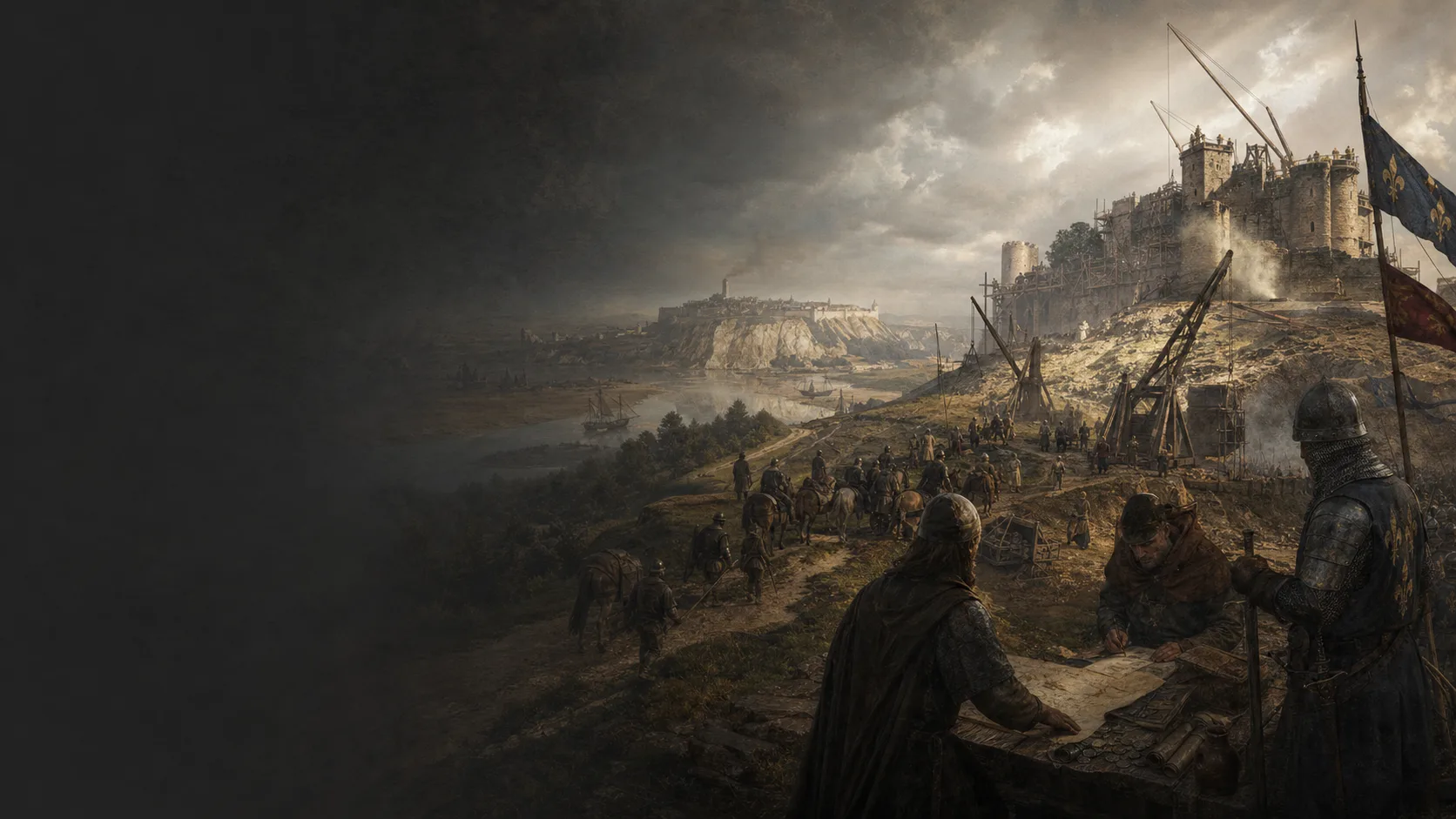
English victories
Crécy, Calais and Poitiers show the effectiveness of an army combining archers, defensive positions and operational mobility, but territorial gains remain costly to hold.
War
An intermittent war in which armies must follow taxation, strongholds and alliances
Military history
The Hundred Years’ War is not a continuous front line but a succession of campaigns, truces and dynastic crises. The English exploit the longbow, chevauchées and port strongholds; the French learn to avoid certain battles, retake fortresses and make taxation an instrument of reconquest.
Crécy, Calais and Poitiers show the effectiveness of an army combining archers, defensive positions and operational mobility, but territorial gains remain costly to hold.
Charles V and his captains favour sieges, harassment and the methodical recovery of strongholds. Great English chevauchées yield booty without always producing a political decision.
After Agincourt, the English monarchy gains dynastic advantages, then French resistance and artillery gradually recover ground until almost all continental possessions are lost.
Explore
Military history
Court and battle narratives, valuable but marked by noble perspectives.
Political chronology, campaigns, finance and the evolution of the balance of power.
Agincourt, armies, sources and the limits of narratives of numerical superiority.
PDF de la Historical Association, section 14 “Battle of Patay 18 June 1429”, pp. 25–26, lignes 767–814 : éclaireurs, cerf et cri, haies, préparation interrompue, choc, captures et chiffres de cette version.
Cross-check of Wavrin’s account against another chronicle; the translation and figures are explicitly treated as a narrative version, distinct from a final count. Limited to the case of Patay; this reference does not cover the whole conflict.
View ↗