1. Home
  2. Middle Ages
  3. Hundred Years’ War
  4. Patay

Battle

Patay

18 June 1429

Locate · hasten · break · pursue

Military history

How does the French pursuit turn the English retreat into defeat before the archers can redeploy?

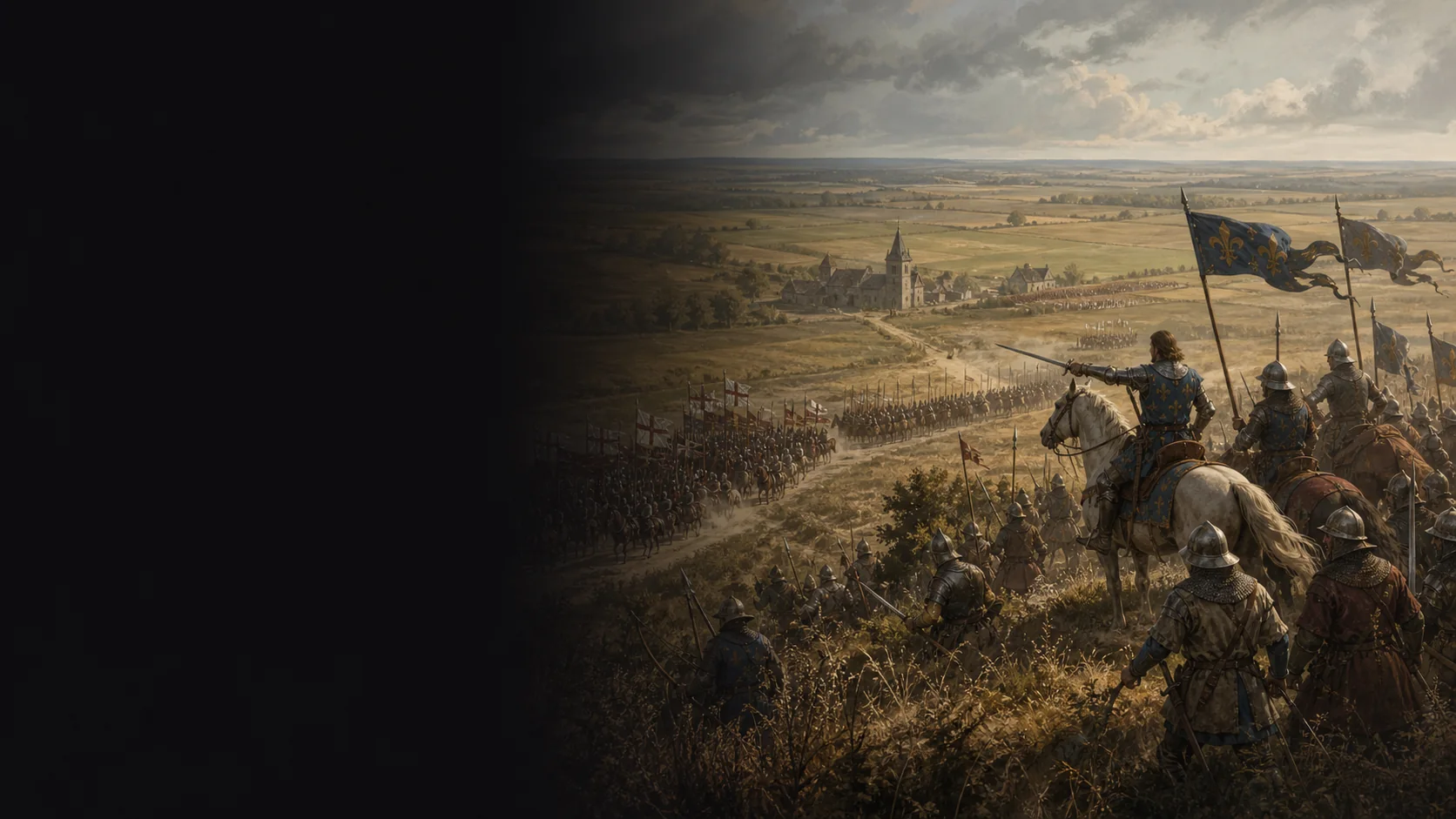
Patay is the product of a window of time, distinct from an isolated miraculous charge. After the French successes on the Loire, Chartier and Wavrin describe an English force marching towards Patay and Janville, preceded by its train and followed by a rearguard. The French catch it before hedges, missile troops and stakes form a coherent defence. The stag and cry said to have revealed the column belong to several chronicle narratives; the robust mechanism is discovery followed by contact rapid enough to prevent the force from forming up.

The Loire successes shift the fighting

After Jargeau, the bridge at Meung and Beaugency, the French royal army retains the initiative. Beaugency’s surrender and the abandonment of Meung make a pursuit into the Beauce possible; Patay is where the English relief column is caught, distinct from a battle long prepared in advance.

An English column still on the march

Chartier distinguishes the vanguard, artillery, provisions and merchants, then the main body and rearguard. Wavrin likewise describes a column that stops near Patay after pursuers are reported. This organisation explains the vulnerability of a hurried halt without allowing every subunit to be drawn.

The hedges form a partial position

Wavrin reports that Talbot dismounts with about five hundred elite archers to hold a passage between hedges while awaiting the main body and rearguard. Cugnac and Soyer emphasise that the French arrive before preparations are complete. The precise type and continuity of the obstacles remain reconstructed. Exact measurement lies beyond the dossier’s scope.

The clash creates the rupture

Chartier places the French vanguard, with La Hire and Poton de Xaintrailles, in contact before the English bodies have joined among the hedges. Wavrin then reports Talbot’s capture, Fastolf’s flight and an English defeat; totals of dead and prisoners differ among the chronicles.

Military history

Sources

Narrative primary source, critical editionJean Chartier, Chronique de Charles VII, éd. Vallet de Viriville

PDF, chap. 44, pp. 152–154 : nouvelles après Beaugency, marche vers Patay, avant-garde nommée, lisière boisée près d'un village, capture de Talbot et poursuite ; OCR consultable aux lignes 3271–3319.

Primary narrative source for the chain retreat → pursuit → vanguard → woodland edge → defeat; strengths and losses are retained as the chronicle’s version, with a function distinct from measurement.

View ↗
Narrative primary source, edited Burgundian chronicleJean de Wavrin, Recueil des croniques et anchiennes istories de la Grant Bretaigne, dans Quicherat, tome IV

Quicherat, Procès de Jeanne d'Arc, t. IV (1847), pp. 421–423 ; transcription Wikisource, pages 436–438 : ordre de marche et arrêt près de Patay p. 421, haies et cinq cents archers p. 422, cerf, choc, capture de Talbot et chiffres de la version p. 423.

Burgundian perspective on the column, hedges, Talbot’s role and the divergent outcomes of Talbot and Fastolf; the transcription is checked against the printed reference on pp. 421–423.

View ↗
Translated primary source, specialised institutional compilationEnguerrand de Monstrelet, récit de Patay dans After Agincourt: A selection of contemporary sources

PDF de la Historical Association, section 14 “Battle of Patay 18 June 1429”, pp. 25–26, lignes 767–814 : éclaireurs, cerf et cri, haies, préparation interrompue, choc, captures et chiffres de cette version.

Cross-check of Wavrin’s account against another chronicle; the translation and figures are explicitly treated as a narrative version, distinct from a final count.

View ↗
Specialised article in the Revue historique des ArméesMichel de Lombarès, “Patay, 18 juin 1429”

Revue historique des Armées, 22-4 (1966), pp. 5–16, DOI 10.3406/rharm.1966.5997 ; p. 5, lignes 37–54 pour le contexte de Loire et la géographie générale de la campagne.

Specialised military framework for the campaign and check of the relationship between the Loire bridges and pursuit into the Beauce; location details remain bounded.

View ↗
Specialised article in the Revue historique des ArméesJean de Cugnac, “Les grandes heures de la cavalerie française (fin)”

Revue historique des Armées, 13-4 (1957), pp. 29–58, DOI 10.3406/rharm.1957.10168 ; p. 29, lignes 47–53 : avant-garde en poursuite, bois, haies, archers à pied et attaque avant l'ordonnance.

Specialised cross-check of the tempo and close-contact mechanism; used for causality. Establishing an exhaustive topographical plan lies beyond the documentary use made here.

View ↗
Specialised archival synthesis, publication of the Bibliothèque de l’École des chartesJacques Soyer, La bataille de Patay (samedi 18 juin 1429)

Notice Persée, Bibliothèque de l'École des chartes, t. 76 (1915), p. 172 : présentation d'un discours de onze pages fondé sur les documents contemporains et annoncé comme un récit technique.

Identification of the late, archival nature of Soyer’s reconstruction; its figures and terrain identification are never elevated to independent contemporary evidence.

View ↗
Specialised transcription of a local archival studyJacques Soyer, discours de 1913 sur la bataille de Patay, transcription

Sections du texte, lignes 65–86 : retraite vers Janville, organisation de la colonne, Retrève, Lignerolles, haies, pieux, poursuite et pertes ; lignes 99–105 : plan cadastral et citation de Wavrin, pp. 421–422. Lignerolles y est explicitement une inférence, à distinguer d’un nom présent dans le texte de Chartier.

Toponymy and cadastral plan used to support a relational reconstruction; the source is dated, local and secondary, and its precision is separated from facts attested by the chronicles.

View ↗
Institutional iconographic source, BnF/BiblissimaMartial d'Auvergne, Les Vigiles de la mort de Charles VII, bataille de Patay

BnF, manuscrit Français 5054, fol. 58v ; notice Biblissima, image Gallica f. 128. Manuscrit enluminé postérieur aux faits : utile pour l'histoire de la mémoire. Les positions et les effectifs reposent sur les autres documents du dossier.

Institutional check of Patay iconography and safeguard against using a late representation as a map or direct testimony.

View ↗

Edited by BattlesInMotion.com