A defence in depth rescued by an about-face under pressure
Military history
How did Morgan turn the uneven reliability of his troops into a layered defence and then an envelopment?
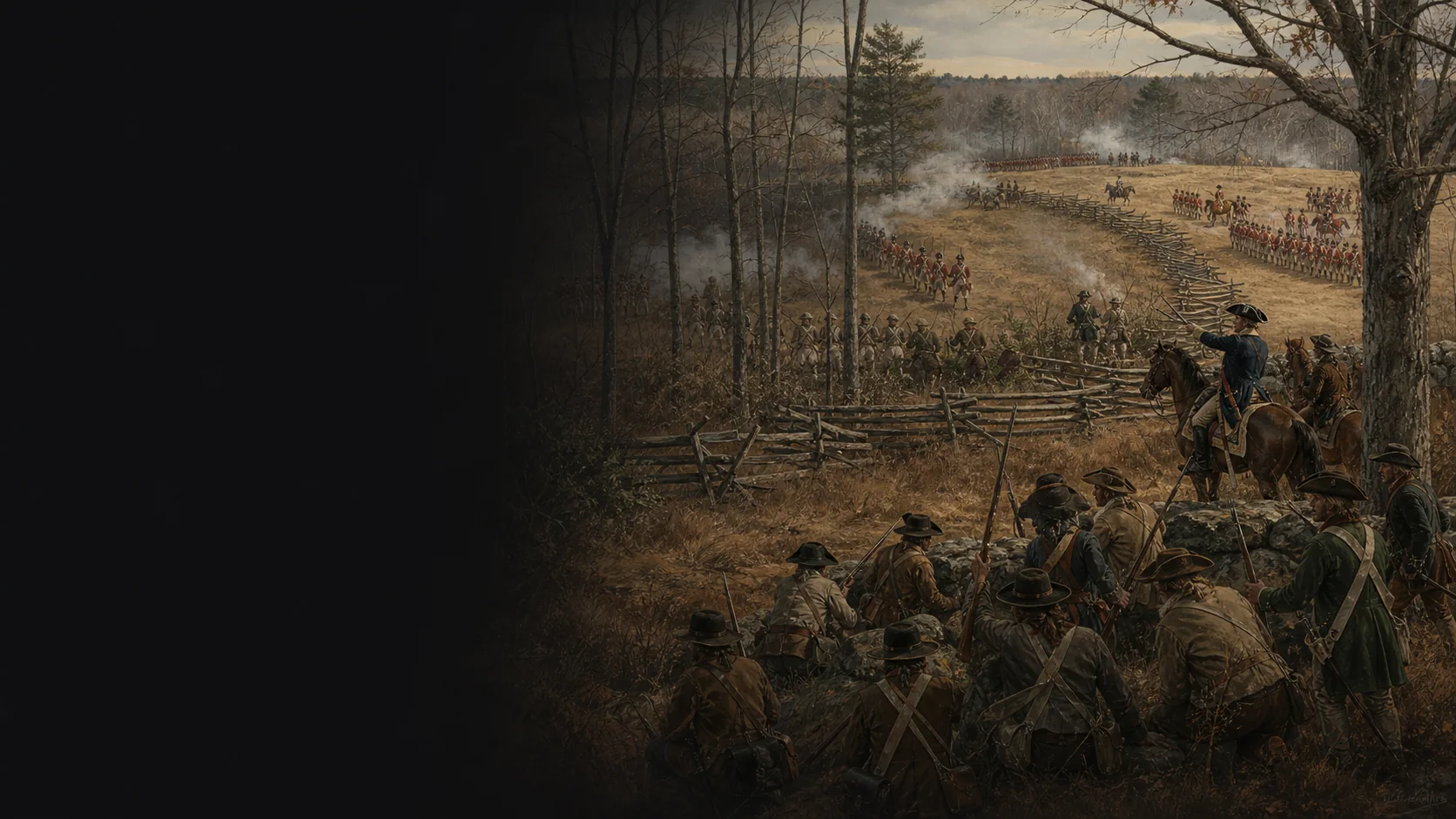
Morgan deploys his men according to their capabilities: skirmishers and militia slow Tarleton, then the Continentals hold the main line. But the success is not entirely planned: a misunderstood change of front makes Howard fall back. His ranks remain orderly enough to turn, fire at short range, and charge. The return of the militia and Washington’s cavalry then turn British disorder into surrender.
Greene disperses his forces to survive
After the reverses of 1780, Nathanael Greene divided his Southern Army: Morgan moved southwest of the Catawba to threaten British operations and supplies in the backcountry. Cornwallis responded by sending Tarleton against this mobile detachment. Cowpens was therefore first the result of a pursuit through a ravaged theatre, not an abstract encounter between two intact armies seeking battle.
Morgan chooses a tolerable risk
Morgan abandoned his positions near the Pacolet and Thicketty Creek, then stopped at the Cowpens, an open pasture near Green River Road. The Broad River, swollen by rain, made an immediate retreat more dangerous; the field, however, provided space, visibility, and forage. In his report, Morgan justified the site by the opportunity to improve an advantage or better secure his safety in case of failure. An explanation based on certainty of a perfect trap goes beyond the dossier.
The figures change with the scope
Morgan's report says that 800 men fought, two-thirds of them militia, and estimates the British force at no fewer than 1,150 including its baggage guard; it also reports a British figure of 1,037. Institutional accounts count a broader American ‘Flying Army’ of about 1,700 men and roughly 1,200 British and Loyalists. These figures do not necessarily refer to the same scope: those present, detachments, baggage guards, and troops actually engaged are not interchangeable.
The disputed point is the about-face
The withdrawals of the skirmishers and militia are documented as orderly actions, even if the ‘two shots’ formula comes mainly from interpretive tradition. Howard, however, described confusion that arose when he tried to change the front of Wallace's company: first part of the line and then the entire line began to fall back, before Morgan and Howard halted and turned them. The victory rests on this distinction between a prepared withdrawal and a misunderstood movement.
Primary document, campaign report reproduced by the United States ArmyDaniel Morgan à Nathanael Greene, rapport de Cowpens, 19 janvier 1781
Cowpens Staff Ride Handbook, Appendix C, document 1, PDF pp. 126–129 (pagination imprimée de l'appendice 122–125) : choix du poste, formation des lignes, feux, retraits, charge, pertes, prisonniers et effectifs revendiqués.
Principal primary source for the American and British dispositions as reported by Morgan, the sequence of fire and withdrawals, the charge, captures, losses, and limits of his own count.
Primary document, later testimony from a commander who took partJohn Eager Howard, témoignage sur la ligne continentale à Cowpens
Cowpens Staff Ride Handbook, Appendix C, document 3, PDF pp. 130–134 (pagination imprimée 126–131), surtout PDF pp. 131–132 : changement de front de Wallace, confusion de retraite, arrêt sur la hauteur, volée, charge et prise de l'artillerie.
Correction of the causality behind the about-face: distinction between the militia's prepared withdrawal and confusion in the Continental line, followed by a description of the fire and charge.
Official publication, National Park ServiceCowpens National Battlefield, « The Battle of Cowpens »
Paragraphes 22–51 : campagne du Sud, poursuite depuis le Pacolet, choix des Cowpens, lignes successives, confusion de Howard, enveloppement, pertes et suite vers Guilford Courthouse et Yorktown.
Operational framework and institutional synthesis of the sequence; popular formulations about the two shots, the trap, and the turning point are checked against the primary documents.
Official account, National Park ServiceCowpens National Battlefield, « Lieutenant Colonel Banastre Tarleton »
Paragraphes 24–35 : combinaison infanterie-cavalerie, poursuite de Morgan, interprétation des lignes qui se replient, confusion de retraite, sortie de Tarleton et limites de l'image du commandant.
British perspective and caution against reducing a biography to the ‘butcher’ persona; the page cites works by Tarleton and Babits without being treated as Tarleton's primary account.
Official publication, National Park ServiceCowpens National Battlefield, « Forty-eight Hours Following the Battle of Cowpens »
Paragraphes 22–39 : fuite de Tarleton avec 54 cavaliers, franchissement du Broad, prisonniers, rapport de Morgan du 19 janvier, soins aux blessés et marche vers la Catawba.
Immediate consequences and the link between tactical victory, guarding the prisoners, and Cornwallis's pursuit.
Institutional archaeological publication, NPS Southeast Archeological CenterTesting the Battle Field at Cowpens (COWP)
Paragraphes 24–29 : sondages et détection de 2012, sept balles de mousquet et trois projectiles tirés, question de l'emplacement interprété du camp et possible position de la troisième ligne.
Archaeological and cartographic limit: material evidence shifted the interpretation of the field and prevents the lines from being given greater precision than the sources.
Official synthesis, United States Army Center of Military HistoryAmerican Military History, vol. I, « The Winning of Independence, 1777–1783 »
PDF pp. 114–116 (pagination imprimée 97–98), Map 11 « Battle of the Cowpens » : lignes de milice et Continentaux, cavalerie, attaque britannique, double enveloppement et course qui suit vers Greene et le Dan River.
Second institutional synthesis and check on the schematic map, spatial transitions, and operational significance after Cowpens.
Institutional account, National Museum of the United States ArmyCowpens: 17 January 1781, Founding the Nation Trail
Introduction, paragraphes 272–291 : environ 1 200 Britanniques et Loyalistes contre une Flying Army américaine d'environ 1 700, deux tirs de la milice, enveloppement et initiative stratégique de Greene.
Institutional contrast regarding the scope of the strength figures and a summary of the strategic effect. Using it to erase the lower figures in Morgan's report would go beyond the documentary use adopted here.
Specialist work, university press descriptionLawrence E. Babits, A Devil of a Whipping: The Battle of Cowpens
Page de présentation de l'University of North Carolina Press, paragraphes 131–136 : usage des déclarations de vétérans, des récits publiés, de l'armement, du terrain, des blessures et critique des mythes ; bibliographie et auteur aux paragraphes 137–157.
Specialist reference point for Babits's reconstruction method and to indicate that several celebrated details, notably the about-face and losses, are reconstructed from incomplete testimony rather than read from a uniform chronicle.