1. Home
  2. Gunpowder & Empires
  3. American War of Independence
  4. Saratoga

Battle

Saratoga

19 September — 17 October 1777

Freeman's Farm wears down the offensive; Bemus Heights opens the encirclement.

Military history

How did Burgoyne win the field at Freeman's Farm and then lose his freedom of manoeuvre and his army?

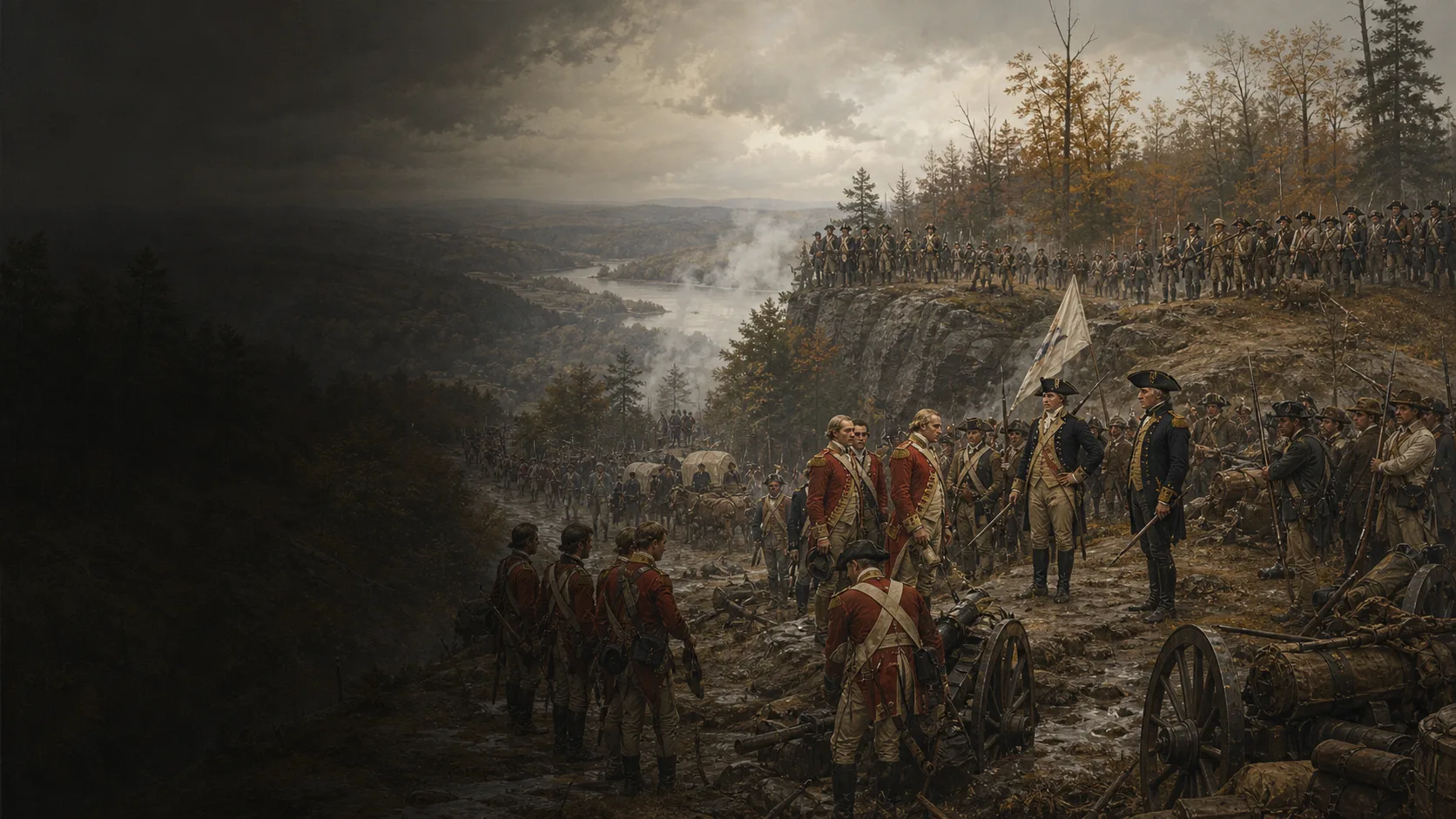
Saratoga denotes a sequence, not a single clash. On September 19, Burgoyne's army held the field at Freeman's Farm without opening the road to Albany. During the ensuing pause, its provisions dwindled while Gates's army grew. On October 7, a British reconnaissance in force triggered the American counterattack at Barber's Wheatfield and then the fall of Breymann's position. The retreat towards Saratoga became an encirclement.

An expected convergence

Burgoyne advances from Canada towards Albany expecting British cooperation. St Leger has left the Mohawk Valley; Howe is campaigning towards Philadelphia; Clinton does not act in the Highlands until October. The degree of intended coordination among these movements remains disputed, but their absence at the decisive moment is established.

Bemus closes the corridor

On the west bank of the Hudson, the road to Albany passes beneath a fortified ridge. The river protects Gates's eastern flank and channels the British march; woods, ravines, and poor roads slow the columns and their baggage.

Time reverses the balance of forces

After September 19, Burgoyne fortifies his camp and waits for news of Clinton. American patrols harass its perimeter, Continental reinforcements and militia join Gates, and the British ration is reduced by one-third on October 3.

Arnold's role must remain bounded

Arnold plays a major role in both battles and is wounded before Breymann's position. However, no known order formally proves that he had been relieved of command before October 7; accounts diverge over the exact moment when he joined the action.

Military history

Sources

Printed primary sourceJohn Burgoyne, A State of the Expedition from Canada

2e éd., Londres, 1780, Narrative, pp. 21–27 ; surtout p. 23 (19 septembre), pp. 24–25 (attente) et p. 26 (7 octobre, pénétration à Breymann).

Decision to cross the Hudson, British reading of September 19, reasons for the pause, action on October 7, and loss of Breymann.

View ↗
Contemporary primary archiveHoratio Gates and John Burgoyne, Saratoga Convention, 16 October 1777

Library of Congress, George Washington Papers, Series 4, General Correspondence, MSS 44693, reel 044, images 1–4, document daté du 16 octobre 1777.

Negotiated nature of the surrender, date of signature, and terms of the Convention.

View ↗
Institutional military study and cartographySteven E. Clay, Staff Ride Handbook for the Saratoga Campaign, 13 June to 8 November 1777

Combat Studies Institute Press, 1re éd., 2018 : pp. 101–121 ; Appendix F, pp. 305–314 ; note sur Arnold p. 122 et note 2 p. 313 ; cartes 43–50, pp. 399–406.

Terrain, order of battle, strengths, tactical and operational chronology, redoubts, retreat, surrender, and uncertainty over Arnold's status.

View ↗
Modern academic monographKevin J. Weddle, The Compleat Victory: Saratoga and the American Revolution

Oxford University Press, 2021 : chapitres « Gates Takes Command » (début p. 258), « The Battle of Freeman’s Farm » (p. 272), « Sir Henry Clinton to the Rescue » (p. 294), « The Battle of Bemis Heights » (p. 307) et « Retreat, Pursuit, and Surrender » (p. 329).

Campaign causality, command, logistics, the two battles, retreat, and strategic significance.

View ↗
Official institutional synthesisSaratoga National Historical Park, Battle of Freeman’s Farm

Section « perhaps the hottest ever fought in America », paragraphes sur les trois colonnes, Morgan, les combats de 15 h à la nuit, les 750 renforts de Riedesel et les pertes ; mise à jour du 29 novembre 2024.

Three columns, Morgan's contact, commitment in waves, Riedesel's arrival, and tactical outcome of September 19.

View ↗
Official institutional synthesisSaratoga National Historical Park, Battle of Bemus Heights

Paragraphes 1–10 sous « Battle of Bemus Heights » : décision de reconnaissance, sortie de plus de 1 500 hommes, déploiement américain, repli, Breymann et concentration près de l’Hudson ; mise à jour du 29 novembre 2024.

Reconnaissance in force, Barber's Wheatfield, American attacks, Fraser's death, the Balcarres and Breymann positions, and operational outcome.

View ↗
Official institutional chronologySaratoga National Historical Park, Campaign Timeline

Entrées des 12, 13, 19 et 20 septembre, puis des 3, 6, 7, 8–10, 10–14, 14–16 et 17 octobre 1777.

Dates, reinforcements, crossing of the Hudson, two battles, retreat, closure of exits, negotiations, and laying down of arms.

View ↗
Specialist contemporary mapThe encampment & position of the army under Lt. Gen. Burgoyne at Swords’s and Freeman’s Farms

Library of Congress, Geography and Map Division, item gm71000664, carte manuscrite de 1777, View 2 ; Swords’s Farm, Freeman’s Farm, Hudson et lignes d’encampement.

Topology of Freeman Farm, Great Ravine, roads, and British positions after the first battle.

View ↗
Specialist historiographyMike Barbieri, Arnold in Command at Bemis Heights?

Sections « The Original Story » et « Summary », paragraphes 1–3 et 12–15 ; notes 1–12, notamment Gates à Hancock (12 octobre), Burgoyne p. 26 et Wilkinson, Memoirs, p. 273.

Comparison of testimony concerning Arnold's status, time of arrival, and effective command on October 7.

View ↗
Institutional diplomatic synthesisU.S. Department of State, French Alliance and European Diplomacy, 1778–1782

Paragraphes 16–19 ; surtout paragraphe 17 sur la nouvelle reçue en décembre 1777 et la signature des deux traités le 6 février 1778.

Link between the arrival of news from Saratoga, Vergennes's decision, and the treaties of February 6, 1778.

View ↗

Edited by BattlesInMotion.com