1. Home
  2. Gunpowder & Empires
  3. American War of Independence
  4. Trenton

Battle

Trenton

26 December 1776

A delayed crossing becomes an urban victory

Military history

How did a partly synchronised winter crossing become a rapid urban victory at Trenton?

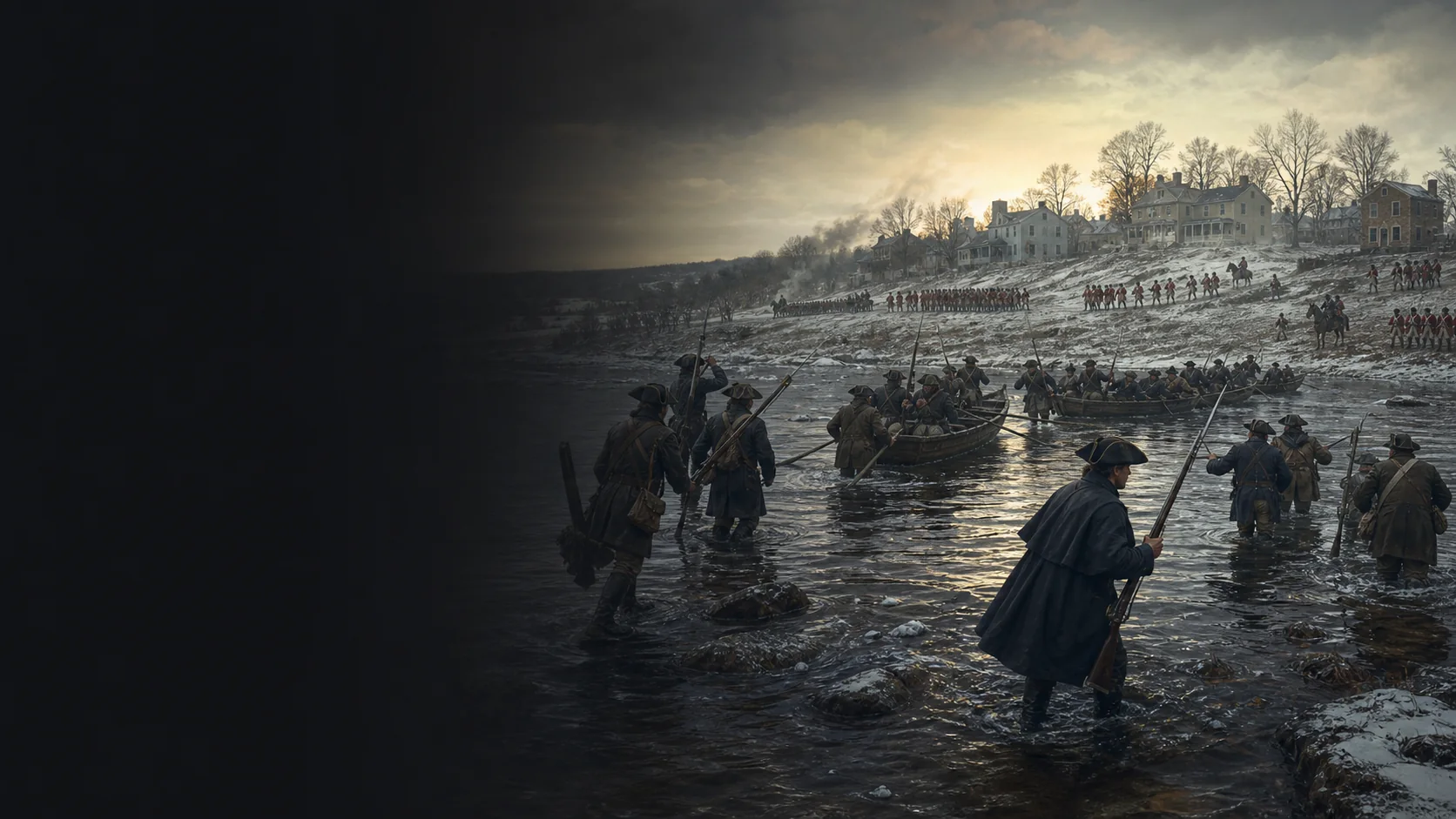
The First Battle of Trenton is reconstructed here as a chain of decisions. Washington planned three crossings of the Delaware, but ice and the storm allowed only the main column to succeed; after a night march, Greene and Sullivan converged by Pennington Road and River Road while the artillery sealed the streets. The Hessian garrison had received warnings and increased its guards in the preceding days, but did not anticipate this general attack; it then lost its guns, connections, and exits. Numbers present, captured, and lost remain bounded by the sources and are not converted into a single homogeneous headcount.

A narrow strategic window

After the American retreat to the Delaware, Washington sought a quick success before enlistments expired and before the chain of British and Hessian garrisons tightened. Trenton was an exposed target, but a local victory meant neither the destruction of the entire British presence nor the end of the war.

The actual plan and its limits

The plan called for three crossings: Washington's main column at McKonkey's Ferry, Ewing toward Trenton, and Cadwalader from Bristol/Dunk's Ferry to contain the southern posts. Neither supporting column crossed with the means it needed; the battle must therefore not be drawn as an effectively coordinated three-axis attack.

Lost time becomes cover

Ice delayed the boats and the artillery had crossed only by about 3 a.m.; the march began around 4 a.m. in snow, sleet, or freezing rain. Washington believed surprise was compromised but continued. Trenton had outposts and had received warnings; bad weather, fatigue, and a mistaken reading of American contact prevented the garrison from turning those signals into an effective mobilisation.

The town closes the options

The American columns and artillery entered along separate axes, then the fighting concentrated in the streets. Taking or blocking the guns, King Street, the Princeton road, and the Assunpink bridge separated the Hessian groups. Capitulation was thus the product of a progressive closure, not merely surprise or general numerical superiority.

Military history

Sources

Contemporary primary source; official letter by George WashingtonGeorge Washington to John Hancock, 27 December 1776

Founders Online, National Archives, paragraphes de la transcription sur le passage à McKonkey's Ferry, l'artillerie vers 3 h, la marche vers 4 h, les deux routes, l'arrivée vers 8 h, la capture et les tentatives d'Ewing/Cadwalader ; édition Papers of George Washington, Revolutionary War Series, vol. 7, pp. 454–461.

Primary chronology, the decision to continue despite the delay, separation of the routes, the capture, numbers delivered, and failure of the supporting columns.

View ↗
Second educational transcription of the same primary letterGeorge Washington to the Continental Congress, December 1776

PDF de transcription hébergé par l'Ohio State University History Teaching Institute, p. 1–2 : paragraphes sur McKonkey's Ferry, les canons passés vers 3 h, la marche vers 4 h, les deux divisions, la capitulation et les pertes.

Transcription check on the letter to Hancock for chronology, routes, weather, American losses, and the return with prisoners and artillery; this PDF is not independent of the Founders Online edition.

View ↗
Official institutional source; New Jersey Department of Environmental ProtectionWashington Crossing State Park

Brochure PDF, p. 1, paragraphes sur le site du ferry, la traversée après Noël et l'occupation de la Johnson Ferry House pour préparer l'attaque de Trenton.

Institutional marker for the ferry and departure bank; spatial boundary of the reconstruction.

View ↗
Official institutional source; historian at Washington Crossing State ParkRall at Trenton

PDF de Clay Craighead, historien du parc, p. 1, paragraphes sur les piquets, patrouilles, redoutes non réalisées, avertissements, escarmouche non autorisée, fatigue, tempête et armes à silex humides.

Correction of the account that the garrison was simply drunk; Hessian preparation, warnings, and weather effects.

View ↗
Official institutional document; National Park Service, National RegisterOld Barracks, National Register nomination

PDF, p. 3, paragraphes sur Trenton et ses quelque 100 maisons, l'association des Old Barracks à la bataille et le combat autour des bâtiments au matin du 26 décembre.

Urban boundary and barracks landmark; basis for keeping positions schematic in a heavily transformed town.

View ↗
Official institutional source; New Jersey Historical CommissionNew Jersey historical markers

Page des marqueurs, entrées Old Barracks et River Road, lignes de la page consultée autour de 323–335 : quartiers hessois, passage de Sullivan par River Road et repères de Trenton.

Place names and road relationships; institutional check on terrain labels.

View ↗
Specialist historical synthesis; American Battlefield TrustThe Battle of Trenton

Paragraphes 315–327 de la page consultée : 2 400 hommes et 18 canons, traversée, routes de Sullivan et Greene, entrée dans les rues, verger, blessure de Rall, capitulation et pertes estimées.

Specialist synthesis of the axes, urban fighting, guns, orchard, and moral effect. Treating it as an independent primary source would exceed its documentary use here.

View ↗
Specialist historical synthesis; American Battlefield TrustTen Crucial Days: The Path to Trenton

Paragraphes 313–347 de la page consultée : chaîne de garnisons, plan à trois traversées, glace, colonnes Greene/Sullivan, artillerie, Assunpink, capitulation et retour de Washington.

Operational context and the causal sequence from preparation to the return across the Delaware.

View ↗
Specialist historical map; Trenton Historical SocietyBattle of Trenton map and narrative

PDF, p. 2, paragraphes sur la marche de neuf milles, les routes de Greene et Sullivan, les pickets, King/Queen Streets, les canons, le verger, l'Assunpink et les repères urbains.

Spatial relationships and urban landmarks on the map; used as a historical reconstruction, not as exact georeferencing.

View ↗
Specialist historiography based on Hessian recordsEdward J. Lowell, The Hessians, chapter on Trenton

Chapitre « Trenton, December 26th, 1776 », paragraphes sur les trois régiments, jägers, cavalerie, rues, pickets, plan de Wiederhold, combat, capitulation et enquête sur Rall ; les sections finales signalent les journaux et dossiers judiciaires utilisés.

Specialist check on the Hessian deployment and narrative disputes; a secondary synthesis. Confusing it with the primary documents would exceed its documentary use here.

View ↗
Older local historiography; Trenton Historical SocietyHistory of Trenton 1679–1929, chapter on the two battles

PDF, pp. 5–7, passages sur les franchissements d'Ewing et Cadwalader, les avertissements et les controverses d'itinéraire ; utilisé uniquement pour documenter une tradition ancienne et ses divergences.

Identification of route traditions and the older garrison narrative. Using it as an arbiter against primary and recent institutional sources would exceed its documentary role here.

View ↗

Edited by BattlesInMotion.com