1. Home
  2. Gunpowder & Empires
  3. American War of Independence
  4. Long Island

Battle

Long Island

27 August 1776

Cross · fix · envelop · save the army

Military history

How did the passage through Jamaica Pass envelop the American defense yet still allow the Continental Army to reach Brooklyn?

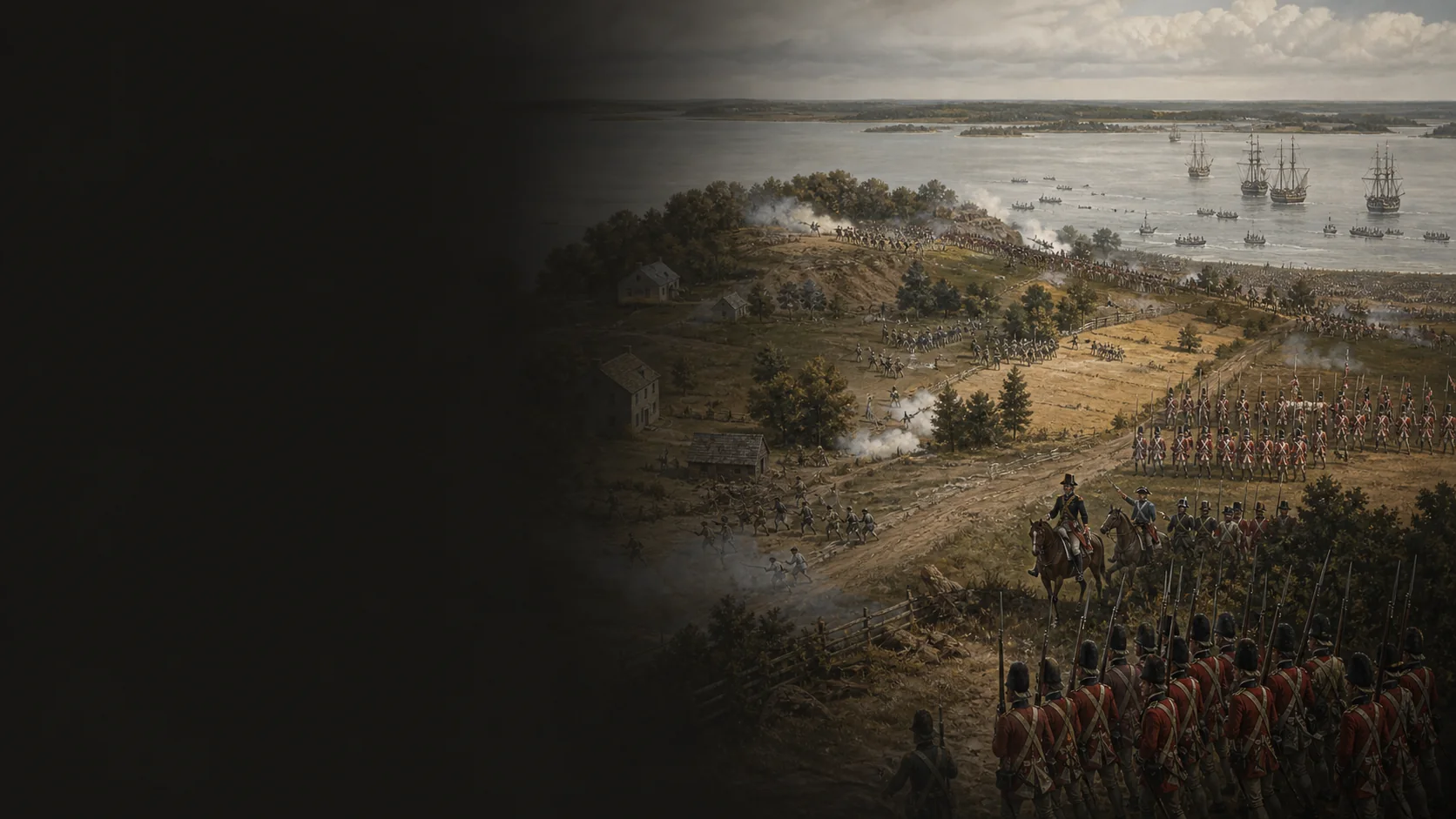
The Battle of Long Island was a clear British victory on the field: the main column passed through Jamaica Pass, struck the American positions from the rear and drove the survivors back toward Brooklyn Heights. It did not become the destruction of the Continental Army because the British began a siege without immediately closing the escape route and Washington evacuated his troops across the East River on the night of 29–30 August. This account distinguishes reported facts, cartographic groupings and figures that do not cover the same population.

A landing that forces dispersal

On 22 August, about 15,000 British troops land on Long Island and the army then establishes itself near Flatbush. Washington must guard both Manhattan and Brooklyn; the National Park Service figures of 19,000 Americans and more than 32,000 British describe the wider theater, not only those who fought on 27 August.

The distant pass

The Heights of Guan offer several routes between the landing site and the Brooklyn lines. Jamaica Pass, far from the American center, is guarded by only a handful of men in the University of Nottingham account; this weakness makes the main column's movement possible, without allowing every unit to be located with topographical precision.

Fix the front, strike the rear

The British plan combines diversionary attacks against the center and Gowanus sector with a column of about 10,000 men moving through Jamaica Pass. A two-gun signal at about 9 a.m. launches the general attack. The American report of 27 August records losses among the detachments and a column then descending from the woods toward the center; by itself, it neither identifies that column with the whole force that crossed Jamaica Pass nor establishes a complete order of battle.

A defeat that leaves an exit

Fighting around Gowanus and the Old Stone House delays the American retreat, while the Brooklyn lines become a besieged position against the East River. Washington later explains that the council of 29 August feared the communications would be cut and that withdrawal saved men, guns and stores, except for a few heavy pieces made immovable by the mud.

Military history

Sources

Primary source, archival editionGeorge Washington Papers, Series 2, Letterbooks 1754–1799, volume 10

PDF pp. 104–106 (lettres des 23–24 août sur Gravesend Bay, Flat Bush et les renforts), pp. 108–110 (ordres à Putnam et répartition du commandement), pp. 112–115 (rapport de Harrison du 27 août, conseil du 29 août, lettre de Washington du 31 août sur la traversée et les pertes), et pp. 147–148 (récit rétrospectif du 19 septembre sur la surprise, Stirling, Gowanus et la nécessité du retrait).

Contemporary report on the fighting, capture of Sullivan and Stirling, council of 29 August, East River crossing, guns left behind and casualty estimates.

View ↗
Institutional history, National Park ServiceNational Park Service — Battle of Brooklyn, Governors Island National Monument

HTML lignes 25–30 : Governors Island et les fortifications de Brooklyn Heights, 19 000 Américains étirés contre plus de 32 000 Britanniques, environ 9 000 hommes acculés, feux et silence pendant l’évacuation, brouillard et arrivée à Manhattan vers 7 heures.

Checking the strategic framework, the position against the East River and the evacuation's effect in preserving the American army.

View ↗
Institutional article, National Park ServiceNational Park Service — The Maryland 400

HTML lignes 27–39 : First Maryland Regiment, débarquement britannique, Jamaica Pass peu défendu, attaque de 9 heures, franchissement de Gowanus Creek, arrière-garde de Stirling, Old Stone House et limites du récit Maryland–Delaware 400.

Documenting the delaying role of the Gowanus fighting and bounding the account of the Maryland and Delaware troops without turning it into a complete order of battle.

View ↗
University resource and manuscript collectionUniversity of Nottingham, Manuscripts & Special Collections — Sir Henry Clinton’s War

Section “Long Island and New York, August 1776–May 1777”, paragraphes HTML 87–91 : débarquement du 22 août, passes, Jamaica Pass, trois secteurs d’attaque, signal de 9 heures, siège et retrait des 29–30 août.

Reconstructing the British operational sequence and distinguishing the university description of the maneuver from primary evidence on losses.

View ↗
Specialist historical mapping, American Battlefield TrustAmerican Battlefield Trust — Brooklyn | Aug 27, 1776

HTML lignes 306–315 et 333–345 : carte du 27 août, débarquement, Jamaica Pass, Battle Pass, Brooklyn Heights, East River, résultat britannique et fourchette de pertes publiée par l’organisme ; la carte sert à contrôler la topologie. Fixer seule le bilan dépasse l’usage documentaire retenu ici.

Checking visible spatial relationships and diagram legibility without adopting its casualty figures as a primary accounting.

View ↗
Specialist historiography, synthesis by John RickardHistory of War — Battle of Long Island, 26–29 August 1776

HTML lignes 13–26 : 15 000 débarqués le 22 août, quatre passes, garde de cinq hommes à Jamaica, mouvement nocturne du 26–27 août, diversions, attaque de 9 heures, Gowanus, siège et évacuation d’environ 9 500 hommes.

Cross-checking the military topography, night movement and retreat chronology; figures not confirmed by institutional sources remain identified as estimates.

View ↗
Specialist military history, Army Historical FoundationArmy Historical Foundation — John Glover

HTML lignes 95–102 : quatre passes, Jamaica jugé trop éloigné, environ 10 000 hommes dans la colonne nocturne, armée repoussée vers Brooklyn Heights, rôle de Glover dans l’évacuation et environ 9 500 hommes traversant l’East River.

Cross-checking the role of the eastern passage and the night crossing; this secondary source is not used to fix the position of every unit.

View ↗

Edited by BattlesInMotion.com