1. Home
  2. Industrial Age
  3. Russo-Japanese War
  4. Liaoyang

Battle

Liaoyang

25 August — 5 September 1904

Fix · turn · threaten · withdraw

Military history

How does the Japanese threat to communications cause the Russian evacuation of Liaoyang?

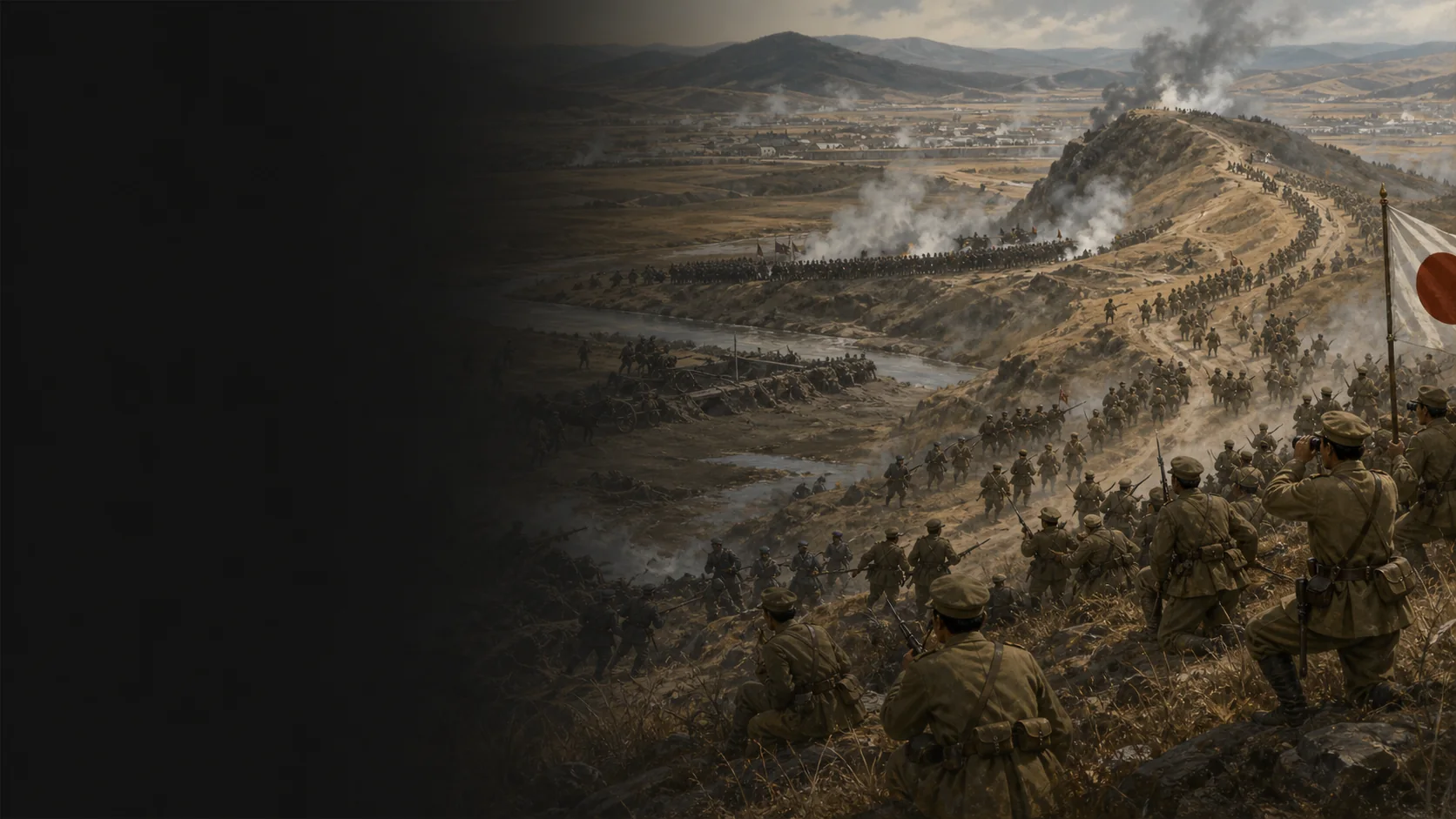
Liaoyang is not a Russian annihilation achieved through complete encirclement. The armies of Kuroki, Oku and Nozu pin the forward positions and press the city, while part of the Japanese force crosses to the right bank of the Taizi and threatens Russian communications. Attacks on the main position are still repulsed, but the combination of this threat, depleted reserves and limited ammunition convinces Kuropatkin to evacuate Liaoyang. Japan gains the city and the Russian withdrawal; the Russian army retains its guns and ability to continue the war.

A communications hub

Liaoyang is at once the Russian military capital of southern Manchuria, a railway point and a position on the Taizi. The city therefore matters as both objective and junction: losing it exposes the retreat, but holding it too long may expose communications towards Mukden.

A defence in depth

The Russians do not defend a single line. A forward position covers the southern and eastern approaches; the main position around Liaoyang then receives Zarubayev and the corps tasked with holding the city. Rain, rivers and kaoliang slow movement and make reinforcement difficult.

Pressure with partial envelopment

Oku and Nozu achieve a pinning effect through costly frontal attacks. Kuroki, in the east, opens a threat to flank and communications by crossing to the right bank of the Taizi. The map distinguishes this operational effect from complete closure: the Russians can still move much of their army and withdraw.

Evidentiary limits of the victory

The capture of Liaoyang is a Japanese victory of objective and manoeuvre, not the destruction of the Russian army. Reports differ over dates, strengths and losses; Japanese and Russian accounts do not describe the threat with equal certainty. The dossier therefore preserves the difference among perceived threat, real capability and visible result.

Military history

Sources

Primary or near-primary source, command memoirA. N. Kuropatkin, The Russian Army and the Japanese War, Vol. II

Project Gutenberg, HTML, compte rendu général de Liao-yang, repères [Pg 229]–[Pg 238] ; notamment p. 229–232 sur les attaques des 30–31 août et le passage de Kuroki, p. 236–238 sur le choix du retrait et sa conduite.

Russian orders of magnitude and disposition, resistance of the forward positions, crossing to the right bank of the Taizi, ammunition shortage, stated reasons for evacuation and condition of the retreat. Retrospective testimony by the Russian commander, therefore interested and incomplete regarding Japanese intentions.

View ↗
Institutional military studyU.S. Army Command and General Staff School, Russian operations and conduct of defense opposite the Japanese Second Army at Liao-yang

PDF, pp. 1–8 et 11 ; OCR consulté lignes 31–81 sur le terrain et les trois lignes défensives, 143–189 sur le plan de Kouropatkine et le repli, 559–736 sur les attaques, l'évacuation et les ponts, 738–851 sur l'interprétation et les limites.

Direct institutional cross-check of positions at An-shan-chan, Shou-Shan-pu and Liaoyang, the sequence of attacks, withdrawal and destruction of bridges. The 1931–1952 military study uses campaign sources; its judgements on defensive planning and command remain interpretations.

View ↗
Academic dissertation, UCLA Electronic Theses and DissertationsJessica Man, The Perfect Type of Industry: Apocalyptic Visions of the Asian Century

UCLA, 2018, PDF p. 18 ; passage de synthèse sur Liaoyang : premier grand conflit terrestre, surestimation russe des forces japonaises, artillerie russe répondant aux assauts, tentative d'encerclement d'Oyama et retraite réussie de Kouropatkine après l'épuisement japonais.

Academic cross-check of the relationship among successive attacks, defence in depth, attempted encirclement and Russian retreat. This dissertation chiefly studies apocalyptic narratives and war reporting; it serves here as a secondary synthesis, not topographical proof.

View ↗
Institutional archive and translation of contemporary pressJACAR, Battle of Liaoyang, ref. A03023691200

Page d'archive datée du 4 septembre 1904 : traduction d'un article du Times daté du 31 août, sous le titre Battle of Liaoyang, ref. A03023691200. Le compte rendu de presse donne des dates et un récit de situation à confronter aux rapports militaires.

Institutional contemporary witness to the circulation of information and battle names. Press figures and chronology are not treated as sufficient evidence against operational reports.

View ↗
Contemporary specialised professional pressU.S. Naval Institute Proceedings, Book Notices, October 1905

Article HTML, passage de la notice sur l'histoire officielle d'Oyama, paragraphes 126–129 : coordination de Kuroki, Oku et Nozu, défense russe derrière des ouvrages et retraite de Kouropatkine sans perte catastrophique.

Contemporary cross-check of a professional reading: Japanese victory and Russian retreat, but no complete rout. This is a review, not the full Japanese report.

View ↗
Specialised institutional synthesisInternational Encyclopedia of the First World War, Russo-Japanese War

PDF, p. 2, lignes 56–79 : avance japonaise en Mandchourie, victoire de Liaoyang contre une armée russe plus nombreuse, pertes supérieures japonaises selon cette synthèse et portée de la campagne.

Operational and strategic framework. The synthesis is not used to place formations at the local scale.

View ↗
Digitised contemporary press, university archiveHistorical Newspapers of South Carolina, report on the Battle of Liaoyang, 28 September 1904

Page 2, OCR lignes 34–80 sur Oku, Nozu, Kuroki et les pertes incertaines ; lignes 81–118 sur le franchissement de la Tai-Tse ; lignes 228–260 sur le lien entre le passage de Kuroki et la décision russe. Compte rendu de presse à confronter aux récits d'opérations.

Contradictory check of circulating contemporary narratives about the crossing, alleged encirclement and losses. Used to document the dispute, distinct from serving as the sole basis for positions.

View ↗

Edited by BattlesInMotion.com