1. Home
  2. Industrial Age
  3. Russo-Japanese War
  4. Siege of Port Arthur

Battle

Siege of Port Arthur

1 August 1904 — 2 January 1905

Investment, saps, and observation turn a series of costly assaults into the methodical reduction of a coastal fortress.

Military history

How does the investment of Port Arthur turn an observation height into an advantage against the harbour and forts?

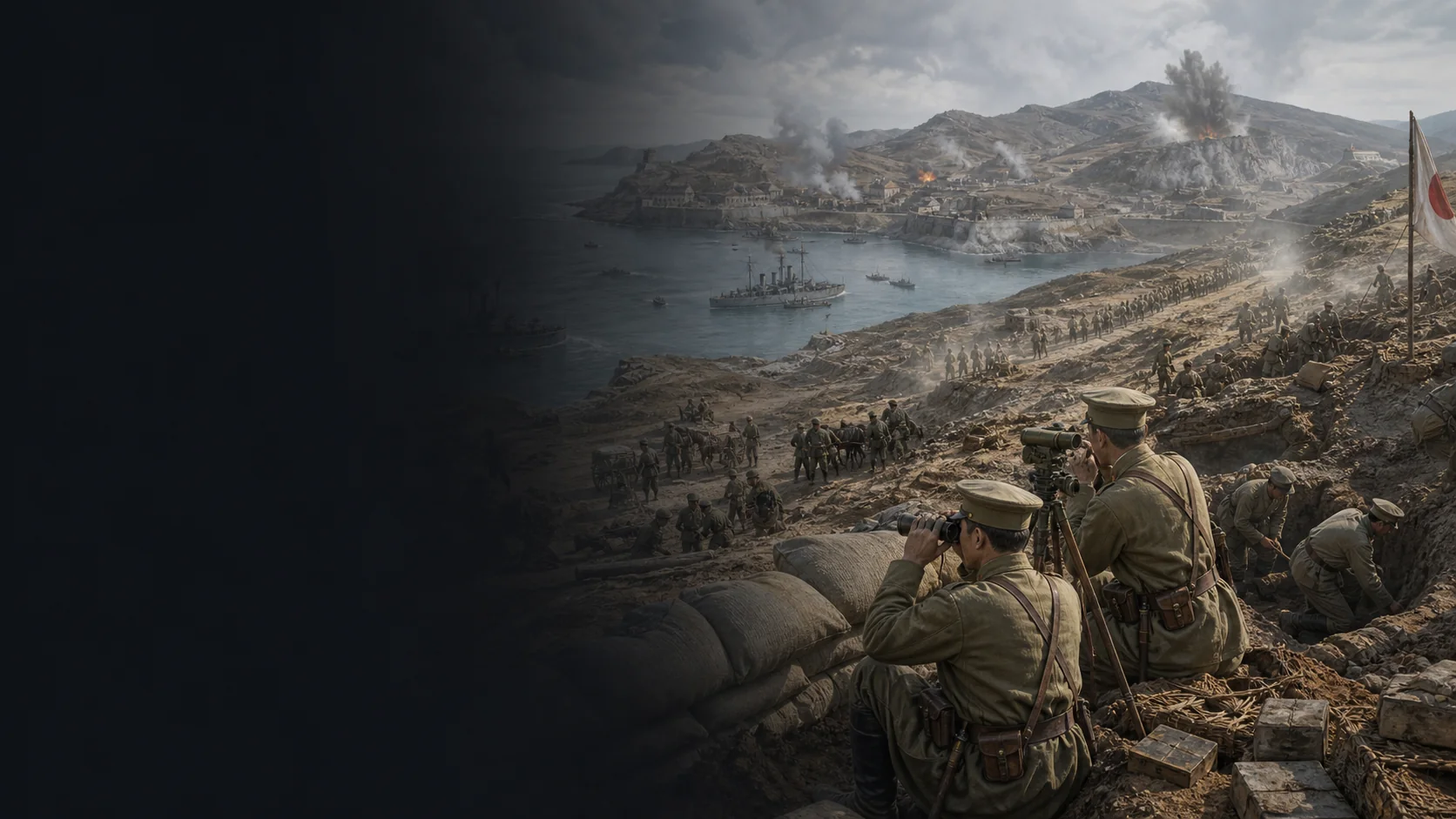
Port Arthur is a fortified position and naval base, not a town that the Japanese Third Army can take in a single charge. After Nanshan, the Russians withdraw behind a belt of heights, forts, ditches, and interlocking fire. The August assault and the attacks of September, October, and November fail to open the desired breach. Saps, mines, and 28 cm howitzers then bring firepower and infantry closer. The capture of 203 Metre Hill on 5 December chiefly provides a view over the harbour and a fire-control link; the works and garrison still have to be reduced before the capitulation of 2 January 1905.

A fortress to isolate

The capture of Nanshan does not take Port Arthur: it allows the Japanese Third Army to close the land approaches and push the Russians back into their permanent works. The harbour remains a second problem, addressed through blockade and pressure on the trapped squadron.

Relief shapes the defence

The line of forts and batteries rests on heights and covered intervals. 203 Metre Hill lies northwest of the harbour; it is not the fortress's central fort, but a post whose loss changes visibility over the port and works.

From shock to siegecraft

The failure of the first assault leads to the digging of parallels, communication trenches, and saps; heavy artillery, including 28 cm howitzers, then enters the chain. The September, October, and November attacks are therefore moments of pressure within a siege whose method is changing, not four independent pitched battles.

Disagreements preserved among the sources

Tretyakov writes from within the Russian defence; Ashmead-Bartlett and Nørregaard observe the Japanese army at different times and from different positions. Loss totals, the precise share of fire directed from 203 Metre Hill in the destruction of each vessel, and calendar-dependent dates are therefore not turned into artificial certainties.

Military history

Sources

primary-participantN. A. Tretyakov, My Experiences at Nan Shan and Port Arthur with the Fifth East Siberian Rifles

Project Gutenberg HTML : préface et position de l'auteur, lignes 76–90 ; table des matières, chap. VI–VII, pp. 147–194, pour les assauts d'août et les premiers combats de 203 ; chap. IX–XII, pp. 212–301, pour les travaux, les attaques du 23 novembre au 5 décembre, les forts de fin décembre et la reddition. Passages de texte utilisés aux lignes HTML 1177–1184, 1506–1517, 1553–1581 et 2285–2425.

Testimony from a Russian defender, the sequence at 203 and in December, fortification work, counterattacks, and the limits of a situated account.

View ↗
contemporary-specializedBenjamin Wegner Nørregaard, The Great Siege: The Investment and Fall of Port Arthur

Édition Runeberg HTML : table des matières, chap. XIII–XIX, pp. 145–245, pour septembre, octobre, novembre et les assauts généraux ; chap. XX, pp. 246–258, notamment p. 247 sur la fonction de la cote 203 et p. 250 sur les approches et sap-heads du 27 novembre ; chap. XXI–XXIII, pp. 259–294, pour la réduction et la capitulation.

Contemporary war-correspondent account, chronology of the assaults, shift to siegecraft, and operational role of 203 Metre Hill, with due caution about the observer's viewpoint.

View ↗
Official institutional sourceGreat Britain Committee of Imperial Defence, Official History (Naval and Military) of the Russo-Japanese War, vol. II

Google Books, vol. II, H.M. Stationery Office, 1912 : contenu bibliographique et table des matières, lignes 16–18 et 68–75 ; chapitre XXXV, The Siege of Port Arthur, p. 179 et suivantes ; sections complémentaires sur la situation de Port-Arthur et la destruction des navires, pp. 515 et 638 et suivantes. La notice permet de localiser l'ouvrage officiel. Remplacer la lecture critique des témoignages dépasse l’usage documentaire retenu ici.

Official British synthesis of the campaign, siege, forces, works, and fleet; cross-check of the chronology and casualty categories.

View ↗
primary-eyewitnessEllis Ashmead-Bartlett, Port Arthur: The Siege and Capitulation

Extrait Brill de l'édition de 1906 : PDF pp. 11–13, préface imprimée vi–vii ; l'auteur indique avoir rejoint la 3e armée au début d'août, être resté au quartier général de Nogi jusqu'au 17 janvier et ne pas avoir accès à tous les ordres. Ce locator est utilisé pour la valeur et les limites du témoignage. Un usage consacré à une localisation exacte de chaque unité dépasse l’usage documentaire retenu ici.

Testimony by an observer attached to the Third Army and a methodological bound on Japanese intentions and losses.

View ↗
institutional-mapMap of Kwangtung Peninsula, July 1904

Notice Princeton via UWM GeoDiscovery : fiche de carte de juillet 1904, relief et courbes/points cotés, autorités Russian General Staff, Office of Naval Intelligence, Japanese General Staff et U.S. War Department General Staff ; la carte contrôle les relations péninsule–place–rade, à distinguer des positions quotidiennes.

Historical orientation and check of relational topography before placing aggregates on the educational map.

View ↗
institutional-mapE. Sharpe Grew, sketch-map of the main forts and successive Japanese investment lines

Research Center for Japanese Studies, notice de carte : légende « Sketch-map showing main forts at Port Arthur and successive lines of Japanese investment at various dates during siege », auteur E. Sharpe Grew, dans Far East war history, vols. 3–4. Utilisée pour la relation entre ceinture de forts, cote 203 et lignes d'investissement, sans lire une échelle métrique dans le schéma.

Institutional cartographic check of the principal forts and advance of the investment lines.

View ↗
official-military-reportJoseph H. Kuhn, Final report on Japanese Army during Russo-Japanese War, Part 18

Combined Arms Research Library, PDF Part 18, section Port Arthur, pp. 340–359 : discussion de la destruction des navires par les pièces de 28 cm, de la vue complète du port fournie par 203 et du réglage téléphonique ; le rapport précise que la part du feu terrestre et celle de la bataille navale du 10 août ne peuvent pas être séparées avec certitude.

Official US military report on siege methods, observation from 203, and caution in attributing damage to individual ships.

View ↗
Specialised modern studyRobert Forczyk, Port Arthur 1904–05: The First Modern Siege

Osprey, notice éditeur : description et table des matières, sections Origins, Chronology, Commanders, Forces, Plans, Campaign, Aftermath and Analysis ; aperçu éditeur PDF, sommaire p. 2, pour les bornes 19–23 août, 18–22 septembre, 1er octobre, 26–30 octobre, 26–30 novembre et 5 décembre. L'aperçu est utilisé comme repérage spécialisé, avec une fonction distincte de celle de unique preuve primaire.

Modern cross-check of the chronology, succession of assaults, and transition to siegecraft.

View ↗
Official institutional sourceRussian Presidential Library, Port Arthur in the Russo-Japanese War

Dossier historique institutionnel, paragraphes 52–55 et bibliographie 57–59 : mort de Kondratenko, destruction préalable de navires, canons et magasins, reddition et dispersion des bilans de pertes. Utilisé pour la fin du siège et pour ne pas confondre présents à la reddition et pertes totales.

Modern Russian institutional cross-check of the final decision, fleet, and need for caution over figures.

View ↗
primary-archiveSergei A. Rashevski, Diary of impressions of the siege of Port Arthur

Russian National Electronic Library, notice de manuscrit : journal daté du 26 janvier au 22 décembre 1904, 266 feuillets, avec cartes et ordres ; le catalogue établit la provenance archivistique mais ne sert pas à produire une coordonnée ou un chiffre isolé sans lecture complète du manuscrit.

Check that an archival Russian testimony is available, and an explicit boundary on what cannot be extracted from the catalogue alone.

View ↗

Edited by BattlesInMotion.com