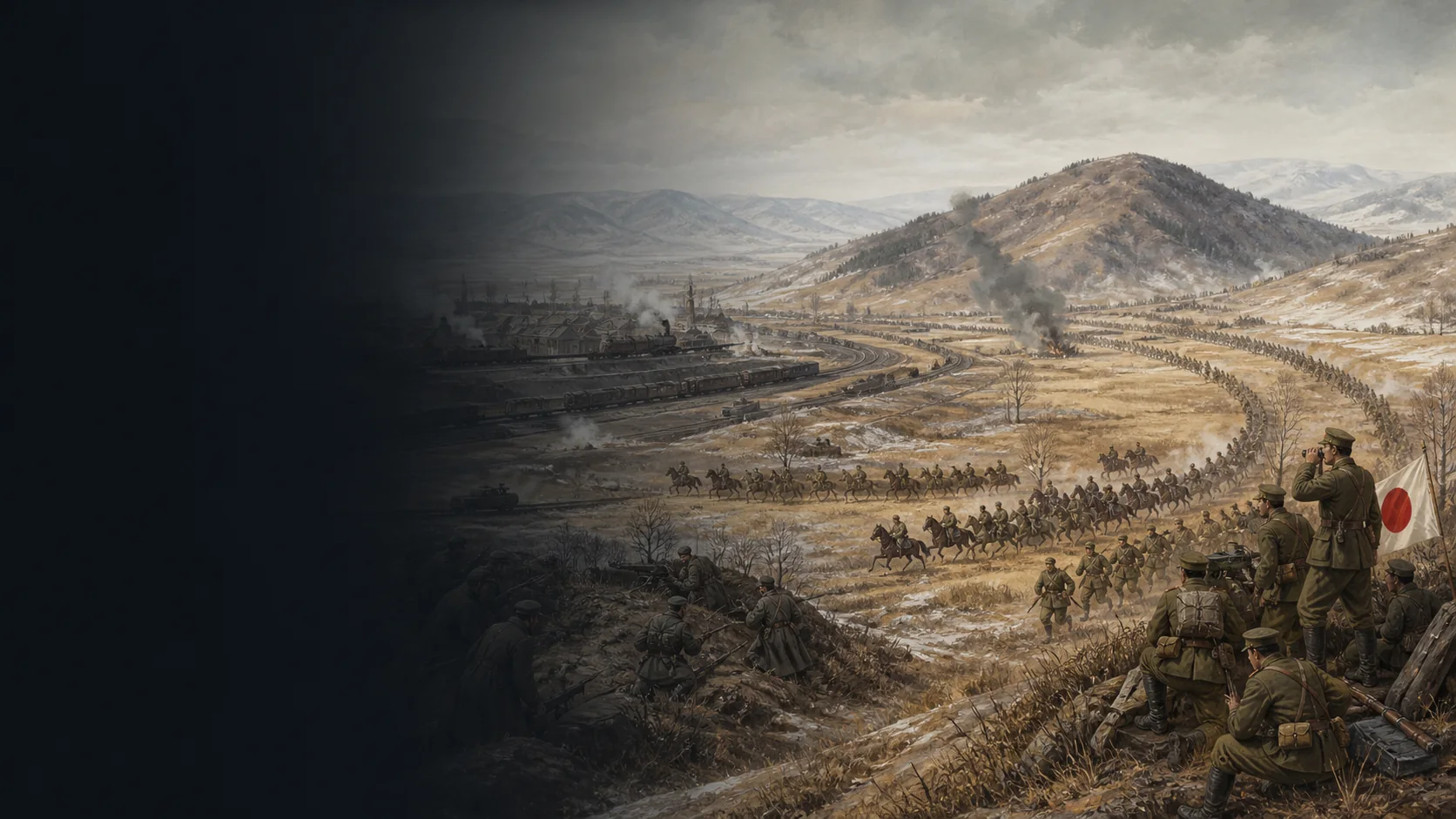
A front too broad for one reserve
Oyama has five armies. He opens the battle in the eastern mountains, then commits Nogi on the western plain. Kuropatkin must protect the southern positions, the flanks and the routes to Mukden at the same time.
Battle
The Russian army avoids general encirclement at the cost of a disorganized retreat.
Military history
At Mukden, Japanese attacks in the east first draw in Russian reinforcements. Nogi’s army then outflanks the Russians in the west, threatening communications behind the city. Russian counterattacks do not remove the danger. Kuropatkin pulls the armies back from the front towards Mukden, then orders a general retreat to Tieh-ling. On 10 March, the columns become congested and come under attack on their flanks. Much of the army escapes, but rearguards are captured or have to force their way through. The Japanese victory is major, but does not achieve the sought-for annihilation.
Oyama has five armies. He opens the battle in the eastern mountains, then commits Nogi on the western plain. Kuropatkin must protect the southern positions, the flanks and the routes to Mukden at the same time.
From west to east: Nogi, Oku, Nozu, Kuroki and Kawamura. The Russians deploy Kaulbars’s Second Army in the west, Bilderling’s Third in the centre and Linevich’s First in the east. Reserves move between sectors.
The first Japanese attacks draw Russian units east. When Nogi appears in the west, some units return while others are taken from the front. Concentrations and counterattacks fail to stop his outflanking movement.
On 7 March, the order moves the First and Third Armies back towards positions near Mukden on the 8th. On the evening of the 9th, Kuropatkin orders the general retreat towards Tieh-ling. The next day, congestion and Japanese attacks turn the movement into a costly breakout.
Explore
Military history
Historical Section Committee of Imperial Defence, 1920, chap. LXVII–LXXXII, pp. 256–706 ; table des matières et chapitres OCR, lignes 263–501 ; forces initiales, lignes 15830–15832 et 15953–16074 ; retrait du 10 mars, lignes 36979–37015 ; commentaire final, lignes 40272–40280 et 40506–40527 ; appendices 16–23, pp. xxxv–xlix.
Order of battle, commands, dated sequence from 18 February to 10 March, counterattacks, withdrawal, pursuit and limits of Japanese closure.
View ↗Sydney Tyler, 1905, chap. XVII, sections sur Moukden et le retrait, lignes 2740–2763 ; récit de la bataille en cinq armées et occupation de Moukden, lignes 2732–2741. Source contemporaine à visée de vulgarisation, utilisée pour la perception et la chronologie narrative, avec une fonction distincte de celle d’une autorité statistique unique.
Contemporary testimony on Kawamura’s eastern attack, the roles of Kuroki, Nozu, Oku and Nogi, the Russian retreat and conflicting estimates of forces and losses.
View ↗L'Illustration, 11 mars 1905, article « La bataille de Moukden », HTML, lignes 167–178 et croquis annoncé ligne 182 : attente des renforts, ouverture orientale de Kuroki/Kawamura, pression d'Oku, passage de Nogi par le Houn-Ho et prise de Sin-Min-Ting ; estimations de correspondant signalées comme telles.
Contemporary cross-check of the sequence and place names; figures and journalistic interpretation are not treated as a definitive count.
View ↗1914–1918 Online, version 2.0, PDF, p. 2, lignes 61–82 ; p. 3, lignes 83–106 : Moukden comme plus grande bataille terrestre jusque-là, enveloppement japonais, coût humain et épuisement des deux États.
Modern perspective on the operational decision, exhaustion and strategic limit of the Japanese victory.
View ↗Vol.II, pp.273–299 relues : renforts orientaux, concentration occidentale, ordres du 7 et du 9, retraite sous le feu le 10. Conclusions très critiques envers Kaulbars, à lire comme plaidoyer situé.
First-rank Russian testimony on the orders, delays in concentration, Nogi’s movement and decision to withdraw; used as a situated source, distinct from a neutral account.
View ↗Foreign Relations of the United States, 1905, doc. 609, 29 juillet 1905, p. 620, lignes 49–68 : copie d'un ordre russe capturé à Shui-lo-tai pendant les opérations de Moukden et discussion de son contenu.
Primary evidence for the circulation of operational documents and contemporary diplomatic perception. General positions and the casualty total rely on the dossier’s other sources.
View ↗National Institute for Defense Studies, Military History Archives, notice id 0060068593 : Yalu Army detailed combat report, items 2, 4, 5 et 10, couvrant les rapports du 22 février au 14 avril 1905 et les rapports de divisions de réserve.
Japanese primary archival anchor for the chain of command and combat reports on the eastern wing; the catalogue is cited without inventing the contents of unconsulted folios.
View ↗Section3 et légendes ⑤–⑥ relues ; carte⑤ des 9–10 mars réellement examinée, archives Chiyoda1062. Carte⑥ non examinée lors de cette révision.
Japanese institutional check of the final chronology, Nogi’s movement and relationship among city, railway and withdrawal; figures are retained as orders of magnitude from this source.
View ↗U.S. Army Center of History and Heritage, notice HTML, lignes 350–356 : 8e division d'Oku sur la rive nord du Hun vers Likwanpu, liaison avec Nogi, ligne japonaise à l'ouest de Moukden au 7 mars, ordre de retrait nocturne, occupation à 10 h le 10 mars et combats dispersés le 11.
Institutional cross-check of Oku–Hun Ho–Nogi geography and the withdrawal/occupation transition. Using it to establish every unit’s position would exceed the documentary scope adopted here.
View ↗Holt, plan des 23 février–9 mars 1905 ; image GIF examinée intégralement : Hun, Shaho, Moukden, rail, relief oriental.
Independent check of relational topography; prevents turning the Hun Ho into the sole front line or placing Mukden south of the Sha Ho.
View ↗Larousse, notice HTML, lignes 40–45 : front russe au sud de Moukden, trois armées russes, déplacement de Nogi derrière l'aile d'Oku le 3 mars, retraite décidée le 8 mars, pertes et limite de l'anéantissement.
Specialist check of conventional dates, order of battle and distinction between Russian defeat and destruction of the army.
View ↗Japan Center for Asian Historical Records, National Archives of Japan, référence A03023699700, 2 images, dossier daté Meiji 38 : article de correspondant militaire et carte de la bataille autour de Moukden.
Map reference retained from the previous dossier; the image was not re-examined in this revision. The new positions rely on Holt, map NIDS⑤ and Kuropatkin.
View ↗Old Maps Online, notice cartographique, British Library, carte représentant le pays autour de Mukden, publiée en 1905, lignes 9–19 de la notice.
Map reference retained from the previous dossier; the image was not re-examined in this revision. The new positions rely on Holt, map NIDS⑤ and Kuropatkin.
View ↗Section Russia, description référée aux uniformes de1905 ; paragraphe sur la capote d’hiver.
Grey-brown greatcoat and protection against the cold; regimental details are not certified.
View ↗Standard Scenic Company,1905 ; photographie effectivement examinée, reproduction cph.3c12596.
Japanese campaign caps, weapons and equipment; this does not establish a specific uniform worn at Mukden.
View ↗Passage indexé sur les vêtements d’hiver japonais ; extrait de recherche consulté, PDF inaccessible, pagination non vérifiée.
Depiction of blue clothing, layers of wool and skin, and a fur-collared coat. Exact colour is not certified.
View ↗